



Jessica Horton

Jessica L. Horton
Native American, Modern, and Contemporary Art
Director, Graduate Studies, Art History
Biography
Professor Jessica L. Horton is a scholar of modern and contemporary Native North American art. Her research and teaching center Indigenous artists in a global story of modernity, following the transcultural movement of people, art, and ideas. Professor Horton has published widely on the relationships connecting Indigenous knowledge, creative practice, and theories of ecology, diplomacy, and globalization. She encourages hands-on collaboration in her classes, such as working with students and Indigenous communities to curate exhibitions of Native American art on campus.
Professor Horton's first book, Art for an Undivided Earth: The American Indian Movement Generation (2017) illuminates the impact of Indigenous struggles for land and life on artists working internationally since the 1970s. Her second book, Earth Diplomacy: Indigenous American Art, Ecological Crisis, and the Cold War (2024), examines how artists revitalized longstanding Indigenous cultures of diplomacy to place the earth at the center of our broken system of international relations. Professor Horton is currently leading Pomo Baskets, Woven Futures, a multi-year collaboration that includes an exhibition at the University of Delaware (2027) and born-digital publication, as well as a book project about basket weaving and fire ecologies across the state of California.
Professor Horton is the co-chair of the Delaware Environmental Institute's Indigenous Sovereignty, Land, and Reparative Futures Working Group, which approaches the continuing colonial legacies of the university's land grant as a critical context for interdisciplinary environmental research. She formerly worked on the American Indian and Indigenous Relations Committee of the UD Antiracism Initiative, helping to complete four inaugural projects that examine the history, present, and future of UD's relationships to Native nations and lands through community-based collaboration.
Professor Horton's research has received support from the Center for Advanced Study in the Visual Arts, the Getty Research Institute, the Clark Art Institute, the Terra Foundation for American Art, the Georgia O'Keeffe Museum and Research Center, a Creative Capital Arts Writers Book Grant, two Wyeth Foundation Publication Grants, and more.
Selected Publications
Earth Diplomacy: Indigenous American Art, Ecological Crisis, and the Cold War (Duke University Press, Aug. 2024).
Art for an Undivided Earth: The American Indian Movement Generation (Duke University Press, June 2017).
"Keywords for Indigenizing Ecocritical Art History” in Methods for Ecocritical Art History, eds. Andrew Patrizio and Olga Smith (Manchester University Press, 2026), 234-243.
“Reading Settler Archives Relationally," Archives of American Art Journal 63, no. 1 (Spring 2024): 76–83.
“Coiled Baskets, Spiraled Futures," The Brooklyn Rail, The Irving Sandler Essay, edited by Alexander Nagel (Dec./Jan. 2023/2024): 50–56.
Christine Howard Sandoval & Jessica L. Horton (2023): ‘Genocide is climate change’: a conversation about colonized California and Indigenous futurism, World Art, DOI: 10.1080/21500894.2023.2183520
-
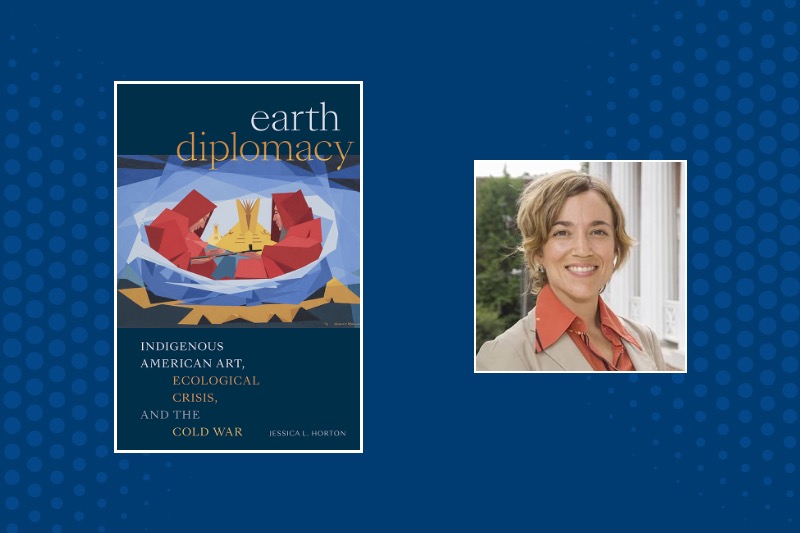
Earth Diplomacy: Indigenous American Art, Ecological Crisis, and the Cold War
May 05, 2025 | Written by Department of Art History staffJessica L. Horton examines how Native American artists in the mid-20th century mobilized Indigenous cultures of diplomacy to place the earth at the center of international relations. -
Harvesting knowledge
April 29, 2025 | Written by Department of Art History staffGraduate students working with members of the Pomo Weavers Society learned about traditional basket weaving methods, including tending the wild plants, and the importance of curating with, rather than about, Indigenous communities. -
UDARI Committee Launches Keywords Project
December 08, 2023 | Written by CAS CommunicationsThe American Indian and Indigenous Relations (AIIR) Committee of the University of Delaware Anti-Racism Initiative (UDARI) has launched an unprecedented educational resource for the UD community, “Keywords for Building Relationships in Lenape and Nanticoke Homelands.”


