



Inside-Out Exchange Program
Inside-Out Exchange Program
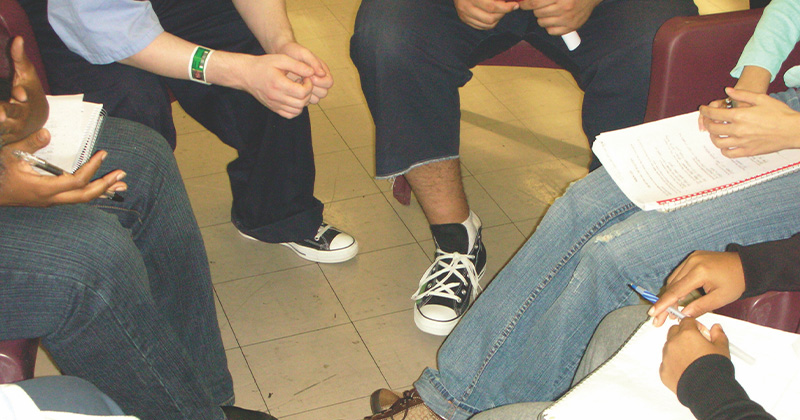
The Inside-Out Exchange Program is an international initiative that brings college-level courses inside correctional institutions. Since 2005, University of Delaware students (“outside students”) and incarcerated scholars (“inside students”) have learned together in a shared classroom environment. Today, the University of Delaware and the Delaware Department of Corrections offer three classes across two institutions. These courses—ranging from Criminology and the Juvenile Justice System to Drugs and the Criminal Justice System—are taught by instructors such as Dan O’Connell, Aaron Kupchik, Ben Fleury-Steiner, and and Emalie Rell. Through collaborative classroom experiences, UD Inside-Out encourages dialogue, critical thinking and a deeper understanding of crime, law and society. The program’s mission is to bridge the gap between academic study and real-world perspectives on the criminal legal system, fostering mutual learning and empathy. More details on the program can be found at the Inside-Out Center website and in this UDaily article.
PROGRAM IMPACTS

The Inside-Out Exchange Program has a transformative impact on both outside students and inside students. Outside students gain firsthand insights into the criminal legal system and the lived experiences of those directly affected by it, while inside students engage with higher education and critical discussions that broaden their perspectives. Faculty involved in the program, such as Chrysanthi Leon, have conducted research highlighting the value of Inside-Out in creating meaningful university-prison collaborations and exploring social issues in literature and society. Over the past two years, four new instructors have been trained through the Inside-Out Training Institute, supported by UD’s First State First Chance Fund for Higher Education, further expanding the program’s reach and impact. Historical and recent accounts of the program demonstrate its ongoing contribution to education, rehabilitation and community engagement.

Beyond academic learning, the program helps build community and empathy, creating a supportive environment where participants can engage openly and reflect on social justice issues. Leon’s research on the “Women in Literature and Society, Inside-Out” course at Baylor Women's Correctional Institution showed how the program could spark deep conversations about crime, race and social inequality, all while emphasizing mutual respect and collaboration. The course materials she developed alongside other collaborators—including sample syllabi, lesson plans and strategies for adapting content to a prison setting—demonstrated how thoughtful design can empower students, encourage reflection and foster meaningful connections. The program not only enriches academic learning but also promotes equity, innovation and lasting partnerships between the University and correctional institutions.
DR. AARON KUPCHIK'S INSIGHT
Aaron Kupchik brings his expertise in youth justice, school discipline and criminal justice policy to the Inside-Out Prison Exchange Program at UD. He shares his insights and vision for this unique learning experience.

For years, I have heard undergraduates rave about their experiences taking Inside-Out courses and faculty talk about how much they enjoy teaching them. Teaching Inside-Out seemed like an opportunity to teach a class that would be impactful and enjoyable. When the department encouraged training for Inside-Out instruction, I jumped at the opportunity.
Everything about it is different. But perhaps the biggest difference regarding outside students’ learning experience is that they are taking a class in a prison, well outside of their comfort zone on campus; the biggest difference regarding inside students’ learning experience is that they are encouraged to share their experiences, feelings and critical thinking.
The key benefits to UD students are that their perspectives widen through exposure to an environment and people whom they would otherwise not likely meet. The key for incarcerated students is that they can take a meaningful program in which they learn, they get to teach others, and for three hours a week, they can feel like a student who is respected for who they are. The key for faculty is to learn more about themselves, grow their teaching skills and feel that they are providing a worthwhile opportunity to students.
STUDENT TESTIMONIALS
“Inside-Out at UD has transformed what I’ve learned in class into real, human experiences. Speaking directly with people affected by the justice system has shaped my path in criminal justice and made me a more confident, informed, and passionate student. Anyone interested in social change should experience at least one class." - Tess (Class of 2026)
"Inside Out was by far my favorite class. The environment is so accepting, and it is amazing to learn from people who have experience in the criminal justice system and hear their insight! he experience is unmatchable, and the change of environment is so important." - Sophia (Class of 2027)
"Eye-opening experience, that everyone should experience at least once."
(Class of 2026)
"I was never judged, always accepted and appreciated, and formed genuine friendships with people I never imagined I’d connect with. Best experience of college so far!!"
(Class of 2026)
"It’s a great and wonderful opportunity. I’m so grateful I got to experience one of these classes."
(Class of 2027)
HOW TO GET INVOLVED?
To get involved in the Inside-Out program, students must join the waitlist and then be interviewed by instructors, who assess the fit between the unique classroom needs and student preparation. There is no guarantee of acceptance into one of the courses, which fill quickly. Students should not attempt to directly enroll in the courses.
Students can fill out this form to register their interest and join the waitlist. You will not be able to register for the course without prior approval. We ask that you do not email faculty members; they will be given your contact information from the interest form and will contact you. If you have any questions, you can email insideout-socicrju@udel.edu. Please do not email individual instructors. If you are not contacted for an interview, you were not high enough on the waitlist and will not be in the course that term.
Recently offered courses include:
CRJU/SOCI 340 – The Juvenile Justice System
CRJU/SOCI 451 – Topics in Crime, Law, and Society: Inside/Out
CRJU/SOCI 452 – Drugs and the Criminal Justice System
FREQUENTLY ASKED QUESTIONS
The Inside-Out Prison Exchange Program is an international initiative that brings together non-incarcerated college students and incarcerated individuals in a shared classroom setting. Through these courses, participants engage in meaningful discussions that deepen understanding of crime, justice, freedom, inequality and other social issues. The program fosters dialogue and learning that challenge perspectives and encourage personal and social transformation. Learn more about the International Inside-Out program.
Students should be available on class days from approximately 4:30 – 9:00 p.m., with classes meeting once per week. In addition to attending class, students are expected to complete class reading and writing assignments, as well as any group projects assigned.
There are no fees for this course. Students will have to travel to the institution, which will likely incur charges for gas (even if you carpool with a classmate).
Course readings will vary from professor to professor.
All courses provide you with 3 credits of coursework. Some courses satisfy the University discovery learning requirement, and some satisfy the University multicultural requirements.
Students can fill out this form to register their interest and join the waitlist. You will not be able to register for the course without prior approval. We ask that you do not email faculty members; they will be given your contact information from the interest form and will contact you. If you have any questions, you can email insideout-socicrju@udel.edu.
‘Inside’ students are selected through an application process reviewed by correctional staff. Course facilitators then interview the applicants, and, together with the prison staff, they invite 10-15 incarcerated students to participate in the course.
Students will need to travel by car to the institution. Each professor will help facilitate carpools among students and will make sure everyone has a ride, regardless of their ability to drive or car ownership.
Yes, we suggest students dress smart casual in a loose-fitting shirt and pants (jeans may be worn depending on the facility). Shoes must be closed-toed. Sweatshirts with hoods are not allowed. Each student will be given a briefing on what is and is not appropriate to wear, in addition to what can be brought inside (notebook, pen, pencil, etc.).
No. Inside-Out maintains semi-anonymity, using first names only. All outside students must sign an agreement not to seek out or contact inside students outside of class. Inside students will also sign a document stating the same. Anyone who attempts to do so or tries to obtain personal information will be removed from the course.
What security level are the prisons, and what types of offenses have students been incarcerated for?
The female facility is a medium-security unit, housing approximately 575 people. The male facility is also a medium-security unit, housing approximately 2,000 people. In Inside-Out, we do not discuss the charges for specific students.
Safety is the top priority in the Inside-Out program. The course is designed to ensure students are as safe as possible. Both inside and outside students participate in an interview process and orientation to promote integrity and security. While students should always be aware of the prison environment, they are closely monitored at all times by the instructor(s), security cameras and prison security staff.
Sorry, no results found.
GIVING TO THE PROGRAM
Help us provide books and scholarships for system-impacted scholars on and off UD’s campus!
The University of Delaware’s growing prison education program serves over 75 incarcerated students in a typical year. In addition to what is already offered through Inside-Out, we are seeking to expand our support for system-impacted people on UD’s campus, develop a pathway for system-impacted students to access a college education in Delaware, and collaborate with other local colleges and universities to expand offerings and support for currently inside students. Prison education programs often face issues related to funding, which require creative solutions in the form of grants, donations and more. We hope you will consider donating to support this important cause.
Your gift will support student enrollment in college courses and for materials like books. It takes $332.50 to fund one incarcerated student so they can receive college credit. Thank you for your gift and for sharing this fundraiser with your networks. Our prison education programs and the success of our participants are instrumental to UD’s commitment to diversity, equity, inclusion, community, and service.


