



Category: SNF Ithaca Initiative
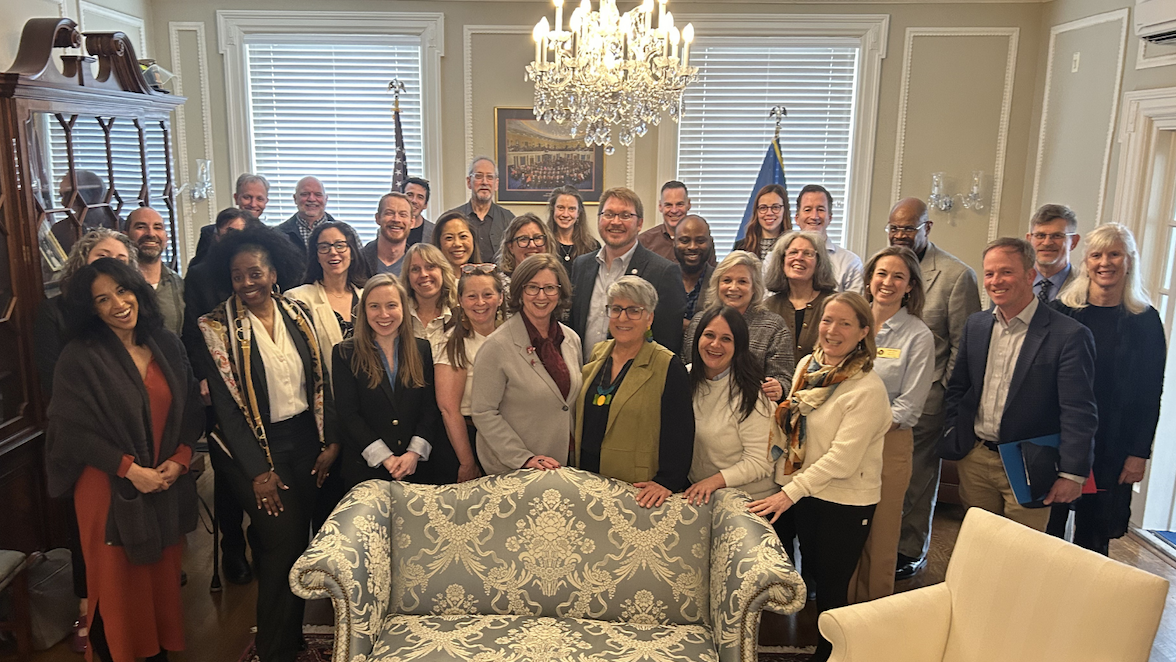
National Thought Leaders Advancing Democracy at the SNF Ithaca National Leadership Summit
April 03, 2026 Written by Jackie Diehl | Photos by Jackie Diehl
How do we advance civil discourse across higher education in a way that’s scalable, impactful, and nonpartisan? National leaders in the theory and practice of civil discourse and civic engagement came together to explore these questions, united by a transformative vision: advancing democracy through institutional and cultural change on campuses across the country.
On March 19-20, 2026, the Stavros Niarchos Foundation (SNF) Ithaca Initiative at the Joseph R. Biden, Jr. School of Public Policy and Administration at the University of Delaware brought together a network of scholars, practitioners, and administrators as national leaders in civil discourse for the fifth annual SNF Ithaca National Leadership Summit.
The two-day gathering kicked off with a reception at the President’s House before extending into a robust day of thoughtful conversation at the Biden Institute, another research and public service center housed within the Biden School. Through a series of breakout discussions and expert-led sessions, participants were invited to explore the theme of “Advancing Constructive Engagement Through Civil Discourse,” with the aim of collaborating on actionable approaches to foster democracy and civic engagement in higher education.
Defining the higher education ecosystem
Timothy Shaffer, SNF Chair of Civil Discourse and Director of the SNF Ithaca Initiative, opened the conversation by emphasizing the importance of solidarity amid differences. “There are these moments where we call for unity and collaboration and acknowledge the environment that we’re in. We have not just some points of tension and disagreement, but real opposition. There are more fundamental questions about the state of democracy, but for our purposes, I think there is an invitation to lead,” he said.
Ojooluwa Ibiloye, a doctoral student at the Biden School and SNF Ithaca Graduate Student Fellow, dug into the root of the conversation with an important follow-up question: What does democracy look like in the current higher education ecosystem? Ibiloye reported on research at SNF Ithaca through a presentation on the national mapping of civil discourse practices in U.S. higher education, noting that the recent explosion of new programs and initiatives is very broad in scope and impact.
“We’ve been trying to map the policies that support civil discourse and the programs and civil discourse initiatives that assist across higher education in the country. We are also trying to document the courses, academic programs, and research that support civil discourse across the country, and we are also documenting institutional resources,” Ibiloye explained. “Findings from the current sample indicate that 40.96% of institutions have no funding or staffing dedicated to civil discourse initiatives.”
Bringing democracy to scale
Ibiloye’s presentation of research being conducted at the University of Delaware exposes a vital point of conversation: scalability. Kara Dillard, Executive Director for the James Madison Center for Civic Engagement at James Madison University, and Graham Bullock, Faculty Director for the Deliberative Citizenship Initiative at Davidson College, stepped in to lead the conversation on what it means to “go to scale” with campuswide programming, sharing the comprehensive programs they are implementing at their institutions and inviting participants to brainstorm bold institutional changes that could sustainably strengthen civil discourse while considering the risks of scaling too quickly.
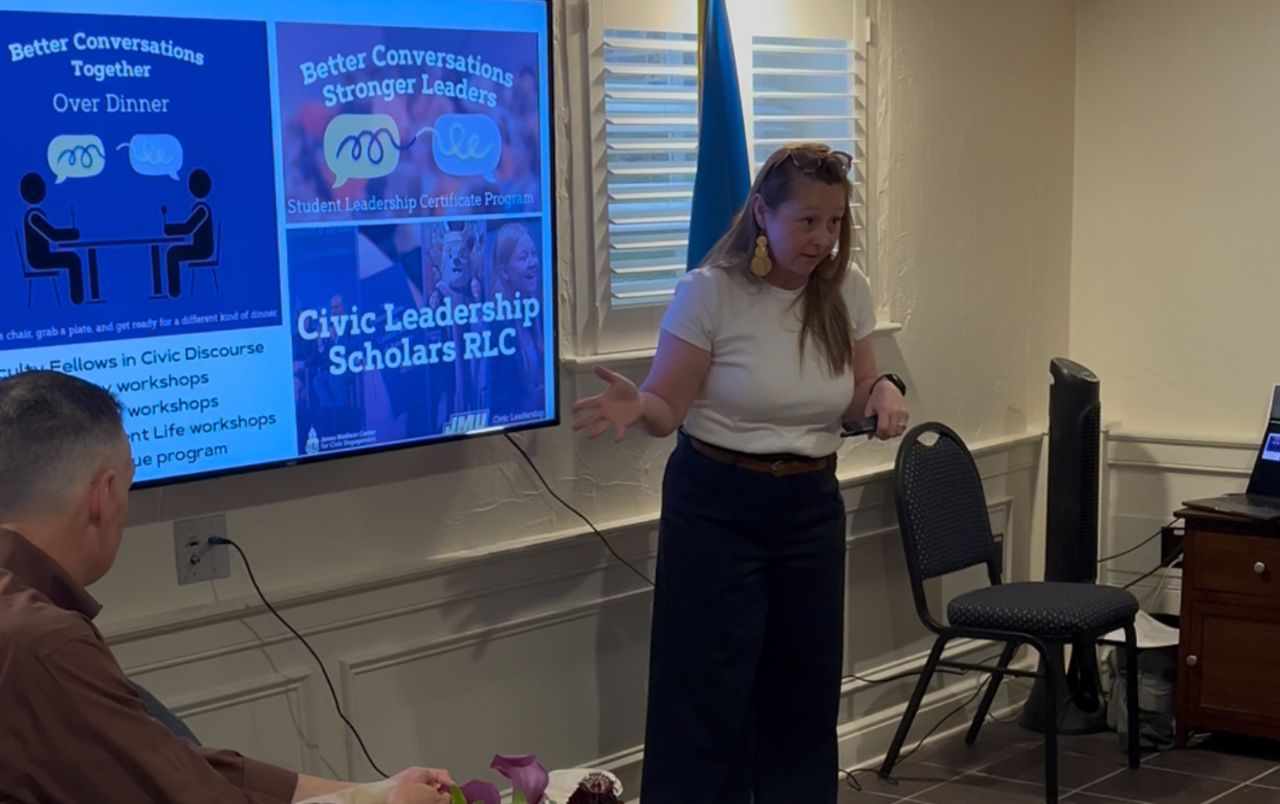
“This is such a great time for the field of civic discourse, civil dialogue, deliberative democracy, and democracy in general, because there are so many wonderful people who are here at the Leadership Summit thinking and talking together and grappling with really big, important questions. How do we scale this work? How do we make it sustainable? How do we do it better?” asked Dillard.
Dillard’s dialogue sparked an insightful conversation, inviting summit participants to consider their own institutions and to determine feasible strategies for implementing campuswide programming that’s not just performative but deeply intentional.
“It’s risky to participate in democracy. It’s risky to go out and try to listen to somebody you have a disagreement with who has a different value set, and it’s certainly risky to engage in conversation with them,” Dillard said, acknowledging the challenges of executing change. “My role is to give them hope that it’s okay to do this, that it’s important that you do this.”
Four phases of facilitative leadership
Lori Britt, Director for the Institute for Constructive Dialogue at James Madison University, recognized that scalability and impactful change are driven by more than institutional legislation; they are also shaped by personal disposition and mindset. Britt led the room through the four phases of facilitative leadership: practicing self-awareness, setting intention, fostering a growth mindset and enacting responsive behaviors.
“Facilitative leadership is about bringing people together to have difficult conversations, which focuses not just on having a good conversation, but on imparting the skills, habits of mind, and knowledge that they can take and model the same things in other parts of their lives. It’s a capacity-building framework. We want to make sure that we’re not just having great conversations, but that we’re showing people that they’re capable of shaping conversations that are better in all parts of their lives,” she explained.
Britt’s presentation on facilitative leadership challenged participants to examine their own biases, inviting leaders to reframe their perspectives and view challenges and conflicts as opportunities for learning and adapting rather than fixed obstacles.
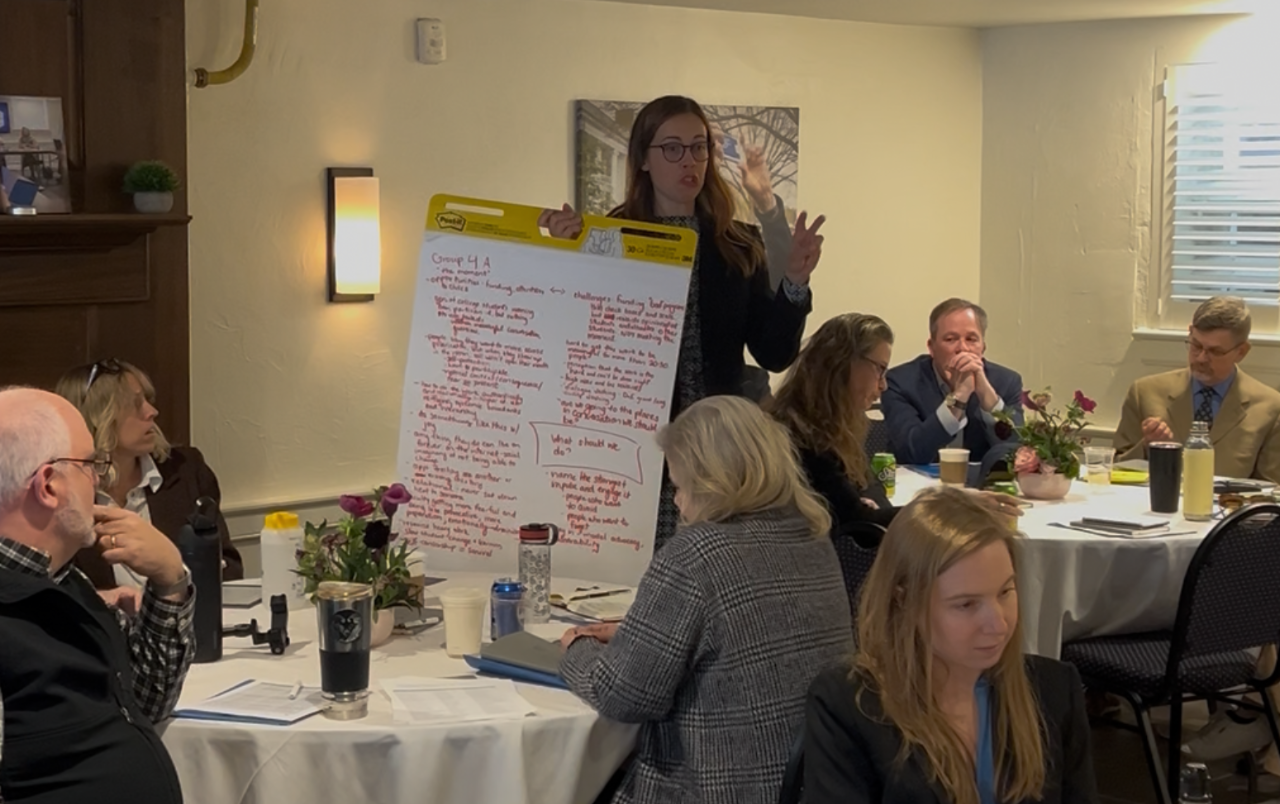
As breakout discussions followed, participants shifted their focus to intentionality, discussing the purpose of engagement and practical ways to foster a supportive, safe environment where diverse voices can be heard. Deliberations over potential barriers embraced crucial topics, including whether the current state of democracy affects academic freedom, how DEI fits into the dialogue movement and ways to approach this work sustainably.
Where do we go from here?
After a robust day of constructive dialogue, deliberation, and self-reflection, the conversation circled back to the mission at hand: Where do we go from here?
“I want to know where the students are going to go with this work they’re building—what they’re doing with these capacities and skills,” commented Renee Heath, Co-Director and Faculty Advisor for the Civil Discourse Project at the University of New Hampshire.
In a final session, Shaffer convened the group to reflect on actionable next steps, discussing ways to connect students with professionals in the field beyond academia, designing a centralized resources to connect institutions nationwide and advancing the day’s work beyond the classroom to local communities.
Robert Boatright, Research Director for the National Institute for Civil Discourse and professor of political science at Clark University, emphasized the importance of universities serving as examples of civil dialogue for their students and communities. “I think the most important thing is for universities to model this, where they’re bringing in speakers who will disagree, and the faculty knows that they can take positions that students disagree with or that other faculty disagree with.”
As the day came to a close, the room full of national civil discourse leaders prepared to return to their institutions with a refreshed approach to implement positive change. Cristin Brawner, Executive Director at the National Issues Forums Institute (NIFI), reflected on the benefits of convening over shared insights: “In working to try to connect Americans to each other and the issues they care about, it really helps to have opportunities like coming to the SNF Ithaca Initiative and learning from other people who are working to connect people and engage them in effective dialogue and deliberation.”
The way forward for democracy isn’t easy, but through efforts such as the annual SNF Ithaca Leadership Summit, we get closer each day, one conversation at a time.


