
Jan. 22, 2012 — At 6:30 a.m., not much was said over breakfast. By 8:30, we were reading the warning sign of the Syndicate Nature Trail that climbs to the 4,747 ft. summit of Morne Diablotin. Peter (our friendly head guide) was accompanying us for the journey; making it his fourth climb to the highest peak in Dominica.
For the first hour, we passed through seemingly untouched rainforest. We passed chatanier trees with giant buttress roots, giant ferns, tall gommier trees, and navigated through mazes of bwa mang prop roots. We periodically stopped on the steep log stairs wedged into the side of the mountain. Many of us would intently watch and listen for jacko and sisserou parrots, hiding the fact that we were winded and resting. We ultimately spotted these two endemic parrot species which are common in Morne Diablotin National Park.
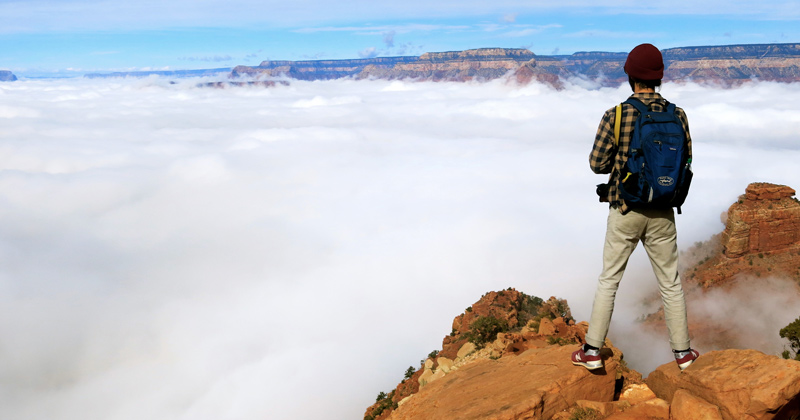
After two hours of strenuous hiking, we had entered a new terrain. The trail consisted of large boulders, boggy mud, mazes of kaklen branches, more mud and plenty of eye-level branches. We persevered through awkward obstacles of tight branches, climbs up rock ledges, and scrambles over and under the never-ending labyrinth of mossy kaklen branches. At the top, we had an amazing view of clouds that engulfed the windy peak.... After testing ourselves on the difficult climb, many of us had feelings of triumph and relief. — Kasper Kuehn

Feb. 7, 2012 — It's the start of a new month and I've come to a new realization. This realization hit me as I was quietly riding the District Line Tube from classes: it's going to be impossible for me to leave London. Not so long ago, London was just a foreign city to me, but now it has become a part of me. This cold and wet city (two adjectives I would normally shiver at the thought of) has found a place in my heart I'll always treasure. Whether it's going to the local pub to watch the football match while drinking a pint, or sipping my latte while reading the Metro in the morning, London's culture has converged a bit with my own cultural identity. I've come to look forward to my Sunday English roast, to going for a walk for no reason at all, and taking pleasure in the quiet solitude of a Tube ride where I'm left to my own thoughts. — Sara Feldman

Jan. 23, 2012 — At the entrance of Ngorongoro Crater, we were greeted with lounging baboons that closely watched our every move. The crater spans nearly 10 kilometers in all directions and is filled with an abundance of wildlife. A myriad of common zebra, cape buffalo, wildebeest and gazelle scattered the entire area. We were even lucky enough to catch a glimpse of a few lazy female lions sleeping with their paws in the air.
Midday, lunch was served by a lake filled with wading hippos and dive-bombing black kites. We saw black rhinos, spotted hyenas and a massive lake turned pink by flamingoes. Our nearby campsite was also teeming with wildlife; the motion-sensing predator camera captured spotted hyenas, elephants, bush pigs, black-backed jackel, porcupines, and bats wandering through our camp. — Holly Pierson, Morgan Fiore, Carly Burrus, Elizabeth Matseur, Kelsey Schwenk and Matthew Fischel


Jan. 28, 2012 — Our last day consisted of building the wooden railings of the bridge — the last major component of the bridge! It was a great last day because we had the right number of men and the right amount of materials for once. It was a long busy day but it ran smoothly and we got to finish!! We even had time for a photo shoot on the bridge....
Andrew and I said a couple words to express our gratitude and excitement, and then the Guatemalans took over. It is a custom for everyone to get a turn speaking if you so desire. And so we listened to about ten people give heart-felt thank you's for the bridge. It was nice to see that they appreciated us and wanted us back very soon. They even asked for us to do more projects with them!
This day had marked the end of a roller coaster ride. Only four weeks ago we were sitting with the leaders of the community telling them we are trying our best but this bridge might not happen and you'll be left with two holes. Now we were in our van on our way home to the hotel, knowing we had finished what we thought was unachievable four weeks ago. All of us were extremely speechless.... We had beat all odds and made a miracle come true for this community. It truly was the perfect team effort, on part of both the EWB team and the Guatemalans! — Dhara Amin

The purpose of my travels, from June to Sept. 2011, was to document and describe Indonesian Teochew, a unique language. It is a Chinese language that is historically related to other Chinese varieties such as Man-darin and Cantonese and spoken by groups of ethnic Chinese who have been residing in Indonesia for two to four generations. The majority of Indonesian Teochew speakers are also speakers of Indonesian languages unrelated to Teochew. As a result, Indonesian Teochew exhibits syntactic properties that are not typically found in other Chinese languages.
I used two methods to collect data. First, one-on-one elicitation involved an interview-type meeting with a native speaker. During these sessions, I met with a speaker and asked questions about possible sentence types. Going through sentences one by one, the speaker gave me a grammaticality judgment on the sentence that I proposed; in other words, how natural or unnatural the sentence sounded in Indonesian Teochew.
Second, recordings of naturalistic speech usually included two to three speakers conversing with each other naturally about daily things. Each word in the conversation was transcribed.
It is difficult to summarize several months' worth of research in a way that conveys how much it has helped. The opportunity to go to these places not only allowed me to significantly improve the quality of my dissertation, but it has also given me a chance for future grant opportunities.

We traveled to Costa Rica this past July to take part in a successful two-week field expedition to the cloud forest for the purpose of collecting insects. Dr. Andrew Short (a UD alumnus) from the University of Kansas and Dr. Monika Springer from the University of Costa Rica led the expedition, which included several other American students, as well as researchers from Costa Rica, Germany, Japan, Guatemala and Colombia.
Our UD target was delphacid planthoppers, which are of great interest agriculturally because they cause significant crop damage. Control of these species is dependent on accurate identification, yet species keys are outdated, and certain Delphacodes are rare in collections, likely due to limited collecting, particularly in the high elevations of the Neotropics.

Between July 12 and 20, we stayed at Kiri Lodge just outside Tapanti National Park. To take advantage of the limited daylight (12 hours), we woke early and then spent the morning and most of the afternoon, collecting along the park trails and roads with sweep nets. We also learned different collecting techniques including the construction of flight-intercept traps (FITs) and seining for aquatic insects.
I [Ashley] easily met my goal of collecting Caenodelphax teapae, the type species for the genus I am examining for my thesis, and Kathryn discovered at least one new species of delphacid planthopper, which we will describe in an upcoming paper.

I took part in the BeST (Beach Sand Transport) field experiment in Perranporth, U.K., in October 2011. The main objective of this collaborative effort by Plymouth University (U.K.), the University of New South Wales (Australia) and UD was to provide the most comprehensive data set so far of hydrodynamics and sediment transport in the swash zone (the area of the beach which is alternatingly wet and exposed as a result of wave action). It is the least understood nearshore area in terms of sediment transport processes.
A rig was built on Perranporth Beach containing 45 ultrasonic distance meters, three pressure sensors and a LIDAR laser scanner to measure depth along the wave run-up zone, three electromagnetic and six acoustic velocity meters and profilers to assess flow velocities, a FOBS (Fiber Optic Backscatter Sensor) to measure suspended sediment concentrations, and two visual and one near-infrared thermal camera to study wave runup characteristics and sediment movement.
My contribution consisted of five novel Conductivity Concentration Profilers (CCP), which were developed at UD, to measure sediment concentration in the sheet flow layer between the sand bottom and the water column. This new instrument made it possible for the first time to directly measure sheet flow pro-cesses, which are expected to account for a significant amount of sediment transport on the beach face.
Measurements were taken for 10 tidal cycles, providing a sufficiently large data set for further analysis, upon which my dissertation will be based. This experience greatly expanded my knowledge as a coastal researcher and my network of peer scientists. The research also was covered extensively by the media, including the BBC Breakfast Show.

Participating in the Atlantic Music Festival this past summer was a worthwhile educational, emotional and artistic endeavor; it taught me about the type of performer I wish to be, the type of teacher I hope to become and gave me a new appreciation for the world in which I exist.
All the opportunities I hoped to take advantage of were available (diction lessons, voice lessons, performance experience and Alexander Technique), and I learned a great deal from the teachers, coaches, accompanists and directors in the program.
I also learned an invaluable lesson about the type of teacher I wish to be. Before this festival, I did not realize how important the chemistry between student and teacher is, but now that I have been exposed to a variety of singing professionals, I have learned what I need from a teacher, and what I want to give as a teacher.
One voice professor was highly technical, while another relied heavily on metaphorical language and poetry. I now recognize merits to both approaches, and I now understand that my teaching philosophy will be one of the most important elements of my ability as a voice teacher.
I returned to UD with new confidence in my craft, which has translated into my work. I recently finished a production with the University of Delaware Opera Theater of the contemporary English opera America Tropical by composer David Conte. This production was unlike any other performance I have given, and the complex nature of both the harmonic palate and the story required a new depth of character development, with which I would have struggled if not for the experiences I gained in the Atlantic Music Festival.
If “sunlight is the best disinfectant,” then transparency and freedom of information are essential to ensure a democratic state and society.

My research this past summer sought to reveal the process through which the Freedom of Information Acts were adopted in the United Kingdom, South Africa and India. These acts are similar to the Freedom of Information Act (FOIA) adopted by the United States in 1966 and which enable citizens to access information from public agencies.
The global research grant enabled me to gather archi-val documents, interview people in government agencies and research organizations, and identify the network between the organizations and legislative bodies that were involved at various stages in the adoption of these acts in the U.K. and South Africa. My work is the first to catalog, compare and examine personal accounts of the various organizations by adopting a process-tracing approach.
The opportunity to visit these places has been instrumental to the completion of my dissertation, “Informing Governance and Governing Information: The Proliferation of Access to Information Legislations,” which focuses on the process through which FOIA legislations were adopted in India, the U.K. and South Africa, in a comparative context.