



Category: News
Delaware Sea Grant holds marine carbon dioxide removal workshop and symposium
November 05, 2025 Written by Adam Thomas
The world’s ocean absorbs about 30 percent of the carbon dioxide released into the atmosphere but having that carbon dioxide in the marine environment can lead to problems of its own. One of the biggest problems is ocean acidification, which can change the pH of the Earth’s oceans and harm marine life that builds shells and skeletons, making it difficult for coral and shellfish to build and maintain their structures.
One solution to this problem is known as marine carbon dioxide removal (mCDR), a process where ocean-based processes are used to not only enhance carbon removal from the atmosphere and store it in the deep ocean, where it can be degraded over a number of years, but also reduce the amount of carbon dioxide in the water itself.
The state of mCDR and its applications was a topic of discussion at a recent workshop and symposium held by Delaware Sea Grant in partnership with Columbia University Law School, New York Sea Grant, Washington Sea Grant, and Ocean Networks Canada. The project was funded by the National Sea Grant Law Center.
The purpose of the workshop and symposium was to grow awareness and knowledge about mCDR for scientists, graduate students, and other environmental professionals, and build collaborations for future mCDR projects.
Held at the FinTech building on the University of Delaware’s STAR Campus in Newark, the workshop was divided into two parts: a morning, in-person mCDR symposium that focused specifically on the Mid-Atlantic, and then participants virtually joined the national symposium happening in New York.
Chris Petrone, marine advisory service director for Delaware Sea Grant, said it was a great opportunity to have members of academia, industry, non-governmental organizations and state agencies come together to network and learn from one another about the challenges and opportunities involved with mCDR.
“It was a nice partnership that came together, and participants delivered information related to this one topic from all their different perspectives,” said Petrone. “It was a great way to get a lot of different stakeholders in the room to discuss this topic.”
Presenters included Wei-Jun Cai, the Mary A.S. Lighthipe Chair of Earth, Ocean and Environment at UD, who gave an overview of mCDR in his “mCDR 101” talk, and Jeremy Testa, professor at the University of Maryland Chesapeake Biological Laboratory, who talked about the effectiveness of an alkaline enhancement treatment on wastewater and how that impacted mCDR and acidification.
Robin Pham and Steven Van Pelt, representatives from Advanced Cooling Technologies, Inc., talked about long-range marine transport carbon capture with seawater sequestration.
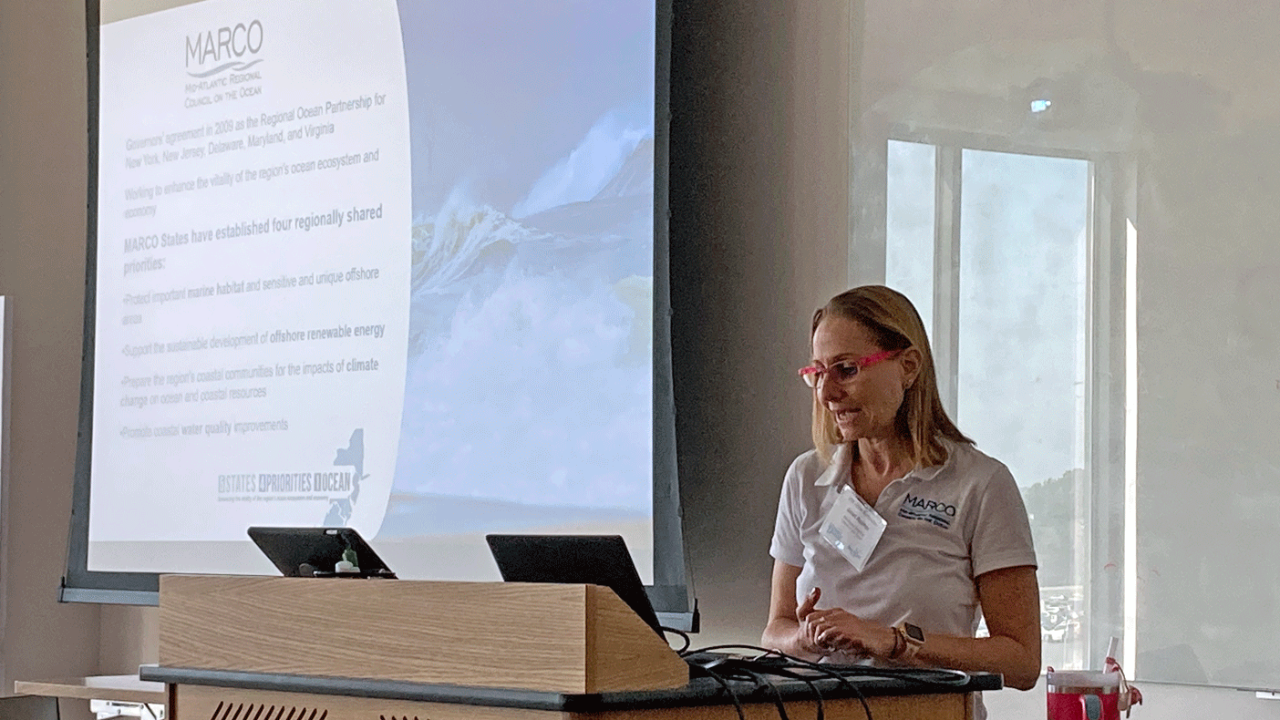
Janet Reimer-Gill, from the Mid-Atlantic Regional Council on the Ocean (MARCO) gave updates on MARCO as well as the Mid-Atlantic Coastal Acidification Network (MACAN), and Priya Arya and Kristi Lieske from the Delaware Department of Natural Resources and Environmental Control (DNREC) gave an update on the Delaware Climate Action Plan and how mCDR can play a role in the plan.
The national symposium focused on policy, science and laws related to mCDR on a national scale.
Petrone said it was great to interface with the National Sea Grant network and to see where issues related to mCDR overlapped on a national scale to those covered in the Mid-Atlantic session.
“Dr. Cai provided a great introduction to the topic, and a lot of that information was reinforced through the project presentations at the Delaware workshop,” said Petrone. “Then, more of that overlap occurred at the state of the science panel that opened the Columbia symposium.”
He added that as carbon dioxide gets into the atmosphere from the burning of fossil fuels, development of land and the cutting down of trees, it warms the atmosphere and so removing that carbon dioxide, and understanding the technologies that impact mCDR, is crucial for humanity moving forward.
“Some of these technologies move that carbon dioxide from the atmosphere to the ocean and some of the technologies, like the wastewater treatment plant technology, is trying to remove the carbon dioxide from the water itself,” said Petrone. “It always amazes me how big of a role the ocean plays when it comes to removing or sequestering carbon dioxide. This symposium was an important step in getting more of the science out to the people who need it to make decisions and take action.”