




Engineering for Impact
Photos by Evan Krape December 11, 2025
Biomedical engineering graduate student Mikayla Jackson received 2025 Laird Fellowship
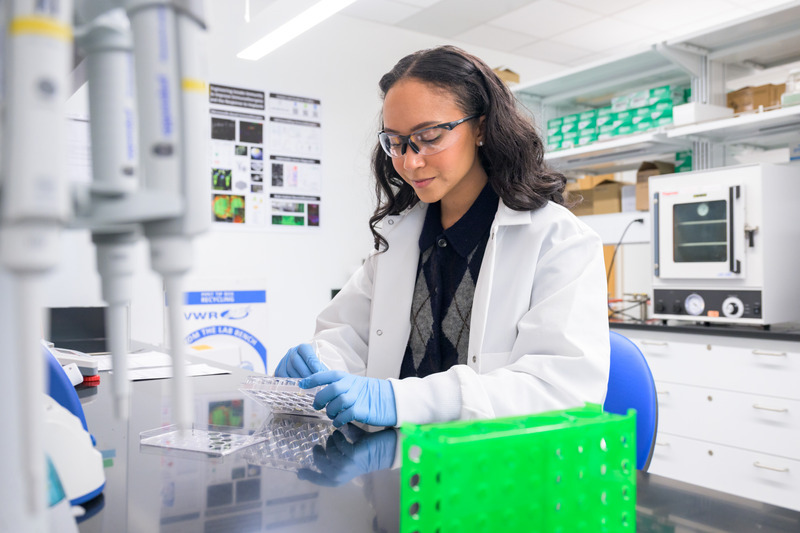
For University of Delaware graduate student Mikayla Jackson, engineering offers a way to connect people with new possibilities. In the lab, she applies her biomedical engineering expertise to improve cancer therapies. In her free time, Jackson has mentored high school students as they design and build their own microscopes, helping them gain confidence in spaces she has learned to navigate with purpose.
Her drive to make science and engineering accessible earned Jackson the 2025 George W. Laird Merit Fellowship, a scholarship that is awarded to a first-year College of Engineering graduate student who demonstrates diverse talents and interests.
“Mikayla’s professional pursuits stem from an interest in community building,” said Robert “Smitty” Oakes, assistant professor in the Department of Biomedical Engineering. “I am confident the Laird Fellowship will amplify her outreach in our local UD community and beyond.”
Oakes advises Jackson’s research on immune-engineering approaches for cancer treatment. He describes her as a team player, confidently leading her own project while supporting the work of others.
“Mikayla’s ability to balance technical excellence with a deep sense of purpose reminds us that the best engineering does not just advance technology, it advances people,” said Ryan Zurakowski, professor and chair of Department of Biomedical Engineering.

From robotics to biomedical engineering
Growing up in Camden, New Jersey, Jackson was first exposed to engineering through a Navy-supported robotics program in middle school. Working in teams, the students built underwater robots and navigated them through obstacle courses. The experience sparked her interest in an engineering career.
She went on to focus on engineering at a technical high school, where she earned certification in machine shop practices and learned to use a variety of manufacturing tools. Though she enjoyed the work, Jackson remained uncertain which branch of engineering she wanted to pursue.
That changed when she joined a high school research competition to create affordable water purification technology.
“We had frequent boil-water advisories and limited access to clean water in my town,” said Jackson. “I realized I could use engineering to help people in my neighborhood. This was a proposed technology, not something we actually built, but it showed me how such projects could impact a community.”
The desire to improve community health led Jackson to major in biomedical engineering at the University of Virginia. Transitioning to a major research university challenged her to find her footing.
“I faced imposter syndrome with peers who seemed ahead,” she recalled in her Laird Fellowship application.
Two full-time summer internships at Harvard University, where she developed hydrogels to regulate immune responses and repair cartilage, were transformative.
“The internships marked the first time I performed many tasks independently in the lab and worked with people who made me feel like I belonged,” she said.
Helping others build confidence and community
Back in Virginia, Jackson began tutoring local high school students through a volunteer program sponsored by the National Society of Black Engineers. She found it inspiring to watch students grasp concepts they had once found challenging.
At the same time, she was collaborating with UVA’s Make to Learn Lab to develop a low-cost, 3D-printed microscope. She expanded her role as a tutor to bring this project to the high school. Over a six-week summer program, students designed and fabricated microscopes for use in their science classes.
“The program showed students how to move from idea to prototype, how iteration works and how to approach design realistically,” Jackson said. “It was so rewarding to see them get excited about building something from scratch.”
After the summer, the effort continued as a club. Moreover, the instructional materials and computer-aided design files that Jackson’s team developed were incorporated into the Engineering by Design Curriculum of the International Society for Technology and Engineering Educators Association, making them widely accessible to teachers and students.
Engineering immune therapies for cancer
For graduate school, Jackson wanted to move closer to her family members in New Jersey, Delaware and Pennsylvania. She was also seeking a laboratory with a unique combination of expertise in immune engineering, biomaterials and design. At UD, her mother’s alma mater, Jackson found her academic home in the Oakes Research Lab.
Jackson’s research explores how the immune system in the skin responds to different cues, with the ultimate goal of improving immunotherapies for cancer. She is developing microneedle arrays — tiny needles arranged on a patch — that can deliver drugs directly into the skin. Her current work focuses on designing them to interact with specific aspects of the skin’s immune system and influence the environment around tumors.

The long-term goal is to create painlessly delivered immune therapies for cancers such as glioblastoma or triple-negative breast cancer. By delivering drugs directly into the skin, microneedle patches could make cancer therapies easier to administer and more widely accessible to patients.
“One element of Mikayla's project is therapeutic accessibility,” said Oakes. “This fits with her previous focus on engineering low-cost microscopes that make science and medicine more accessible.”
After her qualifying exam in the spring, Jackson plans to concentrate on bringing the microscope program to Delaware. She has stayed in touch with her previous collaborators and begun to lay the groundwork for a local chapter.
Receiving the Laird Fellowship has helped renew her energy and excitement for this work. It also introduced her to a diverse network.
“Meeting the other finalists and the previous fellowship recipients has been so inspiring,” she said. “Everyone has amazing stories, and it is such a supportive community.”
Jackson is also beginning to refine her long-term career vision.
“I thought I might go into academia, but I’m now more interested in medical device policy to improve safety and accessibility,” she said. Wherever her path leads, Jackson hopes to keep opening doors for others, just as engineering has opened them for her.
About the Laird Fellowship
The Laird Fellowship honors the memory of UD alumnus George W. Laird, who earned a bachelor’s degree and master’s degree from UD. After George passed away in a tragic accident at the age of 35, his family and friends established the fellowship fund.
The Laird Fellowship is designed to encourage the recipient to become engaged in broad intellectual pursuits that can be outside of the recipient’s chosen field of study. The fellowship, which comes with $28,500 in tuition funding, has been granted annually since 1978.
Contact Us
Have a UDaily story idea?
Contact us at ocm@udel.edu
Members of the press
Contact us at mediarelations@udel.edu or visit the Media Relations website