MAJOR FINDER
Filter by College
Filter by Program Types
Filter by Subject
Chemistry
Transform matter. Create solutions.
Understand how substances behave and change
How can chemists create cleaner fuels, design stronger materials or detect pollutants in the environment? Chemistry examines the structure and properties of matter, the reactions that transform it and the tools scientists use to create and analyze substances.
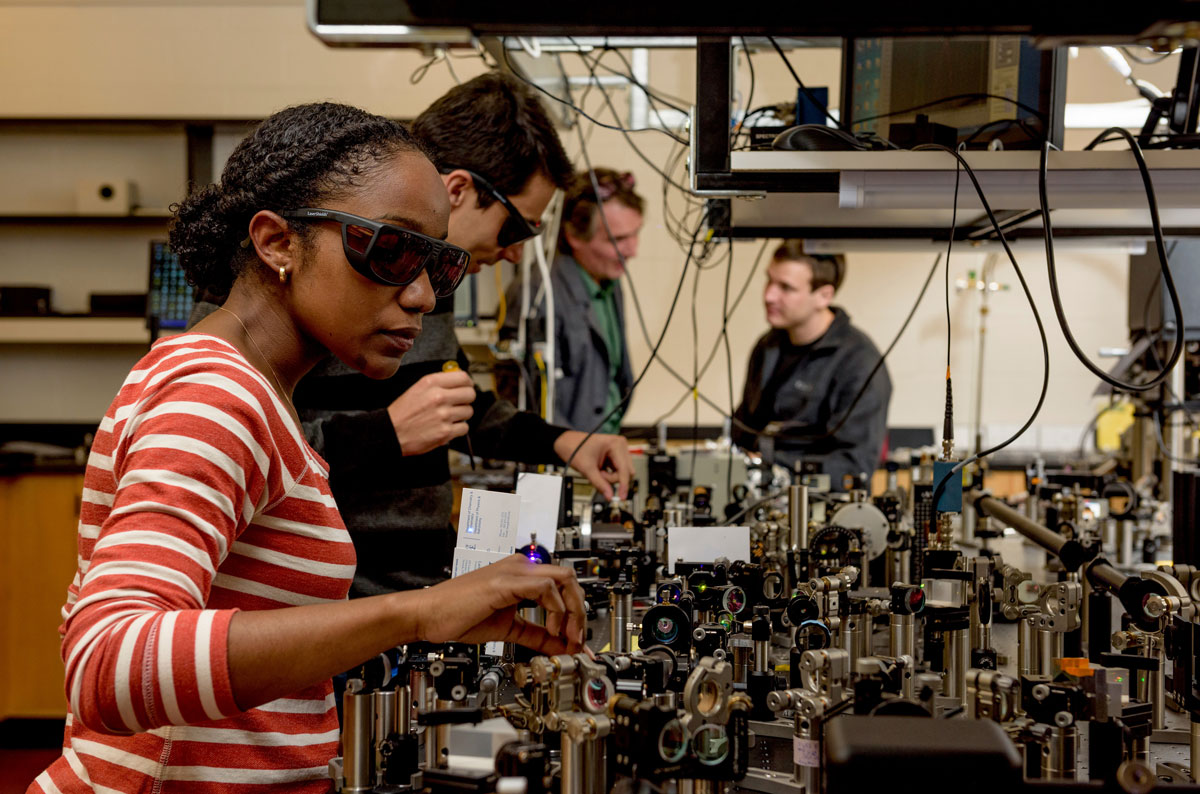
As a chemistry major at the University of Delaware, you will study organic, inorganic, analytical and physical chemistry. You will explore topics such as chemical synthesis, catalysis, thermodynamics, spectroscopy, materials and energy conversion. Laboratory courses will help you develop practical skills in experimentation, measurement, data analysis and the use of scientific instruments.
Choose a path that fits your goals
The American Chemical Society-certified bachelor of science provides intensive preparation for scientific research, industry and graduate or professional study. The bachelor of arts offers greater flexibility to combine chemistry with interests such as business, policy, communication or another academic field. Students may also pursue a concentration in environmental chemistry.
Graduates apply their skills in research, energy, advanced materials, manufacturing, environmental science, forensics, pharmaceuticals and other STEM fields. The major also provides a foundation for medical school, pharmacy school, law and graduate study.
AREAS OF STUDY
- Catalysis and Reaction Development
- Chemical Synthesis
- Chemistry and Life Sciences
- Materials, Polymers, Surfaces and Interfaces
- Thermodynamics, Kinetics and Spectroscopy
- Forensic and Quantitative Analysis
- Energy Conversion, Storage and Environmental Sustainability
- Chemical Data Analysis and Computing
CAREER OPTIONS
- Career Options
Research Scientist
Chemical Synthesis and Reaction Development
Process Development and Manufacturing
Materials and Polymer Science
Analytical Instrumentation
Quality Control and Regulatory Affairs
Environmental Testing and Sustainability
Forensic Analysis
GRADUATE PROGRAMS
- Chemistry and Biochemistry
- Materials Science and Engineering
- Chemical and Biomedical Engineering
- Environmental and Data Science
- Health Professions, including medicine, physician assistant studies, pharmacy, dentistry, nutrition and veterinary science
- Patent Law and Intellectual Property
- Science Education
- Business Administration
What’s special about this program?
At UD, chemistry majors can join faculty research projects as early as their first year. Students may investigate chemical synthesis, catalysis, energy conversion, materials, environmental chemistry or molecules with potential biomedical applications. Departmental programs and alumni-supported fellowships help eligible students pursue funded summer research, and some undergraduate projects lead to presentations or published work.
Eligible students can build on the major through the Chemistry/Materials Science and Engineering 4+1 program or the Chemistry/Secondary STEM Education 4+1 program.
See how UD chemists create molecules to study and treat disease
Get Involved
American Chemical Society Student Affiliates
American Society for Biochemistry & Molecular Biology
Alpha Chi Sigma (AXS)
Chemistry of Baking
NOBCChE Student Chapter: National Organization for the Professional Advancement of Black Chemists and Chemical Engineers
Cosmetic Chemist Society
Sample curriculum
| FALL | SPRING |
|---|---|
| CHEM 111, General Chem. (Majors) | CHEM 112, General Chem. (Majors) |
| CHEM 135, First-Year Majors Chem. Lab. I | CHEM 136, First-Year Majors Chem. Lab. II |
| CHEM 164, Freshman Majors Seminar | CHEM 165, Intro. to Chem. Research (optional) |
| MATH 231, Integrated Calc. IA | MATH 232, Integrated Calc. IB |
| ENGL 110, First-Year Writing | Group A/B/C Elective |
| UNIV 101, First Year Seminar | Group A/B/C Elective |
| Group A/B/C Elective | Multicultural Requirement |
| FALL | SPRING |
|---|---|
| CHEM 331, Organic Chem. I | CHEM 332, Organic Chem. II |
| CHEM 333, Organic Chem. Lab. I (2 credits) | CHEM 334, Organic Chem. Lab. II |
| MATH 242, Anal. Geom. and Calc. B | CHEM 357, Inorganic Chem. I |
| PHYS 201 OR PHYS 207, Intro. Physics I | PHYS 202 OR PHYS 208, Intro. Physics II |
| PHYS 221 OR PHYS 227, Intro. Physics Lab. I | PHYS 222 OR PHYS 228, Intro. Physics Lab. II |
| Group A/B/C Elective | Group A/B/C Elective |
| FALL | SPRING |
|---|---|
| CHEM 443, Physical Chem. I | CHEM 444, Physical Chem. II |
| CHEM 445, Physical Chem. Lab. I | CHEM 446, Physical Chem. Lab. II |
| CHEM 337, Analytical Chem. I | CHEM 338, Analytical Chem. Lab. I |
| CHEM 527, Intro. Biochem. OR CHEM 641, Biochemistry | CHEM 457, Inorganic Chem. II |
| Group A/B/C Elective | CHEM 458, Inorganic Chem. Lab. |
| Group A/B/C Elective | Second Writing Requirement |
| Elective |
| FALL | SPRING |
|---|---|
| CHEM 465, Senior Seminar (University Capstone) | CHEM 465, Senior Seminar |
| CHEM 437, Analytical Chem. II | CHEM 438, Analytical Chem. Lab. II |
| CHEM 6XX, Advanced Chemistry Elective | CHEM 468, Undergrad. Research (opt.) or Elective |
| Discovery Learning Experience (CHEM 468, Undergrad. Research optional) | Elective |
| Elective | Elective |
| Elective |