



Protecting Plants and Pollinators through Crape Myrtle Bark Scale Research and Extension (2025)
Protecting Plants and Pollinators through Crape Myrtle Bark Scale Research and Extension (2025)
Written by Brian Kunkel, Ornamentals IPM Specialist
Collaborators: Tracy Wootten, Horticulture Agent
RELEVANCE
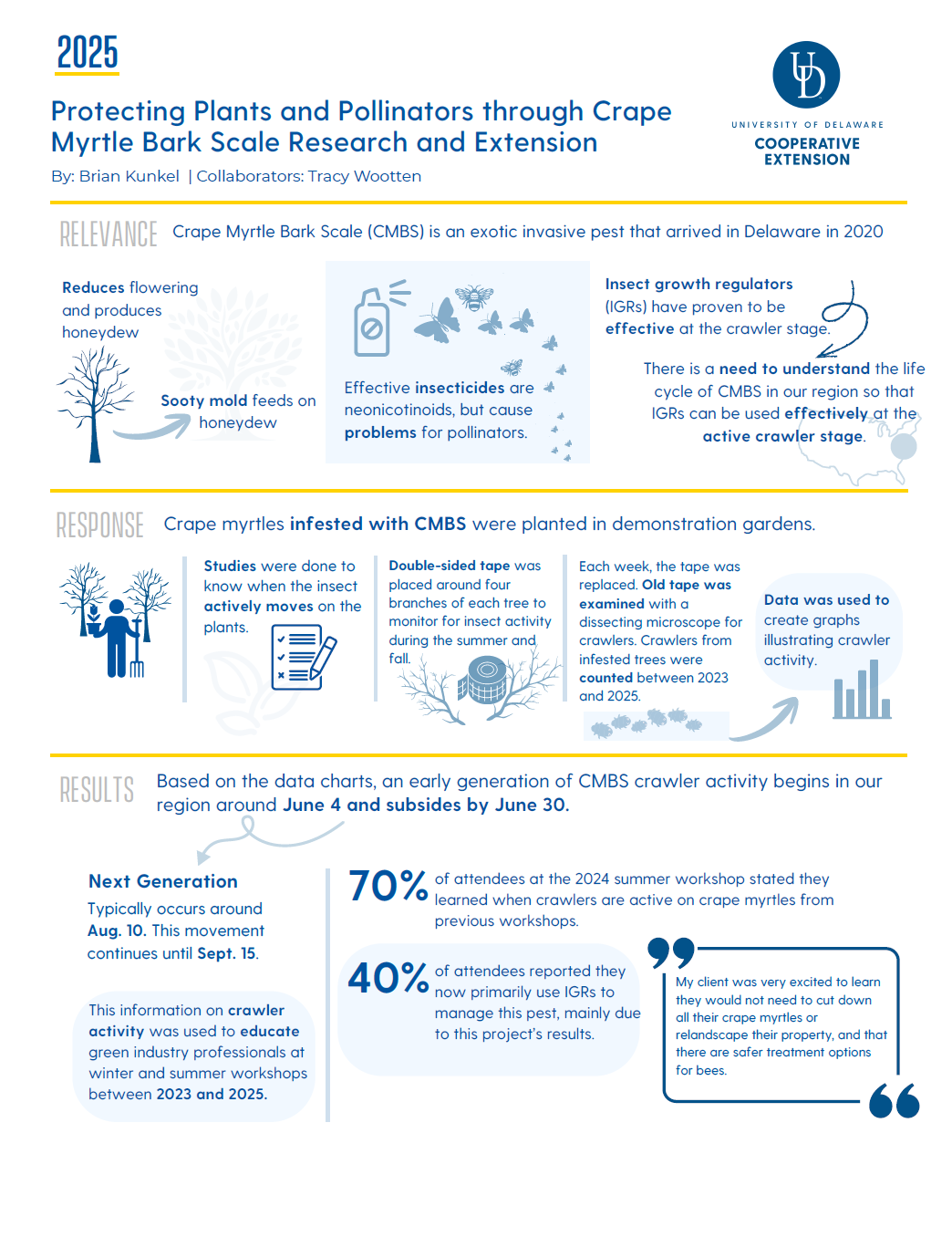
Crape Myrtle Bark Scale (CMBS) is an exotic invasive pest that arrived in Delaware in 2020. This insect reduces flowering and produces copious amounts of honeydew. Sooty mold, a non-pathogenic dark colored fungus, feeds on honeydew. As it grows on the honeydew, it may ruin a plant’s appearance. Homeowners and business owners want crape myrtles that look healthy and are pest-free. The most effective insecticides for treating CMBS are neonicotinoids, which can cause problems for pollinator health. Green industry professionals would prefer to use insecticides that have a lesser impact on pollinators and other non-target arthropods. Insect growth regulators (IGRs) have proven to be effective alternatives to neonicotinoids; however, optimal applications should be made during crawler activity for maximum efficacy. Crawlers are the vulnerable and mobile stage of this insect pest. This pest has not been extensively researched in the Mid-Atlantic. There is a need to understand the life cycle of CMBS in our region so green industry professionals can effectively use IGRs at the active crawler stage.
RESPONSE
University of Delaware horticultural extension agents in New Castle and Sussex Counties helped the ornamental extension specialist plant crape myrtles infested with CMBS in demonstration gardens. The infested trees were planted to study when the insect actively moves on the plants. Entomology interns and the specialist placed double-sided tape around four branches of each tree to monitor for insect activity during the summer and fall. Each week, the team replaced the tape. Old tape was examined with a dissecting microscope for crawlers. Crawlers from infested trees were counted between 2023 and 2025. Data was used to create graphs illustrating crawler activity. The team worked with University of Maryland Cooperative Extension professionals to compare observed insect phenology and monitoring techniques.
RESULTS
Based on the data charts, an early generation of CMBS crawler activity begins in our region around June 4 and subsides by June 30. The insects then settle down to feed and produce a second generation. The next generation crawler activity typically occurs around Aug. 10. This movement continues until Sept. 15.
This information on crawler activity was used to educate green industry professionals at winter and summer workshops between 2023 and 2025.
70% of attendees at the 2024 summer workshop stated they learned when crawlers are active on crape myrtles from previous workshops.
Approximately 40% of attendees reported they now primarily use IGRs to manage this pest, mainly due to this project’s results.
One landscape maintenance contractor shared that a client was very excited to learn they would not need to cut down all their crape myrtles or relandscape their property, and that there are safer treatment options for bees. Furthermore, this individual shared that treatment costs would be significantly lower than the cost of starting over with new plants throughout their property.
PUBLIC VALUE STATEMENT
The data collected on Crape Myrtle Bark Scale crawler activity and resulting dissemination of information through extension programs allows green industry professionals to effectively apply insect growth regulators during the most vulnerable stage of this insect’s life cycle. This practice reduces the need for neonicotinoids as a pest control measure, thereby protecting both plant and pollinator communities.