



Growing Through Gardening Professional Development
Growing Through Gardening Professional Development (2025)
Written by Carrie Murphy, Lawn and Garden Program Leader
Collaborators: Tracy Wootten, Horticulture Agent
RELEVANCE
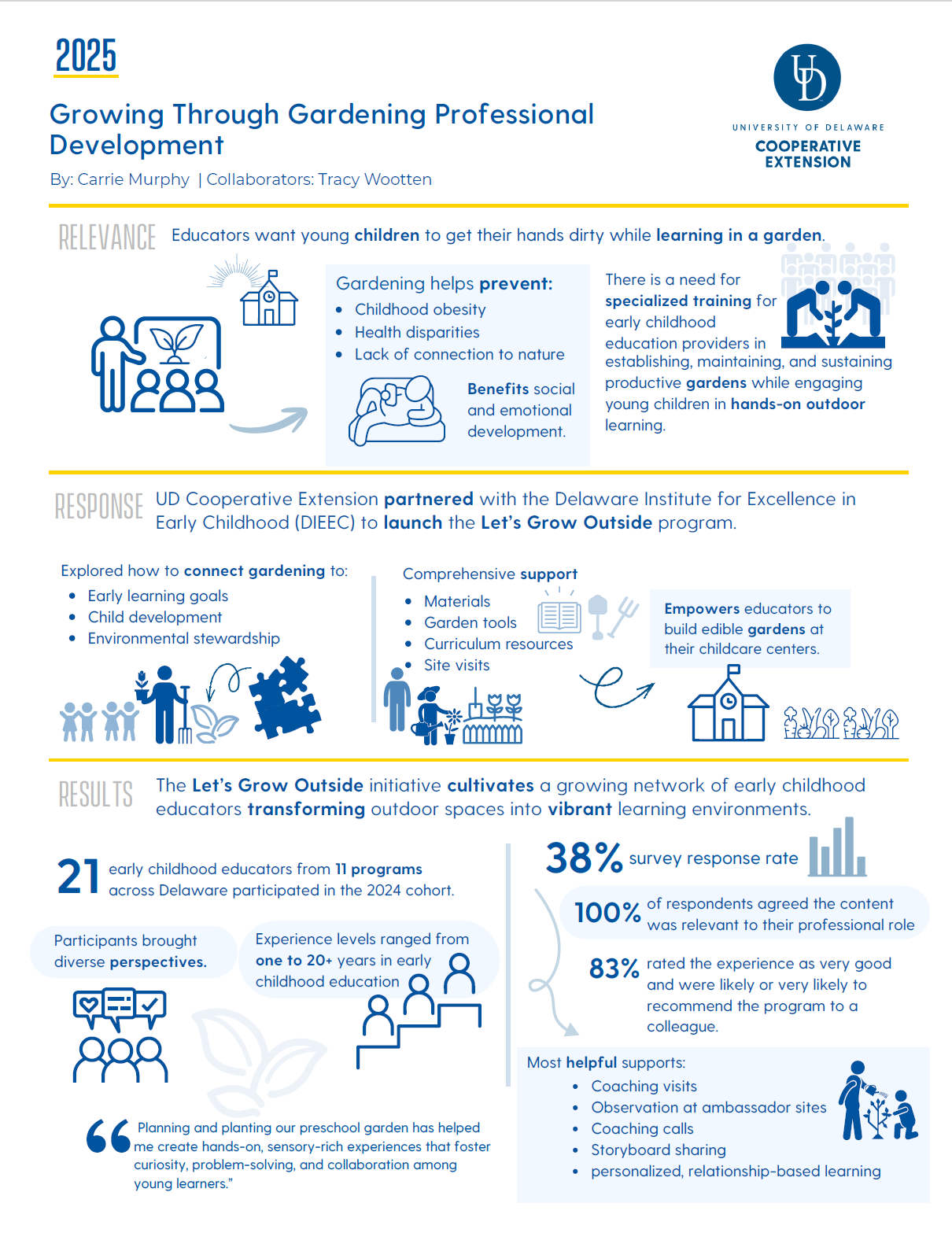
Educators want young children to get their hands dirty while learning in a garden. This helps address issues like childhood obesity, health disparities, and a lack of connection to nature. It also benefits social and emotional development.
A need exists for specialized training for early childhood education providers to aid them in establishing, maintaining, and sustaining productive gardens while engaging young children in hands-on outdoor learning.
RESPONSE
The University of Delaware Cooperative Extension partnered with the Delaware Institute for Excellence in Early Childhood (DIEEC) to launch the Let’s Grow Outside professional development program to help early childhood educators integrate gardening into learning environments. The initiative addressed the need for specialized training to establish, maintain, and sustain productive gardens while engaging young children in hands-on outdoor learning experiences. Participants explored how to connect gardening with early learning goals, child development, and environmental stewardship. The program provided comprehensive support, including materials, garden tools, curriculum resources, and site visits, to empower educators to build edible gardens at their childcare centers. Coaching visits, observation opportunities, and customized action plans further supported program goals.
RESULTS
Twenty-one early childhood educators from 11 programs across Delaware participated in the 2024 cohort. Participants brought diverse perspectives. Experience levels ranged from one to more than 20 years in early childhood education. Educational backgrounds spanned high school through bachelor’s degrees.
A participant survey (38% response rate) highlighted:
100% of respondents agreed the content was relevant to their professional role, and
83% rated the experience as very good and were likely or very likely to recommend the program to a colleague.
Educators identified the most helpful supports as coaching visits, observation at ambassador sites, coaching calls, and storyboard sharing, underscoring the value of personalized, relationship-based learning. Participants reported meaningful growth, including increased confidence in using outdoor learning spaces, stronger time management skills, and a deeper understanding of how to connect gardening to developmental domains such as science, math, and social-emotional learning. Programs reported increased family engagement and enthusiasm around healthy eating and nature exploration. Several participants plan to continue gardening at their centers and at home, extending the program’s impact beyond the classroom.
One participant shared, “Planning, planting, and maintaining our preschool garden has helped me better understand how to create hands-on, sensory-rich experiences that foster curiosity, problem-solving, and collaboration among young learners.”
Educators also noted pride in creating gardens that engage children and families in exploring where food comes from and developing an appreciation for nature. These outcomes align with early childhood best practices and sustainability education.
PUBLIC VALUE STATEMENT
The Let’s Grow Outside initiative cultivates a growing network of early childhood educators transforming outdoor spaces into vibrant learning environments. This collaboration between Extension and DIEEC demonstrates the power of integrating environmental education into early childhood practice—planting seeds for lifelong curiosity, wellness, and connection to the natural world. Teachers gain the skills and confidence to implement and sustain edible gardens that enhance early learning. Gardens provide sensory, inquiry-based learning environments that foster curiosity, responsibility, and collaboration.