



Delaware Youth are Eating Healthier and Getting Fit (2025)






Delaware Youth are Eating Healthier and Getting Fit (2025)
Written by: Diane Oliver
RELEVANCE
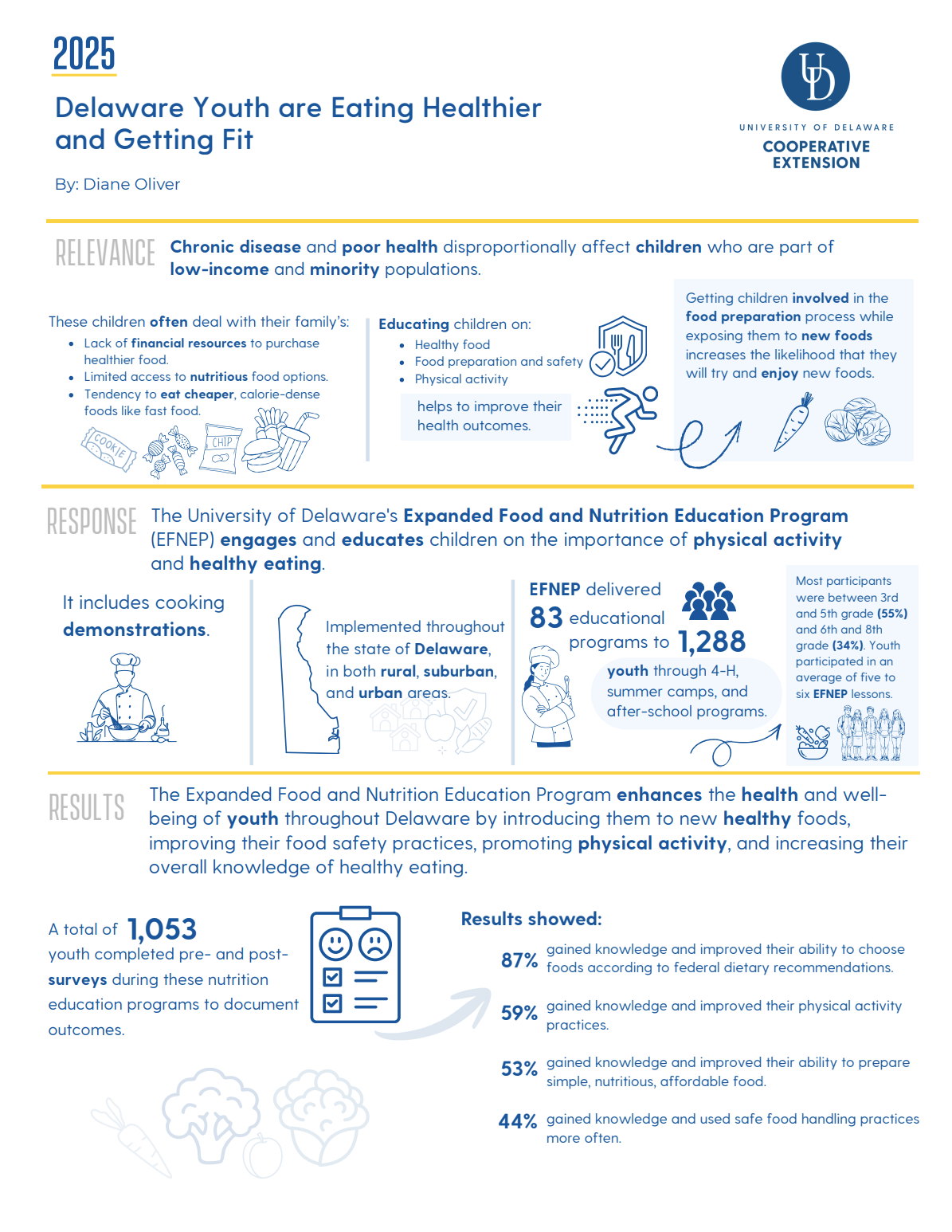
Chronic disease and poor health disproportionally affect children who are part of low-income and minority populations. These children often deal with their family’s lack of financial resources to purchase healthier food, limited access to nutritious food options, or they tend to eat cheaper, calorie-dense foods like fast food. Educating children on healthy food, food preparation and safety, and physical activity helps to improve their health outcomes. Furthermore, getting children involved in the food preparation process while exposing them to new foods increases the likelihood that they will try and enjoy new foods.
RESPONSE
The University of Delaware's Expanded Food and Nutrition Education Program (EFNEP) engages and educates children on the importance of physical activity and healthy eating. It includes cooking demonstrations. The program is implemented throughout the state of Delaware, in both rural, suburban, and urban areas. EFNEP delivered 83 educational programs to 1,288 youth through 4-H, summer camps, and after-school programs. Most participants were between 3rd and 5th grade (55%) and 6th and 8th grade (34%). Youth participated in an average of five to six EFNEP lessons.
RESULTS
A total of 1,053 youth completed pre- and post-surveys during these nutrition education programs to document outcomes. Results showed:
87% gained knowledge and improved their ability to choose foods according to federal dietary recommendations.
59% gained knowledge and improved their physical activity practices.
53% gained knowledge and improved their ability to prepare simple, nutritious, affordable food.
44% gained knowledge and used safe food handling practices more often.
FUNDING
USDA National Institute of Food and Agriculture, with support from the Wilmington Flower Market and a gift from Paul and Linda McConnell.
PUBLIC VALUE STATEMENT
The Expanded Food and Nutrition Education Program enhances the health and well-being of youth throughout Delaware by introducing them to new healthy foods, improving their food safety practices, promoting physical activity, and increasing their overall knowledge of healthy eating.