
Lewes’ living shoreline
Photos by Evan Krape | Video by Jeffrey C. Chase July 15, 2026
Researchers install a living shoreline on UD’s Lewes Campus to help infrastructure and ecosystem
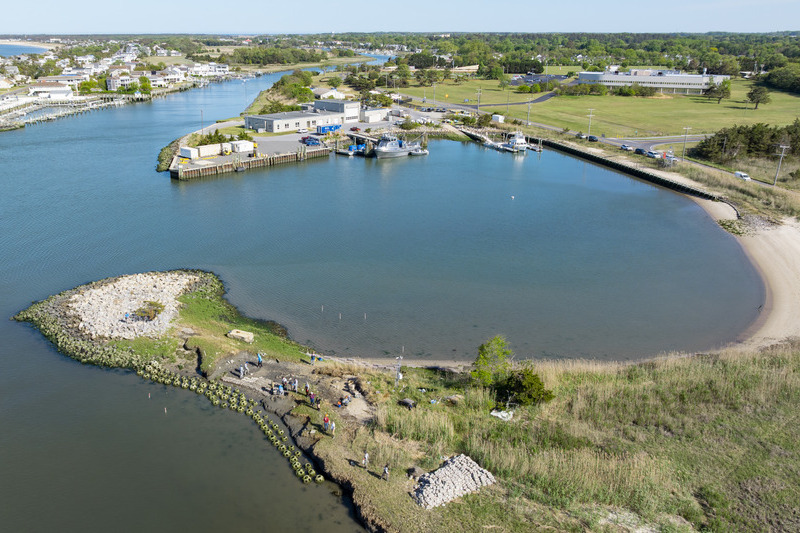
The boat basin at the University of Delaware’s Hugh R. Sharp Campus in Lewes faces a dual threat: rising sea levels and intense storms that surge water into the basin, threatening campus infrastructure and the fleet of research vessels that are harbored there.
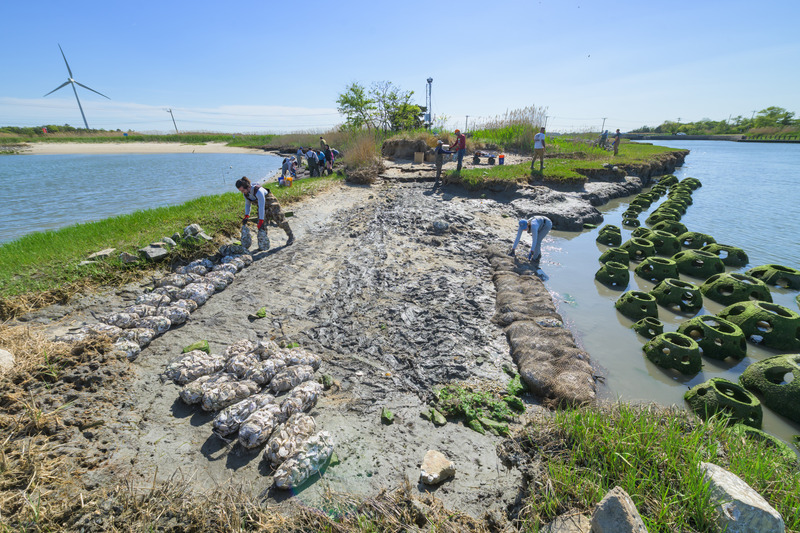
To combat this issue, researchers have installed a living shoreline that protects critical infrastructure while also providing ecosystem benefits to the area.
Living shorelines are nature-based structures that use natural materials like plants, sand, rock and oyster shells to stabilize shorelines and protect them from erosion. Unlike hard structures, such as sea walls, living shorelines can work and adapt with nature to provide environmental benefits like habitat for wildlife, improved water quality and increased resilience to storms.
A living shoreline: youtube.com/watch?v=sA9hVUC6AJc
“As we begin to see real coastal change from rising sea levels and more intense storms, it's important to find ways to protect vulnerable areas,” said Leigh Muldrow, a plant and soil sciences doctoral student who worked on the shoreline design.
The installation marks the culmination of a partnership with UD’s College of Earth, Ocean and Environment, the College of Engineering, the landscape architecture program in UD’s College of Agriculture and Natural Resources, and the Partnership for the Delaware Estuary.
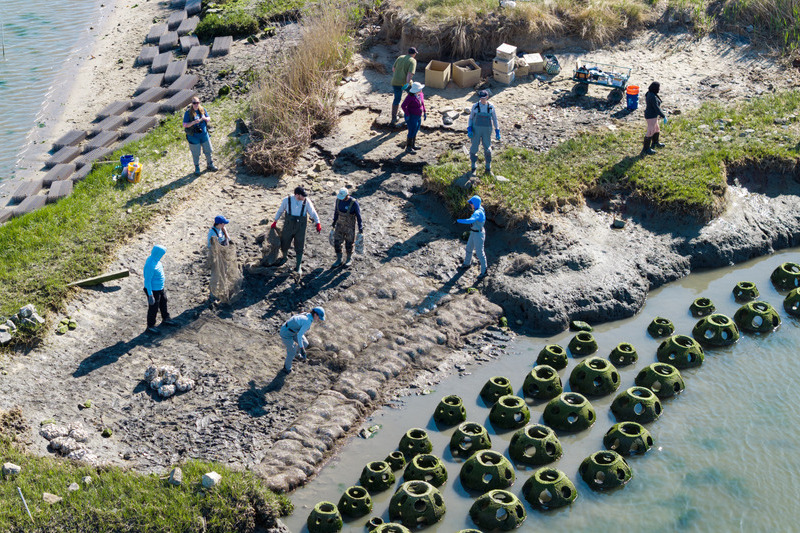
“What sets a living shoreline apart from a seawall or a bulkhead is that it does more than just hold the shoreline in place,” said Muldrow, who is also a licensed landscape architect and graduate of UD’s landscape architecture program. “It absorbs wave energy, collects sediment and creates habitat at the same time. In this case, because it is alive and will be colonized by oysters, it can adapt and keep up as conditions change.”
Boat basin buffers
Ed Hale, assistant professor in UD’s School of Marine Science and Policy and a fisheries and aquaculture specialist with Delaware Sea Grant, has been involved with the project since its inception. After monitoring the site for three years, his group determined that a solution would be needed to protect the boat basin.

He pointed to a 50-meter spit of land that had formerly been a peninsula. Due to sea-level rise and increased stormwater runoff, that peninsula is turning into a fragmented island.
“The water is rising more frequently and cutting off an island, which is going to expose our research fleet, including the RV Hugh R. Sharp, to more direct wave energy as it reverberates off the bulkheads of the Coast Guard safety detachment located next door,” Hale said. “We think this could potentially expose our infrastructure to a higher level of wave energy from the side.”
Plant protectors
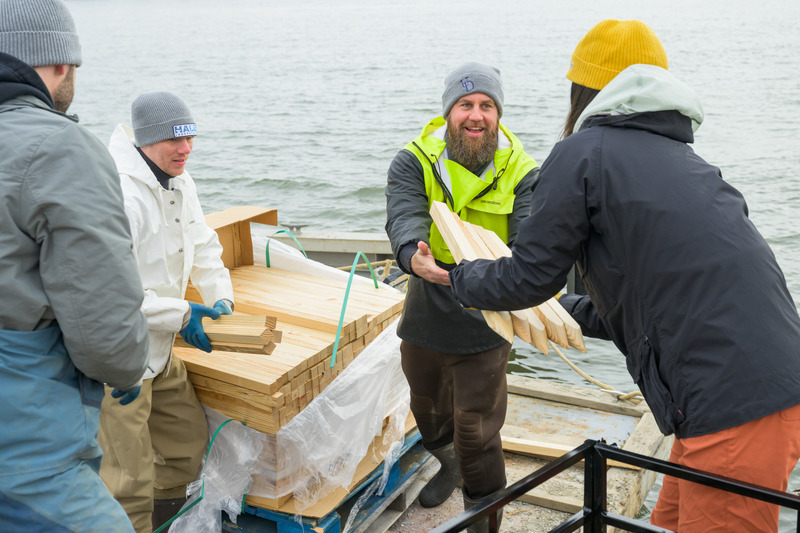
The living shoreline will not only protect the boat basin but also provide opportunities for aquaculture and observing how native plants can defend against erosion.
Students from UD’s landscape architecture program, and members of the Partnership for the Delaware Estuary, were on hand to plant native wetland plants at the living shoreline — primarily saltmarsh cordgrass (Spartina alterniflora), which has been eroding in the area due to tidal forces and wave action.
Jules Bruck, who was a professor and founding director of the landscape architecture program at UD, said the landscape architecture students are trying innovative designs and will monitor progress, working toward a goal of decreased erosion and increased sedimentation and habitat.
They are testing a variety of anchors for the plants, which will need time to grow their root systems in the high-energy system. Determining the best way to anchor plants will help for future installations.
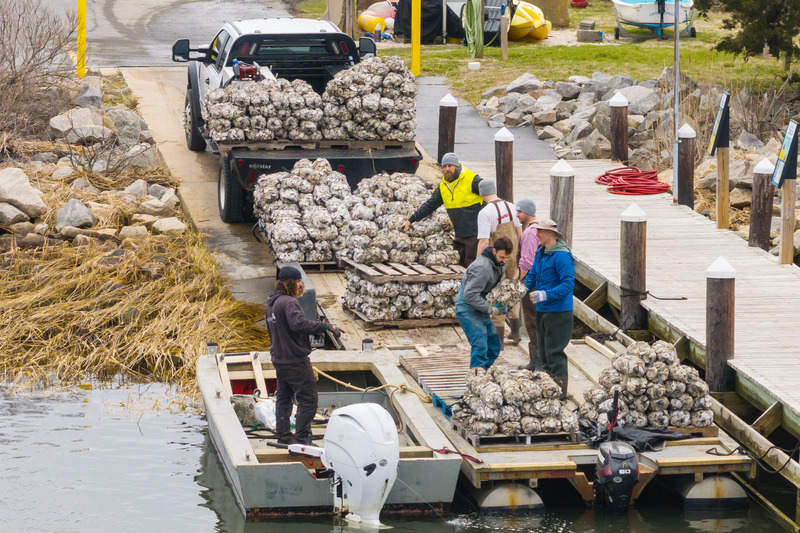
“It’s been such an educational experience working with a diverse team of designers, scientists and engineers to design and build the mosaic living shoreline in Lewes,” said Bruck, who is the incoming dean for the University of Georgia’s College of Environment and Design. “Our students have had a fantastic experience, learning by doing in the field.”
The team from UD’s College of Engineering, led by professor Monique Head, evaluated the water forces acting on the bridge over Canary Creek, which frequently floods because of storm surges and sea-level rise. She said the long-term goal is to determine how effectively the living shoreline absorbs wave energy and helps protect the bridge from damaging forces.
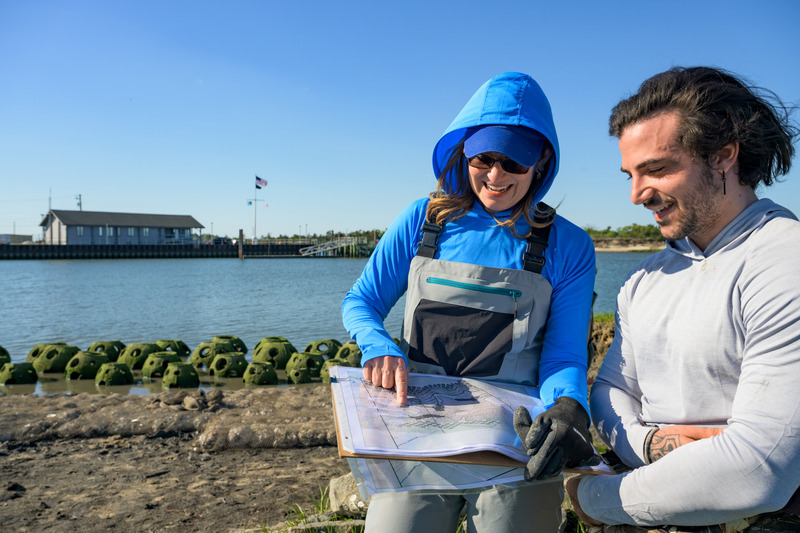
“By understanding the level or force involved, we’ll be able to provide better insights into how similar focus might impact critical structures,” said Head, associate dean of the Honors College and a professor in the Department of Civil, Construction and Environmental Engineering at UD.
Aquaculture assistance
Hale’s team is trying to understand the oyster production potential of the living shoreline, as well as which gear works best. There isn’t a complete understanding of what types of living shoreline features are preferred among fish, so Hale’s group will test preferences in a lab setting and on the new living shoreline.
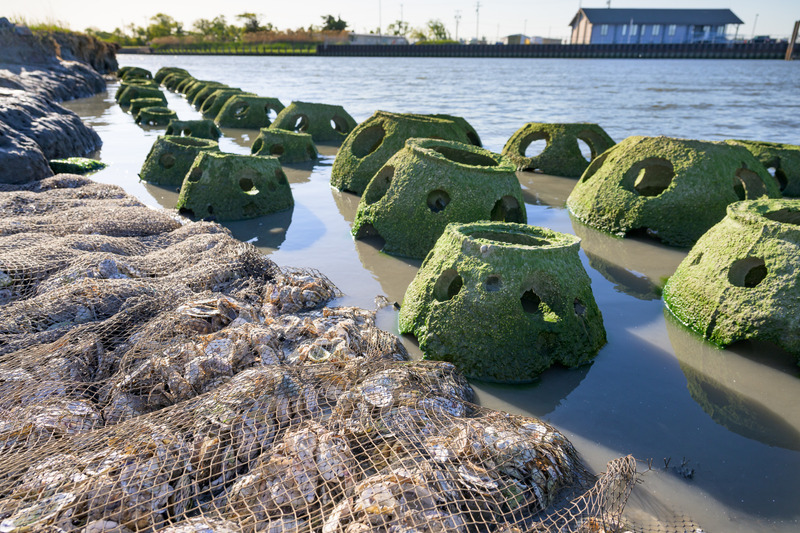
Concrete reef structures, shell mattresses and plants chosen by the landscape architecture students have been installed on the shoreline — in addition to over 1,800 shell bags of oysters.
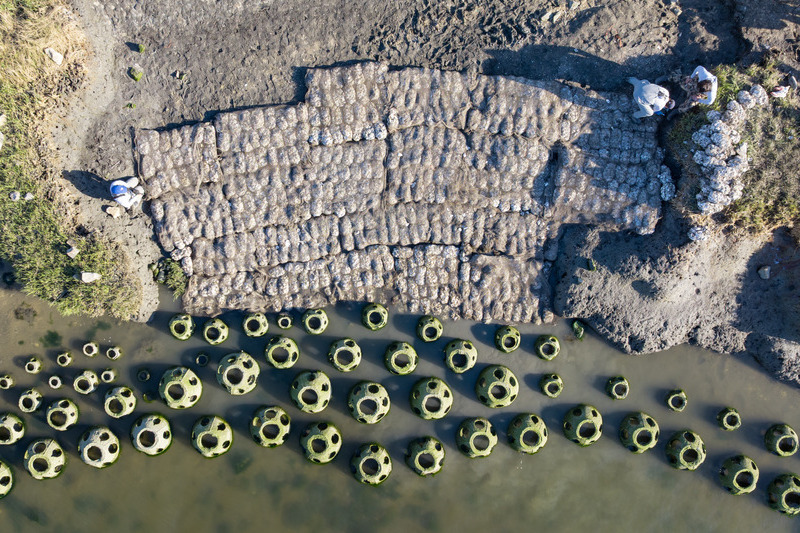
The goal is not necessarily to combat sea level rise, but to reduce wave energy while naturally benefitting the environment. Oyster shell materials and oyster reefs are known to reduce wave energy and potentially trap sediments, which can encourage natural plant growth.
“We wanted to install structures that help materials build up naturally and generate positive community responses,” Hale said.
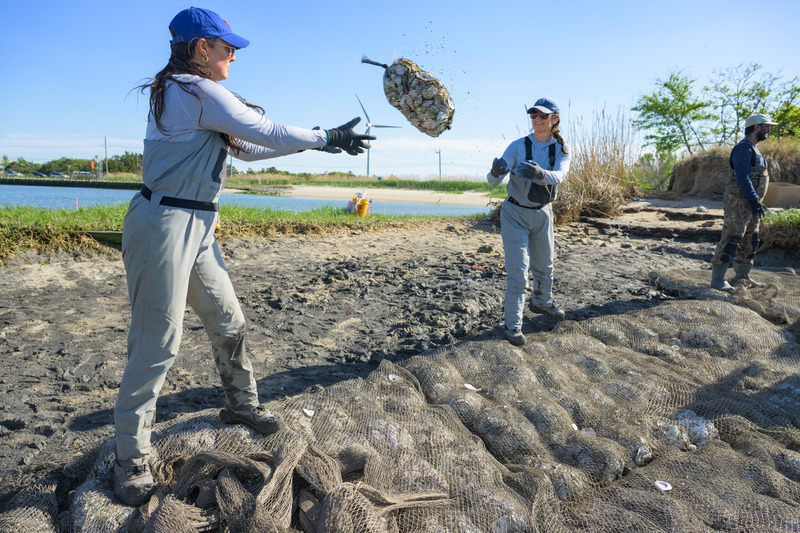
The living shoreline will hopefully allow for the settlement of barnacles, macroalgae and biofilms. When these settle on the structure, they colonize and produce food for other organisms.
The structures also provide habitat for species that settle on the shoreline, as well as for migratory species that might use them briefly. The team has already seen juvenile black seabass and American eels hanging around some of the aquaculture cages.
The research team will now collect data from the living shoreline to build on and confirm findings from previous studies.

“We’re trying to get an understanding of the net benefit of the living shoreline,” Hale said. “The goal is to try and understand what is the functional response of the environment, and if it’s beneficial, can we quantify that in terms of biodiversity, biomass and abundance?”
The work is the result of the five-year Developing Engineering practices using Ecosystem Design Solutions for Future Army (DEEDS) project. The project proposal was developed and submitted by the Delaware Environmental Institute (DENIN) and sponsored by the Department of the Army, U.S. Army Engineer Research and Development Center (ERDC), and administered by the U.S. Army Corps of Engineers.
The team of primary investigators includes Bruck, Hale, Head, Jack Puleo, dean of the College of Engineering and Computing at Florida International University, and Eric Bardenhagen, associate professor of landscape architecture at UD. Between their respective laboratories, they’ve had volunteers ranging from postdoctoral researchers, graduate students and undergraduate students.
Contact Us
Have a UDaily story idea?
Contact us at ocm@udel.edu
Members of the press
Contact us at mediarelations@udel.edu or visit the Media Relations website