

Regulatory Affairs
Conducting Research at UD
Our team oversees and advances UD’s strong culture of compliance with federal, state and University policies and regulations across the spectrum of the University’s research-related activities. We are responsible for the review, negotiation and establishment of research agreements, and the administrative transfer of research materials to and from UD. Whether you’re a first-timer or a veteran at developing research proposals, you will find the tools you need here to prepare your proposal, manage your grant, protect your great ideas and inventions, and present your results to the scientific community and the public.
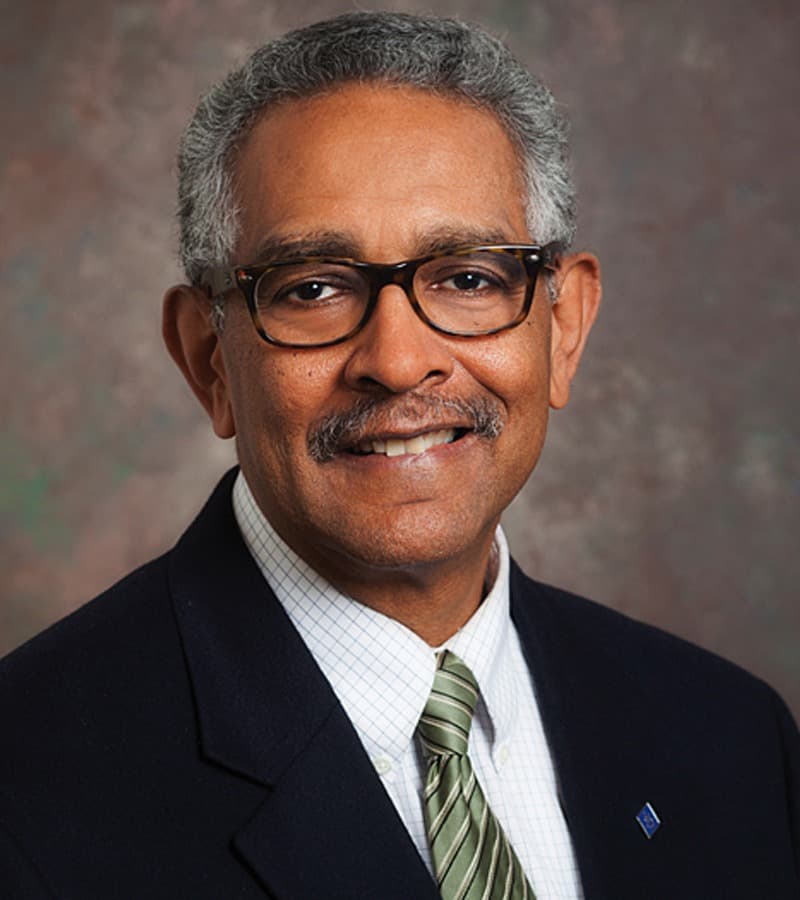
Cordell Overby
Associate Vice President, Research and Regulatory Affairs
Research Integrity
Ensuring responsible conduct of research and upholding the highest ethical standards.
Safety
The UD Office for Environmental Health and Safety distributes information made to ensure safe research practices are followed
Research Administration
The roles and responsibilities of research administration at UD.
Intellectual Property
Counsel on the disclosure of innovations, patents, copyrights, trademarks and other research-related agreements.
Export Regulations
Oversight & administration of regulations regarding UD research and its impact on economic and trade sanctions.
OMB Uniform Guidance
The federal Office of Management and Budget (OMB) guidance for university recipients
Human Subjects
Research involving human subjects, bio specimens and/or tissue samples, and/or private identifiable data
Animal Subjects
Federal regulations require use of non-human vertebrate animals in research, teaching and testing follow established guidelines.
Recombinant DNA in Research
Work involving recombinant DNA must be approved by the UD Biosafety Committee and the Biosafety Officer
- Animal Subjects
- Bayh-Dole Act
- Biological Safety
- Chemical Hygiene Program
- Data Transfer and Use Agreement
- Environmental Health and Safety
- Export Controls and Trade Sanctions Memo
- Export Regulations
- Faculty Handbook
- Foreign Involvement
- Forms
- Human Subjects
- Mentoring Statement for Postdocs
- Misconduct in Research
- Principles of Responsible Conduct
- Policies
- Procedures
- Radiation Safety
- Ratner Prestia
- Recombinant DNA
- Researcher Roles and Responsibilities
- UD Cost Accounting Standards Guidelines
Compliance Hotline:
Reporting a Concern
UD is committed to high ethical standards and enforcing its policies, procedures and all applicable legal requirements.
The UD Compliance Hotline, serviced by EthicsPoint, provides an anonymous, confidential and independent resource for reporting suspected misconduct and other issues of concern in the workplace.
Integrity
Research Integrity at UD
The University of Delaware is committed to promoting and protecting the responsible pursuit of scientific research. UD faculty and students are obligated to practice intellectual honesty and to observe established professional standards in their fields at all times, from the formulation of proposals, to their interactions with research associates and students, to the collection, handling and evaluation of data, to the peer review process, and the protection and presentation of results.
All members of the UD research community are expected to follow the highest ethical standards and are encouraged to report any concerns they may have by contacting the Associate Vice President for Research & Regulatory Affairs in the UD Research Office directly, or the Compliance Hotline.
UD policy and Federal requirements (Pilot Program) prohibit retaliation against an individual making a misconduct allegation in good faith.
UD Research Compliance & Ethics Program
The University of Delaware (UD or University), its faculty, staff and students are committed to conducting their research and scholarly endeavors with the highest ethical standards. Consistent with federal government guidelines and requirements, and with widely-recognized best practices to achieve the responsible conduct of research, the University has developed, conducts and maintains current an effective Research Compliance & Ethics Program (RCEP). In doing so, UD exercises due diligence to prevent, detect and correct any research-related conduct that is not consistent with government and best-practice collective tenets. Additionally, the University creates and promotes, in an ongoing fashion, an institution-wide culture that encourages behavior/conduct that is ethical, complaint and in accord with applicable research-related requirements, guidelines and best practices.
Responsibilities of a Principal Investigator
Serving as a Principal Investigator (PI) at the University of Delaware brings significant rewards & confers concomitant responsibilities. PIs are responsible for the intellectual direction of research and scholarship and for the education and training of students. In carrying out these critical tasks, PIs are also responsible for compliance with laws and regulations that touch on all aspects of the research enterprise.
To ensure compliance with applicable rules, regulations, and contract requirements the University of Delaware requires all PIs to receive training in the financial management of sponsored projects. Developed for PIs already at the University, the University's training program focuses on stewardship of funds, mandatory reporting requirements and particularized training in the fundamentals of federal grant and contract accounting. PIs must complete mandatory training before the University will release project funding.
Code of Conduct
UD Code of Conduct
From its inception, the American Association of University Professors has recognized that membership in the academic profession carries with it special responsibilities. The Association has consistently affirmed these responsibilities in major policy statements, providing guidance to professors in such matters as their utterances as citizens, the exercise of their responsibilities to students and colleagues, and their conduct when resigning from an institution or when undertaking sponsored research.
The Statement on Professional Ethics that follows sets forth those general standards that serve as a reminder of the variety of responsibilities assumed by all members of the profession.
In the enforcement of ethical standards, the academic profession differs from those of law and medicine, whose associations act to ensure the integrity of members engaged in private practice. In the academic profession the individual institution of higher learning provides this assurance, and so, should normally handle questions concerning propriety of conduct within its own framework by reference to a faculty group. The Association supports such local action and stands ready, through the general secretary and Committee B, to counsel with members of the academic community concerning questions of professional ethics and to inquire into complaints when local consideration is impossible or inappropriate. If the alleged offense is deemed sufficiently serious to raise the possibility of adverse action, the procedures should be in accordance with the 1940 Statement of Principles on Academic Freedom and Tenure, the 1958 Statement of Procedural Standards in Faculty Dismissal Proceedings or the applicable provisions of the Association’s Recommended Institutional Regulations on Academic Freedom and Tenure.
Reporting Misconduct
Report a concern
- 1961 — Statement on Recruitment and Resignation of Faculty Members
- 1964 — A Statement on Extramural Utterances (Clarification of sec. 1c of the
- 1940 — Statement of Principles on Academic Freedom and Tenure)
- 1965 — On Preventing Conflicts of Interest in Government
- 1966 — Statement on Government of Colleges and Universities
- 1967 — Joint Statement on Rights and Freedoms of Students
- 1970 — Council Statement on Freedom and Responsibility
- 1976 — On Discrimination
- 1984 — Sexual Harassment: Suggested Policy and Procedures for Handling Complaints
- Professors, guided by a deep conviction of the worth and dignity of the advancement of knowledge, recognize the special responsibilities placed upon them. Their primary responsibility to their subject is to seek and to state the truth as they see it. To this end, professors devote their energies to developing and improving their scholarly competence. They accept the obligation to exercise critical self-discipline and judgment in using, extending and transmitting knowledge. They practice intellectual honesty. Although professors may follow subsidiary interests, these interests must never seriously hamper or compromise their freedom of inquiry.
- As teachers, professors encourage the free pursuit of learning in their students. They hold before them the best scholarly and ethical standards of their discipline. Professors demonstrate respect for students as individuals and adhere to their proper roles as intellectual guides and counselors. Professors make every reasonable effort to foster honest academic conduct and to ensure that their evaluations of students reflect each student’s true merit. They respect the confidential nature of the relationship between professor and student. They avoid any exploitation, harassment or discriminatory treatment of students. They acknowledge significant academic or scholarly assistance from them. They protect their academic freedom.
- As colleagues, professors have obligations that derive from common membership in the community of scholars. Professors do not discriminate against or harass colleagues. They respect and defend the free inquiry of associates. In the exchange of criticism and ideas, professors show due respect for the opinions of others. Professors acknowledge academic debt and strive to be objective in their professional judgment of colleagues. Professors accept their share of faculty responsibilities for the governance of their institution.
- As members of an academic institution, professors seek above all to be effective teachers and scholars. Although professors observe the stated regulations of the institution, provided the regulations do not contravene academic freedom, they maintain their right to criticize and seek revision. Professors give due regard to their paramount responsibilities within their institution in determining the amount and character of work done outside it. When considering the interruption or termination of their service, professors recognize the effect of their decision upon the program of the institution and give due notice of their intentions.
- As members of their community, professors have the rights and obligations of other citizens. Professors measure the urgency of these obligations in light of their responsibilities to their subject, to their students, to their profession and to their institution. When they speak or act as private persons they avoid creating the impression of speaking or acting for their college or university. As citizens engaged in a profession that depends upon freedom for its health and integrity, professors have a particular obligation to promote conditions of free inquiry and to further public understanding of academic freedom. (Added by Faculty Senate 4/95; renumbered 2/99) (Last editorial update 2/12/99)
Responsible Conduct
Ensuring the responsible conduct of research is paramount.
“Scientific research is grounded in values such as integrity, honesty, trust, curiosity and respect for intellectual achievement. The expression of these values in the diverse styles and approaches of the various scientific disciplines has contributed directly to the discovery of knowledge and thus to the achievements of the U.S. scientific research enterprise,” noted the National Academy of Sciences’ Committee on Science, Engineering and Public Policy in the report, On Being a Scientist: Responsible Conduct in Research.
However, as the report goes on to say, growth of the U.S. research enterprise, changing social expectations about the accountability of scientists, increasingly complex research that places new demands on scientific oversight and expanded commercialization of research results have catalyzed the formation and implementation of new policies and regulations by academic institutions and funding agencies to safeguard the process of science in today’s academic research arena.
The University of Delaware holds its faculty and staff to the highest standards of conduct. It is University policy that “employees are expected at all times, to respect the rights of the University, its students, visitors and other members of the University community. Inherent in this responsibility is the obligation to be courteous, respectful, honest and to protect the University environment.”
These standards of conduct are critical to every step of the UD researcher’s pursuit of the truth, from the formulation of proposals, to interactions with research associates and students, to the collection and handling of data from experiments or other scholarly activity, to the evaluation of that data, peer review and protection and presentation of results. Furthermore, research involving human or animal subjects must be administered according to established University policies and federal regulations and with a commitment to the highest ethical standards.
Every UD researcher needs to understand and comply with the policies and procedures, established by the University and the federal government, that are relevant to his or her research. You’ll find links to a complete listing of UD’s policies, along with required forms, highlighted in the blue box above and on our Policies & Forms page on this website.
Research FAQ’s
See More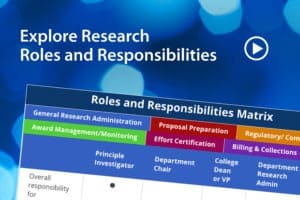
Roles and Responsibilities PDF
On Being a Scientist: Responsible Conduct in Research. (Committee on Science, Engineering, and Public Policy, National Academy of Sciences, National Academy Press, 1995).
Introduction to the Responsible of Conduct by the Office of Research Integrity (ORI). The ORI Introduction to RCR seeks to supplement existing resources by making a comprehensive overview of basic rules of the road for responsible research available to all PHS-funded researchers.
Responsible Conduct Courses. This Web site, produced by Columbia University with support from the Department of Health and Human Services, presents case studies on conflicts of interest, mentoring, peer review, misconduct and data management.
Misconduct
Misconduct in Research
The Federal Office of Science and Technology Policy (OSTP) defines research misconduct as “fabrication, falsification, plagiarism or other practices that seriously deviate from those that are commonly accepted within the scientific community for proposing, performing or reporting research results.”
Reporting Misconduct
Report a concernIt is the policy of the University of Delaware to abide by the OSTP policy in all University research. Any intentional distortion of research data, or intentional distortions of information or conclusions derived from research data, constitutes misconduct in research and is prohibited by University Policy.
The University of Delaware has the ethical responsibility to prevent misconduct in research, and the legal responsibility to inquire into all allegations of research misconduct, and to report and investigate all instances where a reasonable presumption of misconduct is established by inquiry.
The University, the state, suppliers of grant accounts, clients of consultation services and the public all have the right to expect and demand unbiased and factual information from University personnel. In the long run, University personnel benefit individually and collectively from the maintenance of high ethical standards. An atmosphere of intellectual honesty enhances the research process and need not inhibit productivity and creativity. Establishing and maintaining such an atmosphere is a responsibility that must be accepted by all University personnel.
Conflict of Interest
Conflict of Interest (COI) in Research
All UD employees are expected to conduct their research-related duties with integrity, and to avoid association with any activities that could diminish, or could be perceived as diminishing, the effectiveness of their commitment to the University.
Involvement of faculty and staff with appropriate commercial enterprises aligns with University mission as it is an important part of the transfer of knowledge and it is encouraged by the University to enhance both teaching and research programs. Association of faculty and staff with commercial enterprises should be such that it benefits all the parties involved, including the University.
University of Delaware’s Conflict of Interest in Research Policy defines a potential conflict of interest (COI) as an occurrence when there is a divergence between an individual’s private interests and his or her professional obligations, such that an independent observer might reasonably question whether the individual’s professional judgment, commitment, actions or decisions could be influenced by considerations of personal gain, financial or otherwise.
In addition to the Conflict of Interest in Research Policy, the University has another conflict of interest policy which allows the University to identify, evaluate and address conflicts of interest that might call into question the fiduciary duties of its Trustees, Officers and Senior Administrators. It is called the Financial Conflicts of Interest for Senior Administrators Policy and requires all Senior Administrators and Trustees to complete a COI Disclosure annually.
The two policies have different scopes. Depending on the institutional roles and responsibilities of certain positions some individuals are required to fulfill the disclosure requirements from both. Any questions about the Financial COI for Seniors Administrators Policy and procedures should be directed to the Office of the General Counsel.
COI in Research Disclosure and Management Proceduress
Faculty and professional staff must complete a new COI disclosure on an annual basis. A new disclosure must be completed annually, even when they do not have any Significant Financial Interests (SFI) to disclose. COI disclosures must be submitted, via web form, on an annual basis and within 30 days of any change to previous disclosures. Please click on the link below, and log in using your UDNet ID and password. If the link does not take you directly to the form, look for “Conflict of Interest Disclosure Form” under the tab “Blanks.”
- The form describes the different categories of SFIs that are required to be disclosed. A table of examples is provided as a reference. This is not an all-inclusive reference list, rather just a few examples for illustrative purposes.
- If answering “Yes” to any of the listed questions, a pull down menu of required information will appear. Please provide enough detail to facilitate its assessment.
- COI web forms will be automatically routed to the chair or direct supervisor and the dean for review and approval.
COI Management Procedures
- If a COI is determined to exist, a COI management plan is to be developed by the chair and/or dean in concurrence with the employee.
- Please use the template for the COI management plan.
- Examples of conditions or restrictions that might be imposed to manage a COI include, but are not limited to:
- Public disclosure of the conflict (e.g., when presenting and/or publishing affected research);
- Appointment of an independent monitor capable of taking measures to protect against bias resulting from COI;
- Change of personnel or personnel responsibilities and/or modification of the research plan;
- Reduction or elimination of a financial interest; and/or
- Severance of relationships that create the conflict(s).
- In addition, please see below for a detailed guidance for the development of COI management plans in the context of SBIR/STTR awards.
Foreign Involvement
Learn more
- Additional information on UD’s COI disclosure and management procedures can be found in the UD COI training module.
- Further details on reporting requirements specific to PHS-funded research can be found in the Financial Conflict of Interest (FCOI) tutorial provided by NIH.
- Inquiries concerning Institutional Conflict of Interest should be directed to udresearch@udel.edu
Ethics
Research Compliance & Ethics Program
The University of Delaware (UD or University), its faculty, staff and students are committed to conducting their research and scholarly endeavors with the highest ethical standards. Consistent with Federal Government guidelines and requirements, and with widely-recognized best practices to achieve the responsible conduct of research, the University has developed, conducts and maintains current an effective Research Compliance & Ethics Program (RCEP). In doing so, UD exercises due diligence to prevent, detect and correct any research-related conduct that is not consistent Government and best-practice collective tenets. Additionally, the University creates and promotes (in an ongoing fashion) an institution-wide culture that encourages behavior/conduct that is ethical and complaint, and in accord with applicable research-related requirements, guidelines and best practices.
To those ends, the University established and maintains standards and procedures to prevent, detect and correct research-related behaviors that may be (or have the potential to become) aberrant. Methods to keep UD executive leadership knowledgeable with regard to the University RCEP are in place and maintained, so as to accommodate oversight of Program efficacy. Program standards, guidance and training extend to research efforts that include (or potentially include) matters concerning 1) animal care & use, 2) conflict of interest, 3) confidentiality, 4) cost accounting 5) data management, 6) export controls & trade sanctions, 7) freedom-of-information requests, 8) human subject protection, 9) intellectual property, 10) research integrity and misconduct, 11) research-related agreements, and 12) research-related safety (bio-, chemical & hygiene, hazardous substances, radiation and LASER).
The Vice President for Research, Scholarship and Innovation, is the University’s Chief Research Administrator & Advocate. The UD Research Office ensures the presence and maintenance of an adequately-funded and effective research RCEP. Day-to-day operational responsibility for the Program is delegated to the Associate Vice President for Research and Regulatory Affairs, who with colleagues and in cooperation with UD faculty who serve on and chair University compliance and safety committees are tasked to knowledgeably and competently perform the multi-disciplinary duties needed to ensure that the UD research community goes about its work in a compliant and responsible manner. All University persons performing day-to-day operations aimed at maintaining the integrity of the RCEP 1) have no-known transgressions (past or current) from Program tenets, and 2) have direct access to the Office of the University Research and Regulatory Affairs.
In order to maintain Program effectiveness, the UD Research Office’s Regulatory Affairs unit oversees and provides a wide spectrum of research-related compliance and ethics training. Training media include web-based presentations and face-to-face presentations. Face-to-face training is offered for groups or individuals, and is offered on regularly scheduled intervals and upon request. Training is typically tailored for students, research-support staff, faculty and other research professionals, across the full spectrum of research-related RCEP topics.
To ensure that UD’s research community adheres to the requirements of the Program, provisions for periodic monitoring and audit are in place. Additionally, the Program offers anonymous avenues for the reporting of University-research activities that may be suspected of being inconsistent with the responsible conduct of research. As a result of an institutional-wide adherence to a Program of recognized and required research-related compliance and ethical morays, UD maintains an ability to provide an open and supportive environment for the conduct of research, while remaining able to quickly identify abhorrent behavior and suspend offenders.
Finally, to help ensure (and confirm) institutional commitment to providing an effective RCEP, the UD Program is periodically assessed internally (with the assistance non-Program University personnel), and modified as necessary to remain aligned with, and responsive to, modifications in Federal Government and best-practice standards.
Additional information regarding the University RCEP may be accessed by sending an email request to udresearch@udel.edu.
Overview
Intellectual Property Overview
The Office of Economic Innovation and Partnerships (OEIP) is responsible for the management of all intellectual property developed at the University of Delaware. In this role, OEIP provides advice and counsel to UD faculty and staff regarding the disclosure of innovations, patents, copyrights, trademarks, contracts and other research-related agreements. Make sure you understand how to protect your research results and who owns the data generated in UD research. Review this guide for a helpful introduction.
Patents protect inventions and improvements to existing inventions. Copyrights cover literary, artistic and musical works. Trademarks are brand names and/or designs which are applied to products or used in connection with services.
What Is an Invention?
What is an invention, and who owns the inventions made by UD faculty, staff or students?
The University of Delaware Policies and Procedures Manual defines an invention as follows:
“An invention shall constitute any discovery, machine, new and useful process, article of manufacture, composition of matter, life form, design, algorithm, software program, or concept that may have commercial value. University faculty, staff or students employed by the University who discover or invent or develop a device, product, plant variety, method or work while associated with the University must cooperate with the University in defining and establishing the rights to such inventions, works, materials and data.”
It is the policy of the University of Delaware that “all inventions and discoveries, together with any tangible research materials, know-how, and the scientific data and other records of research including any related government protections (collectively “Intellectual Property”), which are conceived or reduced to practice or developed by University faculty, staff, or students in the course of employment at the University, or result from work directly related to professional or employment responsibilities at the University, or from work carried out on University time, or at University expense, or with the substantial use of University resources, shall be the property of the University.”
The University of Delaware is required by law to report its inventions made under federal grants/contracts to the agency, and may elect to own and promote them for commercialization. If you are a UD researcher with an invention to protect, please review these policies and forms and contact the Intellectual Property and Technology Transfer Office of the UD Research Office for more information.
Patents
Patents
A patent for an invention is the grant of a property right to the inventor, issued by the U.S. Patent and Trademark Office. Generally, the term of a new patent is 20 years from the date on which the application for the patent was filed in the United States or, in special cases, from the date an earlier related application was filed, subject to the payment of maintenance fees. U.S. patent grants are effective only within the United States, U.S. territories, and U.S. possessions. Under certain circumstances, patent term extensions or adjustments may be available.
The right conferred by the patent grant is, in the language of the statute and of the grant itself, “the right to exclude others from making, using, offering for sale, or selling” the invention in the United States or “importing” the invention into the United States. What is granted is not the right to make, use, offer for sale, sell, or import, but the right to exclude others from making, using, offering for sale, selling, or importing the invention. Once a patent is issued, the patentee must enforce the patent without the aid of the U.S. Patent and Trademark Office.
Intellectual Property
Quick Reference
View the PDF
Patent Timeline
Throughout the world the first party responsible for filing a patent application is the undisputed owner of the invention. The United States has a one-year time period to file a patent application. This period begins at the formal presentation of the invention. A formal presentation of an invention includes any publication, journal, conference presentation, poster session, newspaper article, Internet publication on a Web page, blog, listserve, etc. In most other countries, you are banned from obtaining patent protection once an invention has been publicly disclosed.
You must file in the United States within one year of the first disclosure of the invention — filing of a provisional application may protect international rights.
It takes an extended period of time to obtain a patent. The patent application can be kept secret while it is pending if you request it; otherwise, it is published by the U.S. Patent and Trademark Office 18 months after filing.
See Policy 6–6 — “Intellectual Property Protection, Ownership, and Commercialization” for detailed information on patent procurement costs and the division of patent income.
Copyright
Copyright
Copyright is a form of protection provided to the authors of “original works of authorship” including literary, dramatic, musical, artistic, and certain other intellectual works, both published and unpublished. The 1976 Copyright Act generally gives the owner of copyright the exclusive right to reproduce the copyrighted work, to prepare derivative works, to distribute copies or phonorecords of the copyrighted work, to perform the copyrighted work publicly, or to display the copyrighted work publicly.
The copyright protects the form of expression rather than the subject matter of the writing. For example, a description of a machine could be copyrighted, but this would only prevent others from copying the description; it would not prevent others from writing a description of their own or from making and using the machine. Copyrights are registered by the Copyright Office of the Library of Congress.
As defined by the U.S. Copyright Office, copyright is a form of protection provided by U.S. law to the authors of “original works of authorship” fixed in any tangible medium of expression. The manner and medium of fixation are virtually unlimited. Creative expression may be captured in words, numbers, notes, sounds, pictures, or any other graphic or symbolic media. The subject matter of copyright is extremely broad, including literary, dramatic, musical, artistic, audiovisual, and architectural works. Copyright protection is available to both published and unpublished works.
Under the 1976 Copyright Act, the copyright owner has the exclusive right to reproduce, adapt, distribute, publicly perform, and publicly display the work. In the case of sound recordings, the copyright owner has the right to perform the work publicly by means of a digital audio transmission. These exclusive rights are freely transferable and may be licensed, sold, donated to charity, or bequeathed to the copyright owner’s heirs. It is illegal for anyone to violate any of the exclusive rights of the copyright owner. If the copyright owner prevails in an infringement claim, the available remedies include preliminary and permanent injunctions (court orders to stop current or prevent future infringements), impounding, and destroying the infringing articles.
The exclusive rights of the copyright owner, however, are limited in a number of important ways. Under the “fair use” doctrine, which has long been part of U.S. copyright law and was expressly incorporated in the 1976 Copyright Act, a judge may excuse unauthorized uses that may otherwise be infringing. Section 107 of the Copyright Act lists criticism, comment, news reporting, teaching, scholarship, and research as examples of uses that may be eligible for the fair use defense. In other instances, the limitation takes the form of a “compulsory license” under which certain limited uses of copyrighted works are permitted upon payment of specified royalties and compliance with statutory conditions. The Copyright Act also contains a number of statutory limitations covering specific uses for educational, religious, and charitable purposes.
Intellectual Property
Quick Reference
View the PDF
- UD Library — Copyright
- UD Policy on Copyrightable Material
- UD Coursepack Reproduction & Copyright
- United States Copyright Office
- A Copyright Refresher
Copyright Owner
Copyright Author
What is Not Copyrightable?
Works for Hire
Joint Authorship
Termination of Transfers
For works already under statutory copyright protection before 1978, the present law provides a similar right of termination covering the newly added years that extended the former maximum term of the copyright from 56 to 95 years. For further information, visit the U.S. Patent and Tradmark Office website.
When Is a Work Copyrighted?
- It is recommended that you include a copyright notice on the title page of your thesis or dissertation.
- You should include the copyright symbol ©.
- You should place your name next to the symbol to identify yourself, if you are the copyright owner, as the copyright owner.
- Although no longer necessary, you should also include the words “all rights reserved” below the copyright symbol and name.
Use of Other Copyrighted Works
The Fair Use Doctrine
The fair use of a copyrighted work for purposes such as criticism, comment, and teaching (including multiple copies for classroom use), scholarship, or research, is not an infringement of copyright. In determining whether the use made of a work in any particular case is a fair use, the factors to be considered shall include:
- the purpose and character of the use, including whether such use is of a commercial nature or is for non-profit educational purposes;
- the nature of the copyrighted work;
- the amount and substantiality of the portion used in relation to the copyrighted work as a whole; and
- the effect of the use upon the potential market for or value of the copyrighted work. The fact that a work is unpublished shall not itself bar a finding of fair use if such a finding is made upon consideration of all the above factors.
Transfer of Copyright
Any or all of the copyright owner’s exclusive rights or any subdivision of those rights may be transferred, but the transfer of exclusive rights is not valid unless that transfer is in writing and signed by the owner of the rights conveyed or such owner’s duly authorized agent. Transfer of a right on a nonexclusive basis does not require a written agreement.
A copyright may also be conveyed by operation of law and may be bequeathed by will or passed as personal property by the applicable laws of interstate succession.
Copyright is a personal property right, and it is subject to the various state laws and regulations that govern the ownership, inheritance, or transfer of personal property as well as terms of contracts or conduct of business.
Transfers of copyright are normally made by contract. The Copyright Office does not have any forms for such transfers. The law does provide for the recordation in the Copyright Office of transfers of copyright ownership. Although recordation is not required to make a valid transfer between the parties, it does provide certain legal advantages and may be required to validate the transfer as against third parties. For information on recordation of transfers and other documents related to copyright, request Circular 12 Recordation of Transfers and Other Documents.
Trademarks
Trademarks
A trademark is a word, name, symbol or device which is used in trade with goods to indicate the source of the goods and to distinguish them from the goods of others. A service mark is the same as a trademark, except that it identifies and distinguishes the source of a service rather than a product. The terms “trademark” and “mark” are commonly used to refer to both trademarks and service marks.
Trademark rights may be used to prevent others from using a confusingly similar mark, but not to prevent others from making the same goods or from selling the same goods or services under a clearly different mark. Trademarks that are used in interstate or foreign commerce may be registered with the Patent and Trademark Office. The registration procedure for trademarks and general information concerning trademarks is described in a separate pamphlet entitled Basic Facts about Trademarks.
Intellectual Property
Quick Reference
View the PDF
Appropriate Usage of Symbols
Are there federal regulations governing the use of the designations TM or SM with trademarks?
No. Use of the symbols “TM” or “SM” (for trademark and service mark, respectively) may, however, be governed by local, state or foreign laws, and the laws of the pertinent jurisdiction must be consulted. These designations usually indicate that a party claims rights in the mark and are often used before a federal registration is issued.
When is it proper to use the federal registration (®) symbol?
The federal registration symbol may be used once the mark is actually registered in the U.S. Patent and Trademark Office. Even though an application is pending, the registration symbol may not be used before the mark has actually become registered. The federal registration symbol should only be used on goods or services that are the subject of the federal trademark registration. [Note: Several foreign countries use the letter R enclosed within a circle to indicate that a mark is registered in that country. Use of the symbol by the holder of a foreign registration may be proper.
Trade Secrets
Trade Secrets
In most states a trade secret is a formula, pattern, physical device, idea, process, compilation of information or other information that provides a business with a competitive advantage and it
is treated in a way that can reasonably be expected to prevent the public or competitors form learning about it, absent improper acquisition or theft.
Intellectual Property
Quick Reference
View the PDFWhen determining whether information qualifies as a trade secret under this definition, courts typically consider the following factors:
- The extent to which the information is known outside of the particular business entity
- The extent to which the information is known by employees and others involved in the business
- The extent to which measures have been taken to keep the information secret
- The value of the information to the business and how difficult it would be for others to properly acquire or independently duplicate the information.
A trade secret of another cannot be disclosed in your work or verbally.
Tangible Materials
Tangible Materials
Tangible research materials are any materials, substances or articles created or used in research including, for example, genes and constructs from a molecular biology program, samples of novel photovoltaic solar cell materials, or composite gaseous diffusion membranes for fuel cells. In recent years, biological materials have proven particularly valuable since they may be cumulative of past developments and be self-reproducing, providing future supplies of the material and technology. A decision to release or accept a tangible research material can have far-reaching consequences since such materials are frequently cumulative of advances in technology and carry personal property rights, which can severely limit the practice of future inventions made using the materials. Premature transfer of tangible research materials can constitute disclosure and/or public use of an invention and trigger statutory bars under the patent statute. They also provide an opportunity to the recipient to quickly advance work in the area and make inventions University staff would have expected themselves. Of greatest concern, however, would be the use of materials acquired by a University researcher without a legal right, thereby blocking future commercialization of the fruits of an entire research program. Careful attention to the right to use acquired material has become critical over the last 20 years with new law being created due to developments in the biotechnology field.
Tangible research materials made by faculty, staff or students in the course of employment at the University of Delaware, or work directly related to professional or employment responsibilities, or work carried out on University time, at University expense, or with substantial use of University resources under grants or otherwise, is the property of the University. Data obtained from the use of tangible research materials in research at the University legally belongs to the University, not to the individuals who produced the data. Tangible research materials made by non-employees working with a faculty or staff member under the above conditions are also the property of the University. If the University or faculty, staff or students wish to make such materials available to the research community, such access is under the aegis of a material transfer agreement executed by the University. Questions or requests to review material transfer agreements for signature should be addressed to the Intellectual Property Center.
Intellectual Property Quick Reference
View the PDF
Data
Data
The research activities of the University may create a broad range of intellectual property and tangible research materials, defined as data acquired or generated by faculty, staff or students in the conduct of research. Under federal regulations, data includes all recorded information, regardless of the form or medium on which it is recorded, including writings, film, sound, pictorial reproductions, drawings, designs or other graphic representations, manuals, forms, diagrams or flow charts, data files, data processing or computer programs, statistical records and other research data. Data includes all information and materials commonly accepted as necessary to validate research findings. Frequently, data is used to define forms of intellectual property, such as patentable inventions or copyrightable works, and on occasion may itself constitute trade secret intellectual property.
Data obtained by faculty, staff or students in the course of employment at the University, or work directly related to professional or employment responsibilities, or work carried out on University time, at University expense, or with substantial use of University resources under grants or otherwise is the property of the University. Data obtained from the use of tangible research materials in research at the University legally belongs to the University, not to the individuals who produced the data. Ownership rights in data may be subject to the specific terms of sponsorship or other agreements.
Intellectual Property
Quick Reference
View the PDF
Export Regulations Overview
University research is subject to U.S. Export Control laws that protect national security and trade, including the International Traffic in Arms Regulations (ITAR), implemented by the U.S. Department of State; the Export Administration Regulations (EAR); and the Commerce Control List (CCL), implemented by the U.S. Department of Commerce. The Office of Foreign Asset Control (OFAC), which is part of the U.S. Department of the Treasury, also is responsible for administering and enforcing economic and trade sanctions against certain nations, entities and individuals.
These regulations control the export of strategic information, technology and services to foreign countries, as well as to foreign nationals inside the United States. Temporary export of controlled items, including laptop computers with controlled technologies, such as encryption software or technical project data, also falls under the regulations. Failure to comply with these laws can result in serious consequences, including penalties of up to $1 million in fines and up to 10 years in prison per violation.
The Research Office will work with individual researchers to make all necessary checks of the ITAR, EAR and OFAC regulations to determine when licensing is necessary for shipment or disclosure to foreign countries or nationals. For assistance, please contact Associate Vice President for Research and Regulatory Affairs Cordell Overby.
- Bureau of Industry & Security (BIS) Online Training
- The Council on Governmental Relations
- End Use Certification
- Export Administration Regulations (EAR)
- Export Compliance Program Manual
- Export Control Decision Tree
- Export Control Forms
- Information and Checklist for the Temporary Export of Research Equipment
- ITAR Traffic in Arms (ITAR)
- Office of Foreign Asset Control (OFAC)
- Overseas travel with computers and other electronic devices
- Trade Sanctions Memo
- Travel/Transportation Memo
- UD Export Control Training
- UD Policy 6-17
- USCIS I-129 Export Control Certification Requirement
Export Regulations at UD
It is important for members of the University of Delaware research community to be aware of the University of Delaware Policy on Export Controls (Research Policy 6-17). Additionally, the following tools are available to help researchers become more aware of the issues surrounding Export Controls and to assist them in determining when the regulations are applicable:
- The Memo on Export Controls and Trade Sanctions gives general information about the Export Control regulations, as they apply to the academic research community.
- The Travel with or Transportation of Research-Related materials and Data Memo explains the issues and steps for compliance when traveling.
- The Export Control Decision Tree may be used to help determine if projects are subject to the Export Control Regulations and to learn how to obtain further project-specific information to make sure the work remains in compliance with the laws.
Note: University personnel traveling to OFAC sanctioned/embargoed countries, which at the time of this writing include Cuba, Iran, North Korea, Syria and Sudan, should contact the Research Office – Associate Vice President for Research and Regulatory Affairs Cordell Overby, or University Research Advisor Sean Hayes – for guidance prior to travel. UD personnel should travel with a “clean” laptop that contains software and data that are not export controlled. In this way, previously utilized and generated export controlled software and unpublished research data will remain at home or work and, therefore, are neither exported nor deemed-exported.
Export Control Training
University research is subject to U.S. Export Control laws that protect national security and trade, including the International Traffic in Arms Regulations (ITAR), implemented by the U.S. Department of State, and the Export Administration Regulations (EAR) , implemented by the U.S. Department of Commerce. The Office of Foreign Asset Control (OFAC) , which is part of the U.S. Department of the Treasury, also is responsible for administering and enforcing economic and trade sanctions against certain nations, entities and individuals.
Export Control training is offered through the CITI Program. To complete online training, please register at the CITI Program site and add the University of Delaware as an institutional affiliation in your account. Select the Export Compliance course by clicking on the “Add a Course” option at the bottom of the Courses page.
Online Courses
Export controls and trade sanctions must be considered and, unless specifically excluded, applied to online courses. As is generally the case with universities, UD online courses possibly may be excluded from export control and trade sanction regulations.
- Per EAR regulations, information and software that “are released by instruction in a catalog course or associated teaching laboratory of an academic institution” are not subject to the EAR. 15 CFR 734.3(b)(3)(iii). Please note that some encryption technology is excluded from this EAR exclusion.
- Per ITAR regulations, the definition of Technical Data subject to ITAR “does not include information concerning general scientific, mathematical or engineering principles commonly taught in schools, colleges and universities.” 22 CFR 120.10(b).2
- OFAC legislation provides in 50 USC 1702(b)(3):
-
(b) The authority granted to the President by this section does not include the authority to regulate or prohibit, directly or indirectly—
-
(3) the importation from any country, or the exportation to any country, whether commercial or otherwise, regardless of format or medium of transmission, of any information or informational materials, including but not limited to, publications, films, posters, phonograph records, photographs, microfilms, microfiche, tapes, compact disks, CD ROMs, artworks and news wire feeds.
UD courses generally may be classified as “information and informational materials.” The online presentation does not alter this characterization. Therefore, pursuant to the OFAC legislation cited above, online courses typically are not OFAC-prohibited.
- Exclusions do not apply to all subject matter that may be presented in online courses. The provision of principles not commonly taught in schools, colleges and universities, defense services, ITAR technical data, encryption technology and nuclear technology may not be excluded from control. Online-course instructors of such topics shall complete the export control training found at: http://www1.udel.edu/research/swf/UD-export-controls-training/
- Online courses cannot be taught to students from OFAC-sanctioned countries without a license. Currently comprehensive or selective sanctioned countries include the Balkans, Belarus, Burunda, Central African Republic, Cuba, Democratic Republic of Congo, Iran, Iraq, Lebanon, Libya, North Korea, Somalia, Sudan and Darfur, Syria, Ukraine/Russia, Venezuela, Yemen and Zimbabwe. The list of sanctioned countries is updated periodically – https://www.treasury.gov/resource-center/sanctions/Programs/Pages/Programs.aspx.
Guidance for Foreign On-Line Education
|
Countries/ Regions* |
Undergraduate Courses |
Graduate Courses |
Research |
Export Control Concerns |
|
Most Countries |
Permissible |
Permissible |
Permissible |
Low: Course and/or research-related materials should be examined by Research Office (RO) |
|
Sanctioned Countries* |
Permissible |
STEM: Limited Permissible (Masters-level coursework; /capstone courses on case-by-case basis) |
Limited Permissible: Review/analysis/discussion of public domain information; otherwise, Case-by-Case permissible basis |
High: Course-related materials should be reviewed by RO prior to shipping or electronic transfer Research-related materials and/or information should be reviewed by RO prior to permanent or temporary transfer |
| Cuba |
Permissible |
Problematic: Must be in U.S. on valid visa |
Limited Permissible: Cuban scholars authorized to teach or conduct research, with restrictions |
Restrictive: License required if student or scholar not in U.S. |
| Iran |
Limited Permissible: undergraduate online courses in humanities, social sciences, law, or business are permissible |
Problematic: Must be in U.S on valid visa |
Problematic: Must be in U.S. on valid visa |
Restrictive: License required if student or scholar not in U.S. |
|
North Korea |
Problematic |
Problematic: Must be in U.S. on valid visa |
Problematic: Must be in U.S. on valid visa |
Restrictive: License required if student or scholar not in U.S. |
|
Sudan |
Problematic |
Problematic: Must be in U.S. on valid visa |
Problematic: Must be in U.S. on valid visa |
Restrictive: License required if student or scholar not in U.S. |
|
Syria |
Problematic |
Problematic: Must be in U.S. on valid visa |
Problematic: Must be in U.S. on valid visa |
Restrictive: License required if student or scholar not in U.S. |
*This column refers to foreign nationals of the identified nationality participating in on-line education in that country.
Sanctioned countries include the Balkans, Belarus, Burunda, Central African Republic, Cuba, Democratic Republic of Congo, Iran, Iraq, Lebanon, Libya, North Korea, Somalia, Sudan and Darfur, Syria, Ukraine/Russia, Venezuela, Yemen, and Zimbabwe. The list of sanctioned countries is updated periodically – https://www.treasury.gov/resource-center/sanctions/Programs/Pages/Programs.aspx.
Questions regarding UD online course compliance with export controls and trade sanctions should be directed to UDresearch@udel.edu.
Gifts Used for Research-Related Purposes
Gifts to the University of Delaware (UD) that are to be used for research-related (RR) investigations and/or activities should be directed to the Research Office (RO) for evaluation, and for possible oversight, to help ensure that gift usages will be compliant with U.S. export control and trade sanctions (EC&TS). All UD research-related investigations and/or activities, including those using resources originating from gifts to UD, must be performed consistent with OFAC, ITAR and EAR requirements.
Researchers conducting RR investigations and/or activities using items of value acquired from gifts to the University (both monetary and research-related non-monetary) shall 1) have their planned RR investigation and/or activity evaluated by the RO for EC&TS compliance, and 2) if the RO deems it necessary, obtain a written statement of support/approval from the associated department’s chair and associated college’s dean for the planned RR investigation and/or activity.
After receipt of the associated department and associated college support/approval statement, final UD support/approval for the planned investigation and/or activity will be determined by the UD Vice President for Research, Scholarship & Innovation and the UD Provost.
As with all UD research-related investigations and/or activities, the University may determine that institutional EC&TS compliance requires written institutional-oversight plans or export-licenses. All research-related uses of resources stemming from gifts to UD are evaluated by the RO on a case-by-case basis.
Questions regarding gifts to UD to be used for research-related investigations and/or activities should be submitted to udresearch@udel.edu.
Related Links
1. What is an export?
An export is the shipment of items or data to a foreign country. It is also the electronic or verbal transmission of controlled information (phone, fax, email) to an individual in a foreign country. Provision of a service based on knowledge acquired in the U.S. is also an export.
2. What is a “Deemed Export”?
A deemed export is the disclosure of controlled information or technology to a foreign national within the U.S.
3. What are Export Controls?
Export Controls generally refer to the federal regulations governing the export of materials, data, technical information, services and financial transactions to foreign countries based on U.S. security interests. These regulations include the ITAR, the EAR and OFAC regulations.
4. What is the ITAR?
The ITAR (22 CFR 120-130) is implemented by the Department of State. These regulations are designed to cover materials and technologies whose primary purpose is considered to be military in nature. Materials covered under the ITAR are enumerated in the United States Munitions List. Export of defense services, defense articles and related technical data on the USML requires licensing from the Directorate of Defense Trade Controls (DDTC).
5. What is the EAR?
The EAR (15 CFR 774) is implemented by the Bureau of Industry and Security in the U.S. Department of Commerce. These regulations apply to “dual use” technologies, i.e., items that have a civilian use, but which may also have a military use or which may be controlled for shipment because of national security concerns.
6. How does the EAR work?
Under the EAR, items and technologies are assigned an ECCN or Export Control Classification Number. This number is a five-digit alpha-numeric code that identifies the item and technology. Export controls depend on the item classification and the export destination (or home country in the event of a deemed export to a foreign national). In the case of a controlled export, it may be necessary to apply to BIS for an export license.
7. What are “Specially Designated Nationals” and restricted parties?
SDNs are nations, entities and individuals that are the subject of economic and trade sanctions under the OFAC. Restricted parties are those persons, nations and entities to whom exports are restricted; they may be specially designated nationals, but also include individuals and businesses who have been debarred by the Department of State or restricted by the Department of Commerce because of previous violation of the regulations.
8. Aren’t Universities exempt from the Export Control Regulations?
Both the ITAR and the EAR have clauses providing exemption from the licensing requirements for fundamental University Research. Information resulting from basic and applied research in science and engineering conducted at an accredited institution of higher education in the U.S. that is ordinarily published and broadly shared within the scientific community falls under this exemption.
It is important to note, however, that research will not be considered fundamental if: the University or its researchers accept other restrictions on publication of scientific and technical information resulting from the project or activity, or if the research is funded by the U.S. government and specific access and dissemination controls protecting information resulting from the research are applicable.
Furthermore, participation of foreign nationals should not be restricted if the exemption is to apply.
9. What is a technology control plan?
A technology control plan is a formal plan that delineates how an Export Controlled research project will be conducted. It includes details about how the technology will be secured, who will have access to it and how the technology will be disposed of at the end of the project.
10. Where can I get training on Export Controls?
The Research Office is happy to provide training on Export Controls upon request. Additionally, the office will provide project specific training for new projects and personnel as required. Please contact Dr. Cordell Overby, Associate Deputy Provost for Research and Regulatory Affairs, for more information.
Additionally, view the UD export control training tab or go directly to UD online training hosted by Citi program on Export Regulations or the BIS training sessions.
OMB Uniform Guidance
OMB Uniform Guidance Overview
The federal Office of Management and Budget (OMB) has made a major change to the underlying guidance by which university recipients of federal awards have operated for decades. OMB combined eight separate circulars, applicable to different types of grantee organizations, into a single document, "CFR Title 2, Part 200: Uniform Administrative Requirements, Cost Principles, and Audit Requirements for Federal Awards," commonly referred to as the Uniform Guidance (UG).
The three previous circulars applicable to universities are: A21 – Cost Principles for Educational Institutions, A110 – Administrative Requirements for Grants and Agreements with Institutions of Higher Education, Hospitals and other Non-profit Organizations and A133 – Audits of States, Local Governments and Non-Profit Organizations. There are similar documents applicable to states, local governments and Indian Tribes. The UG includes portions from all of the previous documents as well as new sections and some deletions. While much of it is similar to the previous guidance, there is the potential for both major and minor changes to university recipients of federal awards. In addition, the OMB document is actually guidance to federal agencies and each granting agency must issue its own implementing regulations. While agency implementation plans were due to OMB in June, final versions have not yet been published.
The effective date is December 26, 2014 and is applicable to new grants and funding increments.
The UG encompasses a wide variety of compliance areas, including what constitutes an allowable charge to a federal award, what costs may be included in the Facilities and Administrative Cost Rate, minimum information required in funding announcements, information needed in equipment records, how long records must be retained, requirements for monitoring subrecipients, the frequency and minimum content of programmatic reporting and a host of other topics.
The University of Delaware must be compliant with the UG in order to remain eligible to receive federal awards. The University’s comprehensive implementation plan is described below. The University community will be kept informed of progress through this website, the research-admin listserv, the newly created UD Research Administrators E-Newsletter and topic specific trainings. Your participation and feedback is encouraged.
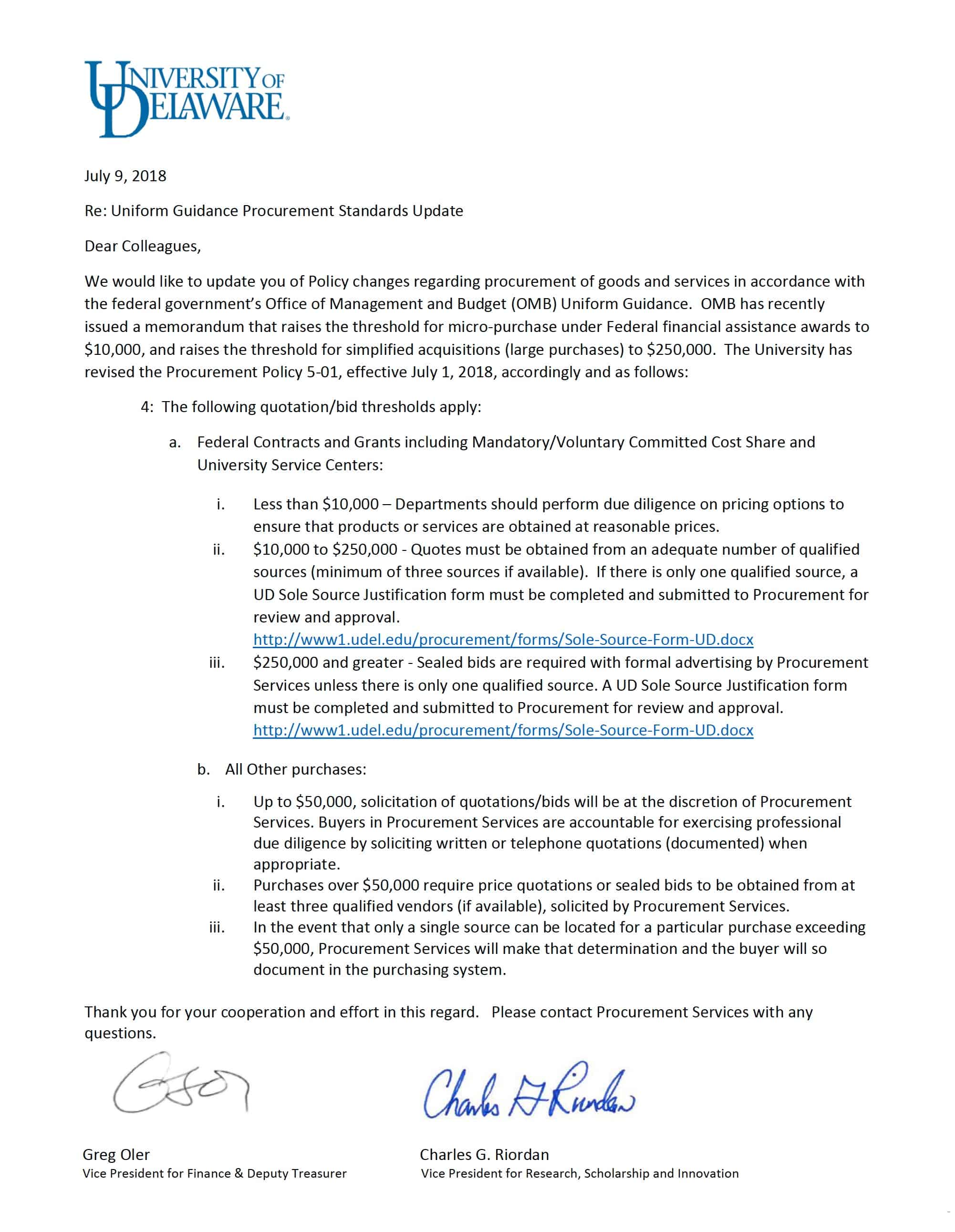
OMB Uniform Guidance Presentation

UD's Implementation
In preparation for the December 26th, 2014 implementation date, we have created working groups based on each of the subparts and the appendices. Each working group has a chair, as well as representation from colleges and central administration (including staff from outside of the research community for some parts). The groups are responsible for determining the impact of the new regulations to existing policy and process, creating new training materials and revising policies where needed, and ensuring broad and effective communication strategies. Work plans and other materials will be posted as they become available.
OMB Uniform Guidance Presentation
- Uniform Guidance Procurement Standards Update (7/9/2018)
- Federal Register - Uniform Administrative Requirements, Cost Principles, and Audit Requirements for Federal Awards
- Uniform Guidance electronic Code of Federal Regulations (e-CFR)
- Uniform Guidance Impact Table (6/16/2015)
- UD: Award Modification Matrix (5/7/2015)
- NSF Webinar: Proposal and Award Policies and Proceedures Guide
(Video - January 27, 2015) (3/17/2015) - Eye on NIH Policy: OMB Uniform Guidance - What it Means for NIH & You
(Video & Interactive Q & A - March 12, 2015) (3/10/2015) - University of Delaware: Closeout and Budget Justification video recording (2/02/2015)
- University of Delaware: Uniform Guidance Justification Guidelines (1/23/2015)
- University of Delaware: Uniform Guidance Justification Template (1/23/2015)
- Faculty Video from Deputy Provost, Research & Scholarship (12/26/2014)
- University of Delaware: Recorded uniform guidance training session (12/09/2014)
- University of Delaware: PDF of uniform guidance presentation slides (12/09/2014)
- University of Delaware: Implementation of new uniform guidance (Revised 11/12/2014)
- University of Delaware: Implementation Timeline (Revised 9/22/2014)
- COGR Guide to the OMB Uniform Administrative Requirements,
Cost Principles, and Audit Requirements for Federal Awards (Revised 9/17/2014)
External Resources
Office of Management and Budget
- The interim joint final rule implementing the Uniform Guidance (UG) is now available in Federal Register (Vol. 79, No. 244, Friday, December 19, 2014).
- OMB Policy Statements: Uniform Grant Guidance
- Uniform Guidance Crosswalk from Existing Guidance to Final Guidance
- Uniform Guidance Crosswalk from Final Guidance to Existing Guidance
- Cost Principles Comparison Chart -- 2 CFR Part 225 (A-87), 2 CFR Part 220 (A-21), 2 CFR Part 230 (A-122), and Final Uniform Guidance
- Audit Requirements Comparison Chart -- OMB Circular A-133 and Proposed Uniform Guidance Subpart F
- Definitions Comparison Chart
- Administrative Requirements Comparison Chart
Other Federal Resources
- COFAR's FAQs on Uniform Guidance 8/29/14
- COFAR's FAQs on Uniform Guidance 2/12/14
- NSF's Draft Proposal & Award Policies and Procedures Guide
Council on Governmental Relations (COGR)
- COGR's response to the NSF implementation in the NSF PAPPG (July 1, 2014)
- Proposed FAQs with answers to OMB (June 26, 2014)
- COGR/COFAR Review: OMB Uniform Administrative Requirements, Cost Principles, and Audit Requirements for Federal Awards (June 23, 2014)
- COGR/FDP White Paper on the Uniform Guidance (June 6, 2014)
- COGR Guide to the Uniform Guidance (April 24, 2014)
- COGR Implementation Plan for a Major Research University (April 24, 2014)
- COGR Preliminary Assessment - OMB Uniform Administrative Requirements (January 14, 2014)
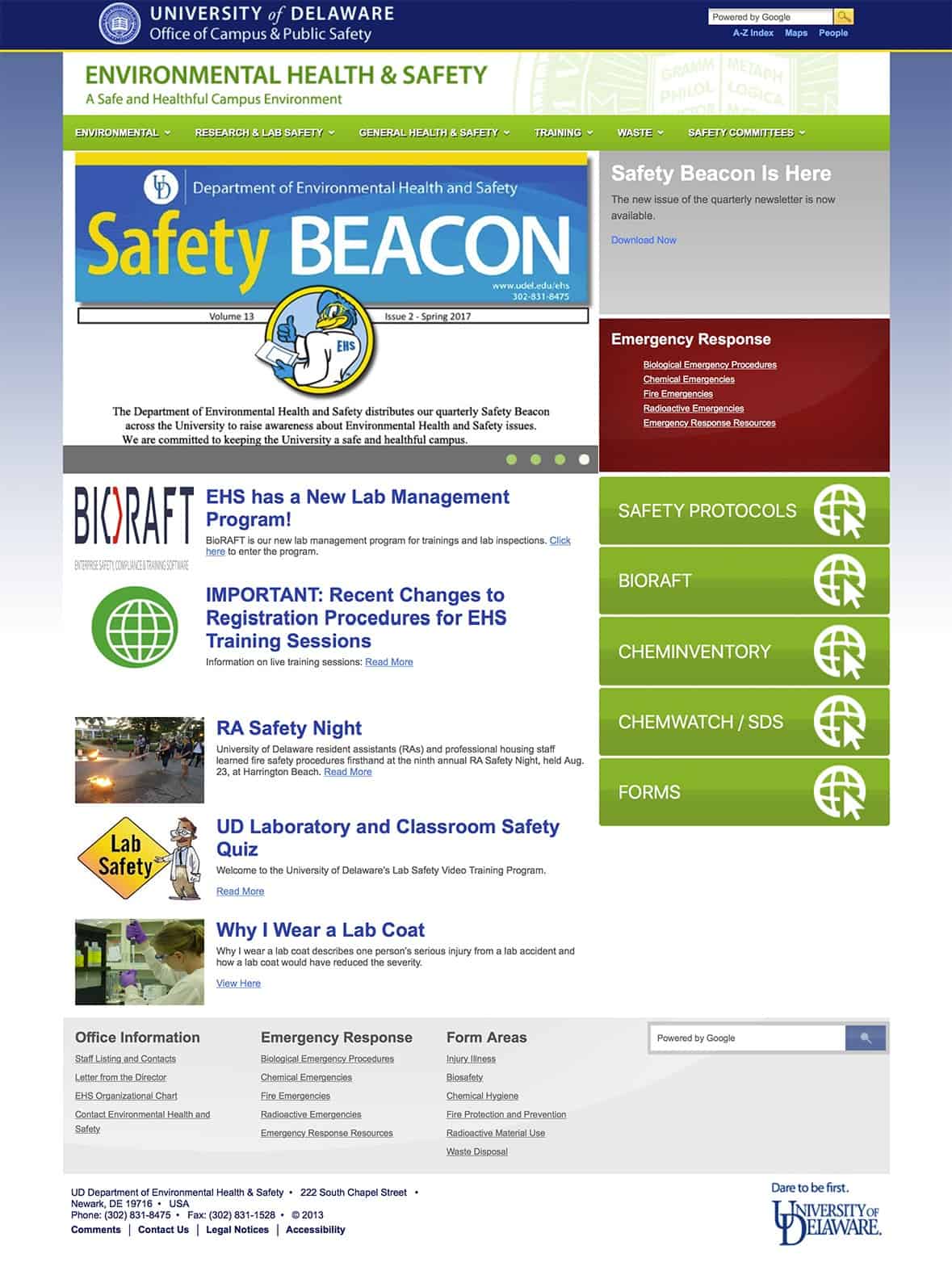
Environmental Health & Safety
Streamlined access to the health and safety programs include compliance with national and local environmental, health and safety regulations, which assure laboratory and occupational workplace safety; Chemical Hygiene and Biological Safety Program compliance, training and waste management; reaction and prevention programs to fire, hazardous materials and other building emergencies; training and compliance to clean air, water and radiological usage; and the safety committee program which includes accident/injury reporting, prevention and building assessments.
The department provides a multitude of laboratory, health and safety training opportunities through EHS Assistant Online Training, monthly scheduled training and special training requests.
Their mission is to serve you and ensure you are provided with healthy and safe living, work, academic and recreational facilities and programs.
Biological Safety
The University’s Biosafety program is established to protect individuals from exposure to biohazards through the application of administrative and engineering controls. The program is managed by the biosafety officer and has oversight by the University Biosafety Committee. The program is described in the various subject areas on the EHS Biological Safety page.
Additionally, any Biosafety issues may be addressed to Krista Murray or by phone at 302-831-1433.

Chemical Hygiene
The University of Delaware is committed to providing a safe working environment for its faculty, staff, students and visitors. The goal of the University’s Chemical Hygiene program is to minimize the risk of injury or illness by ensuring that University personnel have the training, information, support and equipment needed to work safely in the laboratory.
The University Chemical Hygiene Committee facilitates the implementation of the program through the Department of Environmental Health and Safety and develops and maintains the University’s chemical hygiene plan. Further information on the program can be found on the EHS Biological Safety Page.
Any questions or concerns related to the chemical hygiene plan should be addressed to the chemical hygiene officer at dehsafety@udel.edu or call 302-831-8475.

Radiation Safety
The University of Delaware holds a USNRC Type A Broadscope License to use radioactive materials at its campuses in the state of Delaware and in coastal waters, as well as at sea. The day-to-day operations of the program are managed by the radiation safety officer assisted by the radiation safety technician.
Questions regarding radioactive materials may be addressed to William Fendt or call 302-831-1434.

Recombinant DNA
Research involving recombinant DNA is regulated through the National Institutes of Health (NIH) in its Guidelines for Research Involving Recombinant or Synthetic Nucleic Acid Molecules. All work involving recombinant DNA at the University must be approved by the University Biosafety Committee and the biosafety officer. Below is information on the procedures, the necessary forms and the current Guidelines.
Anyone working on a recombinant DNA project that is covered by the NIH Guidelines must complete Recombinant DNA training prior to initiating work and, subsequently, every three years. The training is available online or through EHS. Please see the EHS training schedule for dates.
Specific program elements are available on the EHS page for Recombinant DNA.
Questions concerning Recombinant DNA registration issues may be addressed to Krista Murray or call 302-831-1433.

ASSISTANCE
Compliance Hotline
Phone: (302) 831-2792
E: UD IRB Office
P: (302) 831-2137
F: (302) 831-2828
GOVERNMENT SPONSOR LINKS
- State of Delaware
- US Government
- Dept of Education Grant Opportunities
- Dept of Agriculture
- Dept of Health and Human Services (HRSA) Open Opportunitiess
- Dept of Commerce
- Dept of Housing and Urban Development (HUD) Funding
- Dept of Defense
- Dept of Veterans Affairs (VA) Funding
- Dept of Energy
- Dept of Homeland Security
- Dept of Justice
- Dept of Labor
- Dept of State
- Dept of the Interior
- Dept of Transportation
- Dept of Treasury
- Delaware EPSCoR Funding Opportunities
- Federal Govt Grants (Grants.Gov) Grants
- NASA Solicitation and Proposal Integrated Review and Evaluation System (NSPIRES) Research Opportunities
- National Archives Grant Program
- National Centers for Coastal Ocean Science (NCCOS) Funding Opportunities
- National Endowment for the Humanities (NEH) Grants
- National Endowment of Arts Grants
- National Institute of Health (NIH) Grants and Funding
- National Institute of Standards and Technology (NIST) Funding Opportunities
- National Oceanic and Atmospheric Administration (NOAA) Funding Opportunities
- National Science Foundation (NSF) Funding
- NSF Office of Integrative Activities (OIA) Funding Opportunities