

UD Internal Funding Opportunities
For more information contact
Research Development Office
researchdev@udel.edu
(302) 831-7088
General University Research Grants
February 12, 2024
Full Proposal:
March 11, 2024
UD Research Foundation
December 18, 2023
Full Proposal:
February 1, 2024
UD Research Foundation Strategic Initiatives
Chemours Discovery Research Award

Additional Campus Seed Grants
Additional independently organized seed grant opportunities abound at UD, from pilot programs to call for proposals, these opportunities are waiting to be discovered. Log onto our portal to explore the most recent campus funding opportunities.
FORMS & TRAINING
GRANT RESOURCES
Internal Grant Opportunities FAQs (GUR, UDRF and UDRF-SI)
1. What is the project period?
- GUR Awards are effective from April 1 to March 31 (two-year period)
- UDRF Awards are effective from April 1 to March 31 (two-year period)
- UDRF- SI Awards are effective from February 1 to January 31 (two year period)
2. What is a no-cost extension?
The university expects recipients to complete all requirements of the internal award by the termination date listed in the award letter. The Research Office will provide additional time by approving your request for a "no-cost extension."
3. How do I apply for a no-cost extension?
Submit a request to The Research Development Office via email at researchdev@udel.edu. Please copy your assigned Contract & Grant Specialist and Department Administrator in the email.
4. What information will I need to include in my no-cost request?
Please provide the following information:
- Relevant information that identifies your project: title, purpose (expense code) and the current project termination date
- The extended termination date (month/day/year) you are requesting. Note: the maximum time allowed is one year
- Justification -- reasons you need an extension. See guidelines below for help
5. What justification for no-cost extensions (reasons) is the Research Office likely to accept?
Here are some examples of justifications which would be acceptable:
- Additional time to assure completion of the original approved project scope and objectives, e.g.,
- to conduct additional testing to validate unexpected research findings
- to repeat tests to obtain results lost in a campus building fire
- to conduct the research in a foreign country currently experiencing unrest or a foreign country rebounding from a natural catastrophe (e.g. tsunami, earthquake)
- Lack of success in locating a graduate student with suitable capabilities
- Extensive delay in production or shipment of key equipment or supply items
- Transfer of a key project participant
- Time lost due to illness, pregnancy or accident of a key project participant
6. Under what conditions is the Research Office likely to deny a request?
Here are examples for which an extension request may be denied:
- Requests made merely for the purpose of using remaining funds
- Requests received after the termination date
- Requests that do not include a justification
7. Am I allowed to purchase an item not included in my original proposal?
The university expects recipients to complete all requirements of the internal award and understands that over the life of the project some reallocation of funding may need to occur. Budget changes exceeding 10% prior to 2018 -- or 25% effective 2018 -- of the total award and rebudgeting of funds into categories not in the original budget (e.g., equipment, foreign travel) are subject to prior approval by the RO.
8. How do I request a budget reallocation?
Requests for rebudgeting must be submitted on the Request for Rebudgeting form via email to researchdev@udel.edu. Please copy your assigned Contract & Grant Specialist and Department Administrator in the email.
9. What information will I need to include in my reallocation request?
Please complete the rebudgeting form. This form can be found on the research web site at Form, Policies and Procedures.
10. How do I get my expenses (including salary) paid?
Please see your Department Administrator.
11. Questions about Internal Grant Opportunities?
Please contact The Research Development Office, Research Development Manager, Research Office.
GUR
General University Research Program (GUR)
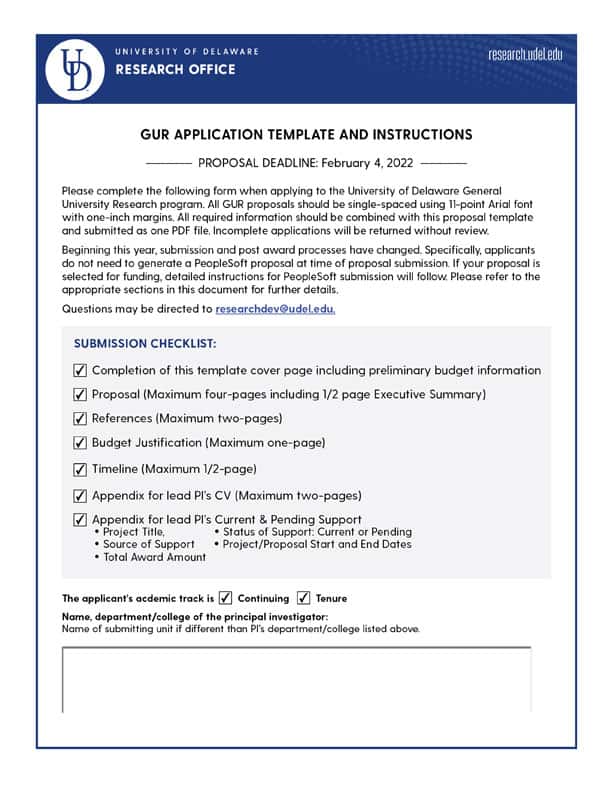
GUR Template
GUR Guidelines
GUR Application Deadlines
LETTER OF INTENT: February 12, 2024
FULL PROPOSAL: March 11, 2024
Please note that submission and award processes have changed. Specifically, applicants do not need to generate a PeopleSoft proposal at the time of proposal submission. If the proposal is selected for funding, detailed instructions for PeopleSoft submission is included in the Appendix.
- Ariel Alperstein
Investigation of Non-small Cell Lung Cancer Erlotinib-Resistance Via Raman Microscopy – ARTS & SCIENCES - Miles Brown
University of Delaware Faculty Jazz Quartet Recording – ARTS & SCIENCES - Siobhan Carroll
The Planetary Estate: Ecological Improvement and Literary Form, 1791-1859 – ARTS & SCIENCES - Zhiyin Renee Dong
Effect of Different Corrective Feedback Strategies on Second Language Mandarin Tone and Vocabulary Learning – ARTS & SCIENCES - Eric Layland
Parent Capacity for Fostering LGBTQ Adolescent Socialization – EDUCATION - Dilia Lopez-Gydosh
Development of “The FTC 1920s Digital Archive – ARTS & SCIENCES - Melissa Melough
Can Dietary Choices Improve Childhood Neurodevelopmental Outcomes via Arsenic Methylation? – HEALTH SCIENCES - Elizabeth Sargent
ANCHORS: Achieving New Course Heights; Opportunities for Research with Students – EARTH, OCEAN & ENVIRONMENT - Kevin Solomon
Programmable control of protein activity via formation of biomolecular condensates in bacteria – ENGINEERING - Rebecca Tollan
Agency and object prominence in linguistic cognition: Investigating sentence processing in Copala-Triqui – ARTS & SCIENCES - Ana Oancea
The Doctor and the Dress – ARTS & SCIENCES
2021-22 GUR RECIPIENTS
2021-22 Recipients
- Zachary Collier Zachary Collier - Addressing Incomplete Data with Artificial Intelligence
- Francisco Costa Francisco Costa - Can market incentives reduce deforestation and promote compliance with environmental law? Evidence from the Brazilian Amazon
- Sambeeta Das (Ryan) Sambeeta Das (Ryan) - Microrobots in Confined Geometries
- Alexei Kananenka Alexei Kananenka - Using Artificial Intelligence to Optimize Light Harvesting
- Maik Kecinski Maik Kecinski - he behavioral impacts of mandates on voluntary contributions to public goods
- Daniel Lee Daniel Lee - Studying the Effects of Moral Violations on Entrepreneurial Decision Making
- Haritha Malladin Haritha Malladi - Design and evaluation of instructional coaching strategies to address social loafing on engineering student teams
- Xi Peng Xi Peng - Adaptive Scientific Machine Learning for Extreme-scale and Ever-evolving Data Analysis
- Kenneth Shores Kenneth Shores - Facilities Disruptions and Disruptions to Student Learning: Empirical Evidence from the School District of Philadelphia
- Evan Usler Evan Usler - Empirical Investigation of A New Theory of Stuttering: The Effects of Motivational Conflict on Speech
- Anamarie Whitaker Anamarie Whitaker - A Mixed Methods Approach to Understanding Perceptions of Early Care and Education Policy Alignment Within State Early Learning Systems
2020-21 GUR RECIPIENTS
2020-21 Recipients
- Jennifer Bouek Jennifer Bouek - The Political Economy of Child Care and the Families Within: A Covid Comparison
- Emerald Christopher Emerald Christopher - The Manifestations of Jane Crow: Gender-Based Violence and Black Women's Experience
- Kyle Davis Kyle Davis - Global mapping of crop climate resilience
- Morgan Ellithorpe Morgan Ellithorpe - Parents' beliefs and intentions toward acceptance of a COVID-19 vaccine for their children
- Ibra Fancher Ibra Fancher - Assessing the dichotomy of vascular function in obesity: Why are some vascular beds impaired while others are spared?
- Lindsay Naylor Jasper Lindsay Naylor Jasper - Inclusive climate adaptation in Delaware
- Zachary Nolan Zachary Nolan - An Empirical Analysis of Complementarities in Advertising Markets
- Xiaotao Ran Xiaotao Ran - The Effect of Online Remedial Course on College Readiness
- Sonia Robles Sonia Robles - Revolutionary Platforms: Public Radio and the Emergence of Modern Mexico
- Kalim Shah Kalim Shah - An E-Waste Materials Flow Analysis for Science-Based Regulatory Reform in the U.S. Virgin Islands
- Lisha Shao Lisha Shao - Investigating the neural mechanisms underlying sexual reward in female Drosophila
- Jiaheng Xie Jiaheng Xie - Understanding Health Misinformation Transmission: An Interpretable Deep Learning Approach to Manage Infodemics
- Janine de Novais Janine de Novais - The Brave Community Workshop
2019-20 GUR RECIPIENTS
2019-20 Recipients
- Ann Aviles Ann Aviles - Housing Status, Health, Well-Being and Violence
- Christina Barbieri Christina Barbieri - Targeting Misconceptions to Improve Core Competencies for Students at Risk for Mathematics Difficulties
- Federica Bianco Federica Bianco - Echoes of light detection with artificial intelligence to characterize the history of explosions in our Galaxy
- Eve Buckley Eve Buckley - Hunger Politics during the Early Cold War: Intellectuals from the Global South Contest the Overpopulation Paradigm, 1948-1973
- Jonathan Cox Jonathan Cox - Arrivals: What's left Behind, What Lies Ahead
- Sarah Curtiss Sarah Curtiss - The Feasibility and Efficacy of Mealtimes on the Spectrum: An Online Toolkit for Making Mealtimes More Meaningful and Functional
- Sarah DeYoung Sarah DeYoung - UD GUR: Infant feeding in emergencies: measuring changes during natural hazards in the United States
- Gregory Dobler Gregory Dobler - Deployment of an Urban Observatory to Monitor Power Distribution and Disruption in Sierra Leone, Africa
- Colton Lynner Colton Lynner - Linking volcanic activity and a large earthquake at the currently erupting Ecuadorian Cotopaxi volcano
- Teomara Rutherford Teomara Rutherford - Assisting Teachers to Support Positive Student Emotions and Motivation While Using Educational Technology
- Brooke Stanley Brooke Stanley - Eating in the Anthropocene: The Global Environmental Novel and the Politics of Food
- Tyler Van Buren Tyler Van Buren - The interaction of Megakaryocytes and Platelets with Turbulence
2018-19 GUR RECIPIENTS
2018-19 Recipients
- Malasree Acharya Malasree Acharya - Mapping the Refugee Net: Border Crossing, Technology and Human Rights in the Mediterranean
- Noel Archambeault Noel Archambeault - The Chicana Art Song Project
- Benjamin Bagozzi Benjamin Bagozzi - When is Access-to-Information an Effective Accountability Mechanism? Using Big Data Tools to Study Responsiveness in Mexico and Beyond
- Sabrin Beg Sabrin Beg - Strengthening Teacher Ability to Reach all Students
- Lauren Covington Lauren Covington - Identifying Multi-level Determinants of Child Sleep Health in Under-resourced Families
- Xiang Gao Shalom Xiang Gao Shalom - Shanghai
- Martha Hall Martha Hall - Development of Novel Orthopedic Boot
- Sean Healy Sean Healy - Adaptation, acceptability and feasibility of an automated smart-scale intervention for weight management among young adults with intellectual and developmental disabilities
- Cresean Hughes Cresean Hughes - GUR Hughes
- Pinki Mondal Pinki Mondal - Analyzing radar satellite data to examine changing rice intensification patterns in the Vietnamese Mekong Delta
- Chiara Sabina Chiara Sabina - A holistic community-based intervention for domestic violence in Quito, Ecuador
- Aaron Terry Aaron Terry - Study of responses to local and global politics, media and propaganda in Post-Cold War visual art, media and design to create and inform studies for exhibition, publication and educational opportunities
- Yi-Lin Tsai Yi-Lin Tsai - The Politics of Offline Consumer Search for Single Family Homes
- Jaipreet Virdi Dhesi Jaipreet Virdi Dhesi - Becoming "Hearing-Minded:" Women Researchers and the Politics of Deafness in Interwar Britain
2017-18 GUR RECIPIENTS
2017-18 Recipients
- Anjana Bhat Comparing fNIRS-based cortical activation during social cooperation between children with and without ASD
- Pascha Bueno-Hansen GUR 18 BUENO-HANSEN
- Abigail Donovan Considerations Relating to the Shape of Equilibrium (Reprise)
- Chad Forbes Enhancing Performance for At-Risk Women in STEM Contexts: Retraining Complex & Persistent Stress Responses with Neural Feedback
- Laura Helton Collecting, Collectivity, and the Making of African American Archives
- Jason Hill Criminal Visibility: Photographic Culture of Crime and Punishment in the United States, 1839-Present
- Paul Jackson Mapping the Lives of Chronic Pain Sufferers and Access to Disability Assistance
- Xiaopeng Ji The Relationship among Sleep, Executive Function and Diabetes Management in Late Adolescents with Type 1 Diabetes
- Peter Mende-Siedlecki Psychological and Perceptual Contributions to Biased and Accurate Pain Care
- Isai Munoz Visca L'Amor! A Reference Audio Recording Documenting the Tenor Voice in Underrepresented Classical Vocal Repertoire by Catalan Composers of the Twentieth and Twenty-First Centuries
- Georgina Ramsay Humanitarian Exploits: Exploring the Livelihood Strategies of Women in Situations of Displacement
- Junbo Son Data Analytics Framework for the Smart Asthma Management System with Bluetooth-enabled Personal Inhalers
2016-17 GUR RECIPIENTS
2016-17 Recipients
- Tara Trammell
Tara Trammell, Agriculture & Natural Resources - Investigating Urbanization Pressures on Soil Carbon, Nitrogen, and Microbial Community Composition Under Different Tree Species - Christopher Nichols
Christopher Nichols, Arts & Sciences - Music: Clarinet Recording - Sheng Lu
Sheng Lu, Arts & SciencesRegional Comprehensive Economic Partnership (RCEP) and Its Impact on the Pattern of Textile and Apparel Production and Trade in the Asia-Pacific Region - Sue McNeil
Sue McNeil, Arts & Sciences - A Stated Preference Survey to Model Patient Behavior During a Biological Outbreak - Julian Yates
Julian Yates, Arts & Sciences - Noah’s Arkive: Adventures in Groundless Reading from the Beginning to the End of Time - Sarah Wasserman Sarah Wasserman, Arts & Sciences - The Death of Things: Ephemera in America
- Martin Brueckner
Martin Brueckner, Arts & Sciences - Literary Things: Material Culture and the Performance of Popular Literature in the Atlantic World, 1700-1900 - Abdol-Razagh Oskooii
Abdol-Razagh Oskooii, Arts & Sciences - How Experiences of Discrimination Impact the Civic and Political Engagement of Muslim-Americans - Mieke Eeckhaut
Mieke Eeckhaut, Arts & Sciences - Contraceptive Sterilization in the US: The Role of Race/Ethnicity - Edward Winn
Edward Winn, Arts & Sciences - Digital Inputs and Outputs to Create Objects that Reflect Their Design in Virtual Space - Ashley Pigford
Ashley Pigford, Arts & Sciences - The Internet of Things (IoT): Internet-Connection of “Smart Devices” Serving the Needs of Users - Lauren Bailes
Lauren Bailes, Education & Human Development - GUR Bailes - Erica Litke
Erica Litke, Education & Human Development - Empowering Teachers to Improve Algebra Instruction - Tia Barnes
Tia Barnes, Education & Human Development - GUR BARNES - Frederick Bereskin
Frederick Bereskin, Lerner College of Business & Economics - The Effect of Cultural Similarity on Mergers and Acquisitions: Evidence From Corporate Social Responsibility - Jing Ma
J ing Ma, Lerner College of Business & Economics - Targeting Norovirus on Cruise Ships and Recommendations for Food Safety Improvement - Gang Wang
Gang Wang, Lerner College of Business & Economics - Impacts of Social Influence on Consumer Consideration Set Formation and Choice
UDRF
University of Delaware Research Foundation (UDRF)
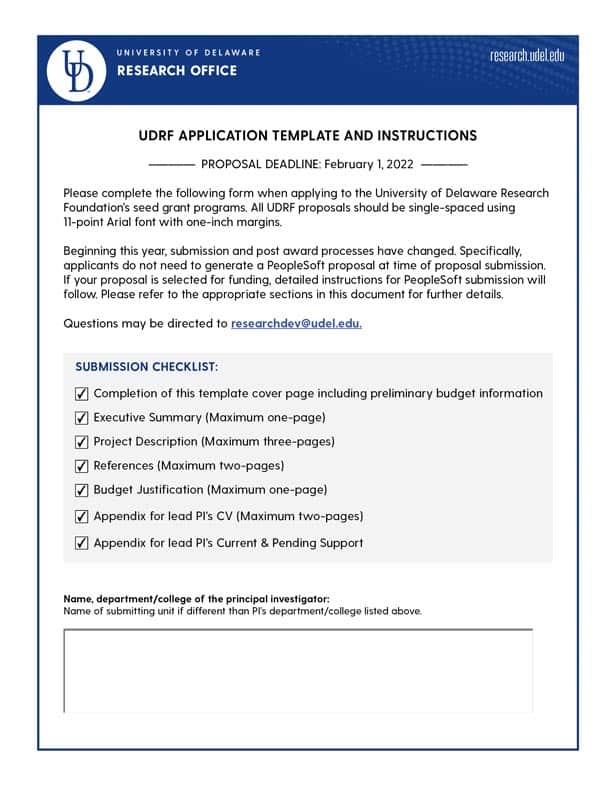
UDRF Template
UDRF Guidelines
The University of Delaware Research Foundation, Inc. (UDRF) is a nonprofit, tax-exempt organization for the support of fundamental research in all fields of science. Although an independent corporation, it is chartered primarily to support the University’s research mission. In 1994, the UDRF Board of Trustees redefined its mission to focus on assisting only early-career permanent faculty who provide grants supporting the highest quality engineering and scientific research.
UDRF Application Deadlines
LETTER OF INTENT: December 18, 2023
FULL PROPOSAL: February 1, 2024
- Aditya Dutta — Investigating the Therapeutic Role of Metformin in Prostate Cancer, AGRICULTURE & NATURAL RESOURCE
- Alon Hafri — The Neural Representation of Visual Relations, ARTS & SCIENCES
- Elise Corbin — Tunable and Dynamic Materials to Exploit and Assess Spatiotemporal Mechanobiology, ENGINEERING
- Emil Hernandez-Pagan — Stimuli Responsive Electroactive Materials for Sustainable Fuel Production, ARTS & SCIENCES
- Justin Parreno — Transgelin Regulates Myofibroblast Contraction During Ocular Lens Posterior Capsular Opacification, ARTS & SCIENCES
- Roderick Carey — Exploring How “Mattering” Matters for Improving Outcomes for Black and Latinx Adolescents in Delaware Schools, EDUCATION & HUMAN DEVELOPMENT
- Stephanie Cone — Structural and Functional Analyses of the Human Iliotibial Band During Locomotion, ENGINEERING
- Vincenzo Ellis — Population Genomics of the Lyme Disease Bacterium Borrelia Burgdorferi and its Reservoir Hosts in the Northeastern United States, AGRICULTURE & NATURAL RESOURCE
2021-22 UDRF RECIPIENTS
2021-22 Recipients
- Austin Brockmeier — Mapping and Decoding the Brain’s Activity During Human-AI Interaction, ENGINEERING
- Christina Barbieri — Supporting Student Attention, Metacognition, and Mathematics Learning with the ByExample Approach, EDUCATION & HUMAN DEVELOPMENT
- Evan Usler — The Role of Motivational Conflict in Developmental Stuttering, HEALTH SCIENCES
- Jaclyn Sions — Identification of Biopsychosocial Factors Associated with Persistent Low Back Pain Among Adults with Lower-Limb Amputation, HEALTH SCIENCES
- Laure Kayser — Synthesis and Properties of Thermo-Responsive Conducting Polymers, ENGINEERING
- Mark Ku — All-Electrical Magnon-Mediated Spin Qubit Gate as a Building Block of Hybrid Quantum System, ARTS & SCIENCES
- Michael Crossley — “ReVAMP” Waste: Recycling and Value-Added Mealworm Processing of Waste, AGRICULTURE & NATURAL RESOURCE
- Roxana Burciu — How Aging Affects the Neural Control of Upper and Lower Extremity Movements, HEALTH SCIENCES
- Vijay Parashar — Targeting Second Messenger Metabolism in Bacteria for Novel Antibacterial Adjuvants, HEALTH SCIENCES
- William Kenkel — Using Open-Source Technology to Track Weigh Gain in an Animal Model of Obesity, ARTS & SCIENCES
- Yihang Li — Identifying the Impacts of Early Life Adversity on Intestinal Amino acid Sensing and Transport Efficiency in a Pig Model, AGRICULTURE & NATURAL RESOURCE
2020-21 UDRF RECIPIENTS
2020-21 Recipients
- Alyssa Koehler — Integrated Approaches to Reduce Yield Loss Due to Root-Knot Nematodes in Lima Bean Production, AGRICULTURE & NATURAL RESOURCE
- Anne Siders — Evaluating Floodplain Bbuyouts: Understanding How Voluntary Property Acquisitions Affect Participants, ARTS & SCIENCES
- Charles Dhong — Quantifying and Controlling Tactile Perception Through Polymer Crystallinity, ENGINEERING
- Chi Keung Lam — Elucidating the Role of Hsp90 Complex in Cardiac Diseases, ARTS & SCIENCES
- Chitraleema Chakraborty — Spin Engineering in 2D Materials for Quantum Information Science, ENGINEERING
- Jeffrey Mugridge — Structure and Function of a tRNA Modifying Enzyme with Links to Neurodegenerative Disease, ARTS & SCIENCES
- Jodi Hadden-Perilla — Implementing the AMBER Force Field for Large-Scale Biomolecular Simulations in NAMD, ARTS & SCIENCES
- Joshua Cashaback — Learning Joint Actions During Cooperative and Competitive Human-Human Interactions, ENGINEERING
- Lisha Shao — Functional Dissection of Neuropeptide F and its Downstream Neural Pathways in Reward-Driven Behaviors, ARTS & SCIENCES
- Nektarios Georgios Tsoutsos — Zilch: A Framework for Remote Verification of Security Properties Using Zero Knowledge Proofs, ENGINEERING
- Shangjia Dong — Integrated Household Vulnerability and Flood Risk Analysis for Equitable Transportation Access to Emergency Medical Services, ARTS & SCIENCES
- Yuping Zeng — High Performance GaN Transistors with HfZrO Ferroelectric Gate Dielectric, ENGINEERING
2019-20 UDRF RECIPIENTS
2019-20 Recipients
- Aditya Kunjapur — Engineering Targeted and Conditional Proteolysis in Aerobic Environments, ENGINEERING
- Aimee Jaramillo-Lambert — Elucidate the Mechanism of tdpt-1 Mutant-Mediated Suppression of top-2(it7) Lethality, ARTS & SCIENCES
- Christopher Martens — The Role of Intracranial Pressure on Global Brain Stiffness and Cognitive Function in Human Aging, HEALTH SCIENCES
- Frances Earle — Investigating the Roles of Sleep and Wakeful Rest in the Consolidation of a New Speech-Motor Pattern, HEALTH SCIENCES
- Jennifer Semrau — Upper Limb Proprioceptive Plasticity and Learning in Sub-Acute Stroke, HEALTH SCIENCES
- Kalim Shah — Application of the OSeMOSYS Energy Modelling Tool in U.S. Island Territories, BIDEN SCHOOL
- Lauren Bailes — Psychometric Aanalyses of the Delaware Performance Appraisal System for Administrators and Selected Evidentiary Artifacts, EDUCATION & HUMAN DEVELOPMENT
- Lena Mashayekhy — Cloudlet Management: Enabling Cooperative Edge Computing, ENGINEERING
- Mona Batish — Functional Characterization of Post-Transcriptional Regulation in Congenital Cataract, HEALTH SCIENCES
- Sarah DeYoung — Infant Feeding in Emergencies: Measuring Changes During Natural Hazards in the United States, ARTS & SCIENCES
- Stephanie Del Tufo — Changes in Neuroarchitecture and Neurochemistry that Result from Reading Intervention, EDUCATION & HUMAN DEVELOPMENT
- Sunita Chandrasekaran — Developing an Accelerated Next Generation Sequence Alignment Tool Using GPUs for Paired-End Reads, ENGINEERING
- Sunita Walter — Determining the Function and Biogeochemical Role of Archaea in Shallow Waters, EARTH OCEAN & ENVIRONMENT
- Teomara Rutherford — Exploring the Impact of Scaffolds on CT Skills within a Robot Obstacle Course Task, EDUCATION & HUMAN DEVELOPMENT
- Xi Wang — Laser-Based Strain Engineering to Tune Electrical, Optical and Magnetic Properties of 2D Materials, ENGINEERING
- Zachary Collier — Data Mining to Evaluate Politics and Policymaking in Education, EDUCATION & HUMAN DEVELOPMENT
2018-19 UDRF RECIPIENTS
2018-19 Recipients
- Aimee Jaramillo-Lambert — Elucidate the Mechanism of TDPT-1Mutant-Mediated Suppression of Top-2(it7) Lethality, ARTS & SCIENCES
- Danielle Durham — Understanding How Habitat Degradation Could be Impacting DE Fisheries Through Larval Supply, EARTH OCEAN & ENVIRONMENT
- Frank Gerhard Schroeder — Radio Detection of Ultra-High-Energy Cosmic Rays at the Pierre Auger Observatory, ARTS & SCIENCES
- Jennifer Semrau — Upper Limb Proprioceptive Plasticity and Learning in Sub-Acute Stroke, HEALTH SCIENCES
- Jovan Tatar — Smart Polymer Sealant for Natural Hazard Resilient Energy-Efficient Buildings, ENGINEERING
- Karl Schmitz — High-throughput Identification of Sequences that Target Proteins for Destruction by Cellular Proteases, ARTS & SCIENCES
- Kathryn Franich — Investigating Cross-Cultural Variation in Speech-Body Coordination and Communicative Timing, ARTS & SCIENCES
- Koffi Pierre Yao — Fast-Charging Electric Vehicles, ENGINEERING
- Pinki Mondal — Big Data Analytics for Quantifying Land Cover Transitions in Coffee Production Systems in Vietnam, EARTH OCEAN & ENVIRONMENT
- Rebecca Pompon — Modification of a Measure of Resilience for People with Aphasia, HEALTH SCIENCES
- Roghayeh Barmaki — Mirrored Augmented Reality for Nurse-Practitioner Workforce Training, ENGINEERING
2017-18 UDRF RECIPIENTS
2017-18 Recipients
- Andrew Wozniak — Probing the Estuary’s Skin: Environmental Controls on the Chemical Composition of Delaware Bay’s Surface Microlayer, EARTH OCEAN & ENVIRONMENT
- Carlos Moffat Varas — Topographic Controls on the Rapid Melting of Marine-Terminating Glaciers in Patagonia, EARTH OCEAN & ENVIRONMENT
- Catherine Fromen — Optimizing Nanoparticle Delivery to Lung Dendritic Cell Subsets for Development of New Pulmonary Therapeutics, ENGINEERING
- Elisa Arch — Evaluating the Influence of Novel Deformable Foot Orthoses on the Energetics of Walking, HEALTH SCIENCES
- Erin Sparks — Bracing for Impact: The Role of Aerial Roots in Maize Stability, AGRICULTURE & NATURAL RESOURCE
- Giovanna Morini — Combining fNIRS and Eye-Tracking Measures to Examine Dynamic Changes in Neuroplasticity and Language Skills in Deaf and Hard-of-Hearing Infants, HEALTH SCIENCES
- Jessica Tanis — Investigating the Impact of Diet on Amyloid-beta Toxicity in C. elegans, ARTS & SCIENCES
- Lena Mashayekhy — Cloudlet Management: Enabling Cooperative Edge Computing, ENGINEERING
- Naomi Samimi-Sadeh — Assessing Stability and Change in Inhibitory Brain Networks Related to Psychopathology and Risky Behavior, ARTS & SCIENCES
- Peter Mende-Siedlecki — Perceptual Determinants and Neural Bases of Racial Bias in Pain Care, ARTS & SCIENCES
- Tingyi Gu — Plasmonic Nanomaterials Enhanced Photoelectrochemical Fuel Cells, ENGINEERING
- Veronique Petit — The Origin and Fate of Magnetic Massive Stars, ARTS & SCIENCES
2016-17 UDRF RECIPIENTS
2016-17 Recipients
- Allison Karpyn — Understanding the Impact of Economic Incentives at Farmers Markets for Low-Income Shoppers, EDUCATION & HUMAN DEVELOPMENT
- Amy Biddle — Using an In Vitro System to Identify Interactions Between Non-Steroidal Anti-Inflammatory Drugs (NSAIDs), AGRICULTURE & NATURAL RESOURCE
- Carly Pacanowski — Self-Weighing’s Psychological Effects: A Randomized Controlled Trial Using Ecological Momentary Assessment, HEALTH SCIENCES
- Emily Day Slater — Nanoshell-Photosensitizer Conjugates for High Precision Therapy of Triple-Negative Breast Cancer, ENGINEERING
- Eric Bloch — Small Molecule Activation with Bimetallic Complexes, ARTS & SCIENCES
- Jeffrey Spielberg — The Interactive Impact of Testosterone and Brain Network Myelination on the Developmental Trajectory of Anxiety, ARTS & SCIENCES
- Jennifer Frances Biddle — Exploring Marine Microbiomes for Potential Drug Development, EARTH OCEAN & ENVIRONMENT
- John Hundley Slater — Validation and Implementation of a Tissue Engineered Microstroke Model to Investigate Capillary Stroke in the Initiation and Propagation of Small-Volume Neuronal Necrosis, ENGINEERING
- Mahya Ghandehari — Study of Spatial Networks VIA Graph Limits, ARTS & SCIENCES
- Md Hossain — Determining the Molecular Origin of Osteoporotic Fracture, ENGINEERING
- Michele Lobo — Development and Testing of Wearable Technology to Promote Early Movement and Cognition, HEALTH SCIENCES
- Rodrigo Vargas Ramos — HAKER-HPC: HArnessing Knowledge for Environmental Research Using High Performance Computing Solutions, AGRICULTURE & NATURAL RESOURCE
- Tara Trammell — Urban Forests Predict Impact of Global Change and Plant Invasion on Future Forest Ecosystem Services, AGRICULTURE & NATURAL RESOURCE
2015-16 UDRF RECIPIENTS
2015-16 Recipients
- UDRF COWPERTHWAIT 2016 – 2018 — Amy Cowperthwait, College of Health Sciences
- UDRF GUILLOT 16-18 — Dominique Guillot, College of Arts & Sciences
- Accelerated magnetic resonance elastography of the brain — Curtis Johnson, College of Engineering
- Identifying The Role Of Chondrogenesis, Driven By Fibroblast Growth Factor 18, In Tendon-to-Bone Attachment Maturation and Healing — Megan Killian, College of Engineering
- Development of a Scalable Method for Identifying Dietary Clusters in the National Health and Nutrition Examination Survey using MapReduce — Mia Papas, College of Health Sciences
- UDRF PARK 16-17 — Junguen Park, College of Arts & Sciences
- UDRF: REINFORCEMENT LEARNING IN SPEECH MOTOR CONTROL — PARRELL — Benajmin Parrell, College of Arts & Sciences
- Sedentary behavior and Cardiovascular Disease: Using Big Data to Quantify the Role of Sedentary Behavior In Predicting Cardiovascular Disease — Freda Patterson, College of Health Sciences
- Understanding Changes in Precipitation Seasonality in the Tropics — Sara Rauscher, College of Earth, Ocean & Environment
- UDRF RIZZOLO 16-18 — Douglas Rizzolo, College of Arts & Sciences
- High-power MRI-compatible haptics to study brainstem correlates of post-stroke spasticity — Fabrizio Sergi, College of Engineering
2014-15 UDRF RECIPIENTS
2014-15 Recipients
- Development Of An Innovative Mass Vaccine Administration Method For Poultry — Hong Li, Agriculture & Natural Resources
- Investigating Neural Control Of Social Communication In Mouse Models Of Autism — Joshua Neunuebel, Arts & Sciences
- Novel Mechanisms Of Pathogen Survival In Human Cells — Maria Neunuebel, Arts & Sciences
- Evaluation Of Change In Viscoelastic Tendon Properties Following An Achilles Tendon Rupture — Karin Gravare-Silbernagel, Health Sciences
- Assessment Of Sepiolite-Palygorskite Group Minerals For CO2 Capture And Storage — Adam Wallace, Earth, Ocean & Environment
- Achieving Fundamental Understanding Of Alkaline Electrochemical Interfaces — Bingjun Xu, Engineering
2013-14 UDRF RECIPIENTS
2013-14 Recipients
- Photothermally Active Spherical Nucleic Acids for Treatment of Triple-Negative Breast Cancer — Emily Day, Engineering
- Design of Embedded Nanostructures with High Phonon Scattering Efficiency — Joseph Feser, Engineering
- Learning To Let Go: Why Women Are More Likely to Leave STEM Domains — Chad Forbes, Arts & Sciences
- Traumatic Stress Exposure Induces Long-Term Extinction Deficits By Enhancing Glucocorticoid Receptor Interactions With Kinases in the Ventral Hippocampus — Dayan Knox, Arts & Sciences
- Couple Wave-Ocean Modeling System for the Delaware Coastal Environment to Assess Storm Hazards — Tobias Kukulka, Earth, Ocean & Environment
- Non-Invasive Brain Stimulation for Physical Rehabilitation After Stroke — Susanne Morton, Health Sciences
- Ionic Liquid Gas Uptake at the Interface: An In Situ Molecular Level Investigation — John Newberg, Arts & Sciences
- Application of Optogenetic Tools to Dissect Osteocyte Behavior and Cell-Cell Communication — Christopher Price, Engineering
- Determining the Underlying Mechanisms of a Sex Difference in Developmental Disorders — Jaclyn Schwarz, Arts & Sciences
- Toward Global Food Security: Understanding the Impacts of Altered Dissolved Silicon on Iron Plaque Formation, Mineralogy, and Arsenic Uptake by Rice —Angela Seyfferth, Agriculture & Natural Resources
- Fabrication of Polymer Embedded uFluidic Derived from In Vivo Vascular Architecture — John Slater, Engineering
- The Neural Basis of Reward Learning — Timothy Vickery, Arts & Sciences
2012-13 UDRF RECIPIENTS
2012-13 Recipients
- Understanding avian host movements for developing a holistic approach to reduce tick-borne diseases in an urban landscape — Jeffrey Buler, Agriculture & Natural Resources
- Hydro-ecological examination of the effectiveness of urban stormwater retrofitting in reducing watershed nutrient export — Lodevicus Claessens, Earth, Ocean & Environment
- The effects of land-use practices on the genetic diversity and temporal stability and health of economically important pollinator species in forest fragments in the Mid-Atlantic region — Deborah Delaney, Agriculture & Natural Resources
- Development of an Ultrafast Time-resolved IR Microscope — Lars Gunclach, Arts & Sciences
- Observing Plastic Garbage Island from Space —Young-Heon Jo, Earth, Ocean & Environment
- Intelligent Nano Composite Material For Bone Tissue Repair and regeneration — Arun Kumar, Health Sciences
- Understanding the Body Schema – The Cognitive Neuroscience of Body Representation — Omar Jared Medina, Arts & Sciences
- Reverse engineering cellular networks from single-cell gene-expression data — Abhyudai Singh, Engineering
- Multifunctional Textile Structures with Integrated Carbon Nanotube Networks — Erik Thostenson , Engineering
- On the immortality of plants: Identifying the role of non-structural carbon reserves on long-lived desert plants—Rodrigo Vargas, Plant & Soil Sciences
- Altered ET-B receptor expression in postmenopausal women — Megan Wenner, Health Sciences
- Functional and biomechanical impairments in patients undergoing total hip arthroplasty: A longitudinal analysis — Joseph Zeni, Health Sciences
2011-12 UDRF RECIPIENTS
2011-12 Recipients
- Simulating kinetic energy dissipation by wind turbines — Cristina Archer, School of Marine Sci & Policy
- Survival in the plankton: neural integration of chemical and visual information in a larval crab — Jonathan Cohen, School of Marine Sci & Policy
- Bacterial Cell Wall Remodeling: A Tool for Studying Mammalian Innate Immune Activation — Catherine Grimes, College of Arts & Sciences
- Role of Non-terrestrial Phosphorus Sources in Eutrophication in the Chesapeake Bay — Deb Jaisi, College of Agriculture & Natural Resources
- Thio-Ether Nucleic Acid (TNA) Arrays for Rapid Detection of Genetic Disease —Christopher Kloxin, College of Engineering
- Multi-mode degradable hydrogels for controlled in situ therapeutic release — April Kloxin, College of Engineering
- TDRD7 function in mammalian eye development and disease — Salil Lachke, College of Arts & Sciences
- Detection of Osteoarthritis at Early Stage — Xin Lu, College of Engineering
- Compressive Super Resolution Imaging — Edward Lyman, College of Arts & Sciences
- Microbially-mediated detection and repair of damaged concrete — Julia Maresca, College of Engineering
- The Path Less Taken: Understanding the Experience of Black Pre-Medical Students — Michalec Barret, College of Arts & Sciences
2010-11 UDRF RECIPIENTS
2010-11 Recipients
- Labeling the party wallflowers: use of laser dissection to interrogate low-activity estuarine microorganisms — Jennifer Biddle, Marine Science & Policy, College of Earth, Ocean & Environment
- Novel Nanoporous Cathode Material for Lithium Ion Batteries— Feng Jiao, Chemical Engineering, College of Engineering
- Creating efficient and modern software tools for plant breeders in developing countries—Jong-Soo Lee, Food & Resource Economics, College of Agriculture & Natural Resources
- Electrocatalytic Reduction of Carbon Dioxide to Chemical Fuels—Joel Rosenthal, Chemistry & Biochemistry, College of Arts & Sciences
- DNA methylation changes associated with early-life experiences—Tanya Roth, Psychology, College of Arts & Sciences
- Quantitative Acoustic Emission Monitoring for Reinforced Concrete Bridges—Thomas Schumacher, Civil & Electrical Engineering, College of Engineering
- Dolphin sound studies in the Xiamen Waters—Aijun Song, Physical Ocean Science & Engineering, College of Earth, Ocean & Environment
- Proteomic approach in identifying conserved microRNA gene targets—Jia Song, Biological Sciences, College of Arts and Sciences
- Energy balance in infants with ‘rapid’ versus ‘normal’ weight gain —Jillian Trabulsi, Behavioral Health & Nutrition, College of Health Sciences
- Efficient Energy and Thermal Management through Application- and Architecture-Specific Optimizations—Chengmo Yang, Electrical & Computer Engineering, College of Engineering
- Tracing Land-derived Nitrogen into Inland Bays Macroalgae: A Stable Isotopic Assessment—Joanna York, Marine Science & Policy, College of Earth, Ocean & Environment
UDRF-SI
University of Delaware Research Foundation Strategic Initiatives (UDRF-SI)
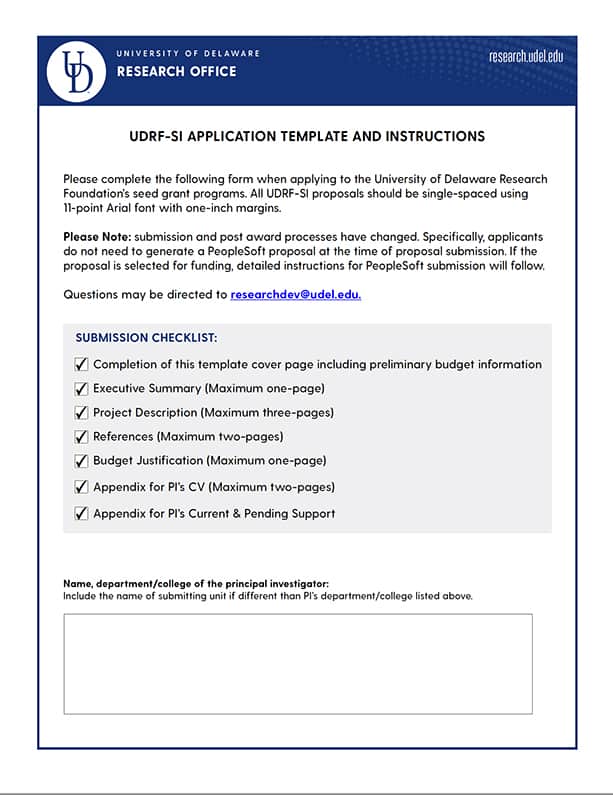
UDRF-SI Template
UDRF-SI Download
The University of Delaware Research Foundation, Inc. (UDRF) is a nonprofit, tax-exempt organization supporting fundamental research in all fields of science. Although an independent corporation, it is chartered primarily to support the University’s research mission. In 1994, the UDRF Board of Trustees redefined its mission to focus on providing research grants to early-career permanent faculty within science and engineering disciplines.
Established in 2008, the University of Delaware Research Foundation Strategic Initiatives (UDRF-SI) program supports innovative, high-impact scientific research proposals that are likely to elevate the research prominence and the competitiveness of UD’s faculty researchers.
UDRF-SI Application Deadlines
LETTER OF INTENT DEADLINE: October 9, 2023
FULL PROPOSAL DEADLINE: October 31, 2023
Please note that submission and award processes have changed. Specifically, applicants do not need to generate a PeopleSoft proposal at the time of proposal submission. If the proposal is selected for funding, detailed instructions for PeopleSoft submission is included in the Appendix.
- Jiaheng Xie — Care for the Mind Amid Chronic Diseases: An Interpretable AI Approach Using IoT, LERNER COLG OF BUS & ECON
- Laure V Kayser — Integrated Experimental-Simulation Design, Synthesis and Characterization of Synthetic Aggrecan Mimics, ENGINEERING
- Mark Ku — Diamond Micro-Structures as a Building Block of Quantum Technology, ARTS & SCIENCES
- Tingyi Gu — Lab-on-chip single particle capturing and nonlinear spectroscopy, ENGINEERING
2021-22 UDRF-SI RECIPIENTS
2021-22 Recipients
- Adriana Gorea — Exploratory Development of a Compressive Stocking Design to Minimize Occurrence of Deep Venous Thrombosis (DVT) in Patients Recovering from Achilles Tendon Rupture, ARTS & SCIENCES
- Lena Mashayekhy — Edge-Enabled Solutions for Assisting Patients Suffering from Dementia, ENGINEERING
- Qingwu Meng — Let There Be Light: The Role of Light Quality and Intensity in Disease Resistance of Hydroponic Crops, AGRICULTURE & NATURAL RESOURCE
- Vu Dinh — Information Theoretical and Geometric Measures of Phylogenetic Diversity, ARTS & SCIENCES
- Xi Wang — Novel Neuromorphic Photonic Integrated Circuits using Phase-Transition Materials, ENGINEERING
2020-21 UDRF-SI RECIPIENTS
2020-21 Recipients
- Aditya Dutta — Investigating Tumor Evolution and Drug Response in Organoid Models of Prostate Cancer, AGRICULTURE & NATURAL RESOURCE
- Justin Parreno — The Role of the Actin Cytoskeleton in Regulating Degeneration During Tendon Overuse, ARTS & SCIENCES
- Melissa Witman — Subclinical Cardiovascular Disease in Early Middle-Age Adults: Determining a Role of Chrono-Behaviors, HEALTH SCIENCES
2019-20 UDRF-SI RECIPIENTS
2019-20 Recipients
Awards were delayed until to 2021 due to pandemic.
2018-19 UDRF-SI RECIPIENTS
2018-19 Recipients
- Austin Brockmeier — Advancing Machine Learning for Neuroimaging Through Topology-aware Signal Processing, ENGINEERING
- Erin Sparks — Dynamic Plant monitoring to Inform Structural Design Models, AGRICULTURE & NATURAL RESOURCE
- Stephanie Del Tufo — Changes in Neuroarchitecture and Neurochemistry that Result from Reading Intervention, EDUCATION & HUMAN DEVELOPMENT
2017-18 UDRF-SI RECIPIENTS
2017-18 Recipients
- Aaron Carlisle — Development of a New Biologging Tag to Record In-situ Oxygen Use of Fish in the Wild, EARTH OCEAN & ENVIRONMENT
- Eric Bloch — Electrochemical Synthesis of Metal-Organic Frameworks, ARTS & SCIENCES
- Matthias Jungfleisch — Developing New Quantum Materials and Nanoscale Devices for Ultrafast Spintronics Generation of THz Radiation, ARTS & SCIENCES
- Megan Killian — Improving Tendon Healing Using Designer Biomaterials, ENGINEERING
- Mona Batish — Functional Characterization of Post-Transcriptional Regulation in Congenital Cataract, HEALTH SCIENCES
2016-17 UDRF-SI RECIPIENTS
2016-17 Recipients
- Bingjun Xu — A Low-Temperature Thermochemical Cycle for Water and CO2 Splitting, ENGINEERING
- Dominique Guillot — Efficient Design of Uniqueness Sets for Band-Limited Signals on Networks, ARTS & SCIENCES
- Jason Gleghorn — Development Inspired Design: Directed Self-Assembly of Vascular Tissues, ENGINEERING
- Joseph Feser — Thermal Transport in 2D Hybrid Perovskites, ENGINEERING
- Zhenghan Qi — Investigating Statistical Learning in Children with ASD Across Linguistic and Non-Linguistic Domains, ARTS & SCIENCES
2015-16 UDRF-SI RECIPIENTS
2015-16 Recipients
- Nanoshell-photosensitizer conjugates for high precision therapy of triple-negative breast cancer — Emily Slater
- Exploring marine microbiomes for potential drug development — Jennifer Biddle
- Validation and Implementation of a Tissue Engineered Microstroke Model to Investigate Capillary Stroke in the Initiation and Propagation of Small-Volume Neuronal Necrosis — John Slater
- Harnessing Knowledge for Environmental Research using High Performance Computing solutions — Rodrigo Vargas
2014-15 UDRF-SI RECIPIENTS
2014-15 Recipients
- Building Trustworthy Cyber Physical Systems with Untrusted Devices — Chengmo Yang, Engineering
- Investigation of Small Maf Proteins in Age-Related Cataracts — Salil Lachke, Arts and Sciences
- Probing Catalytic Surfaces under Operating Conditions — John Newberg, Arts & Sciences
- Seeing Inside Soil-Biochar Mixtures: Pore-Level Imaging with X-ray Microtomography — Kalehiwot Manahiloh, Engineering
2013-14 UDRF-SI RECIPIENTS
2013-14 Recipients
- NMR As A Tool To Investigate The Molecular Mechanism Of Ligand Recognition By The Innate Immune Receptor Nod2 — Catherine Grimes, Chemistry & Biochemistry
- Multifunctional Collagen-Mimetic Materials To Enhance Bone Repair After Fracture — April Kloxin, Chemical & Biomolecular Engineering
- Targeted Drug Delivery Via CNA Aptamer Hydrogels — Christopher Kloxin, Material Science
2012-13 UDRF-SI RECIPIENTS
2012-13 Recipients
- Smartphone-Improving Design Strategies For Biomimetic Self–lubricating cartilage repair and replacement materials — David Burris, Mechanical Engineering
- Rational Design of Functional Catalysts Using Computational Tools — Feng Jiao, Chemical & Biomolecular Engineering
- Targeting Nuclear Receptors with Synthetic Diarrylalkane Derivatives — Mary Watson, Chemistry & Biochemistry
2011-12 UDRF-SI RECIPIENTS
2011-12 Recipients
- Smartphone-based Treatment Enhancement for Clinical Depression — Hui Fang, Electrical and Computer Engineering
- Next Generation Intermolecular Potentials for Virtual Drug Discovery: Application to Lead Development for Parkinson’s Disease — Edward Lyman, Physics & Astronomy
- Role of Matrix Metalloproteinase 9 in the Spatial Redistribution of Bone Marrow Blood Vessels during Parathyroid Hormone-Induced Bone Remodeling — Rhonda Prisby, Kinesiology & Applied Physiology
- Is Soy Food good for the Prevention of Prostate Cancer? — Changqin Wu, Animal & Food Sciences
- Acoustic Communication for Monitoring the Arctic Interior —Aijun Song, School of Marine Science & Policy
2010-11 UDRF-SI RECIPIENTS
2010-11 Recipients
- Nickel–Cyclam Derivatized Electrode Surfaces for Catalytic CO2 Reduction — Joel Rosenthal, Chemistry & Biochemistry
- Measuring Power Usage from a Software Engineer’s Perspective — James Clause/Kristina Winbladh , Computer & Info Sciences/Electrical and Computer Engineering
- Biogenic elemental sulfur: integrating nanoscale imaging and molecular — Clara Chan, Geological Sciences
- Development and testing of a remote electronic sensor enabled insole for evaluation of gait and mobility in people with Parkinson’s disease — Ingrid Pretzer-Aboff, Nursing
- Time-Resolved Optical Detection of Spin Waves: Towards an Energy-Efficient Alternative to Conventional Electronics —Virginia Lorenz, Physics & Astronomy
- Energy Harvesting Using Thermoelectrics in Time-Varying Environments — Joshua Zide, Materials Science
2010 UDRF-SI RECIPIENTS
2010 Recipients
- The Effectiveness of Hip-Focused Treatment for Older Adults with Chronic Low Back Pain — Gregory Hicks, Physical Therapy
- Neurobiological Factors and Motor Learning Following Stroke — Darcy Reisman, Physical Therapy
- An Early Warning System for Unrecognized Drug Side Effects Discovery — Hui Fang, Electrical and Computer Engineering
- Determinants of Tau Protein Aggregation, a Key Player in Alzheimer’s Disease — David Colby, Chemical Engineering
- Nanoparticle Stabilizaion of Co-continuous Polymer Blends for Organic Photovoltaics — Thomas Epps, Chemical Engineering
- Advanced Nanocomposite Materials for Hydrogen Generation with a High Efficiency — Jonghwan Suhr, Mechanical Engineering
- DNA-modified collagen scaffolds for improving acute wound repair —Millicent Sullivan, Chemical Engineering
- Photo-patterning chalcogenide glasses for nanophotonic light trapping and extraction in photovoltaics and solid state lighting — Juejun Hu, Materials Science and Engineering
- Hybrid, Multiblock Polymers by Condensation Polymerization Employing Tetrazine Ligation — Xinqiao Jia, Materials Science and Engineering
Chemours
Chemours Discovery Research Award
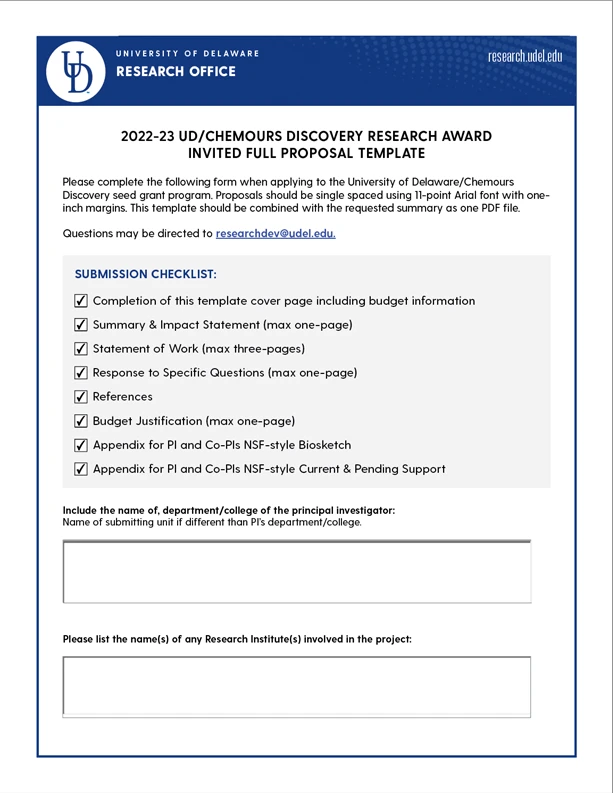
Template
Guidelines
Titanium Technologies
Titanium Technologies
Sustainable Solutions
Recycling of TiO2-containing materials Chemours Titanium Technologies (TT) is interested in supporting research that would fundamentally advance the ability to recycle polymer composites and complex paint matrices containing titanium dioxide in a practical manner. Topics include advances in strategies related to the detection of different composite compositions for advanced sorting technologies, advances in particle and chemical separation science as well as particle reclamation technologies. Research that integrates science and policy to move towards the preferred use of socially-responsible, recycle-friendly composites and paint technologies is also of interest.
Thermal Reflectivity TiO2 is an excellent scatterer of both visible and Infrared (IR) radiation and so has an opportunity to decrease the energy load of cooling buildings in summer months. In certain situations, consumers prefer dark colors, rather than the lighter colors traditionally used for cool buildings. Here visible reflectivity is not desired while high IR reflectivity is. Chemours TT interests in this area are (a) how to modify TiO2 to increase IR reflectance while decreasing visible reflectance and (b) how to quantify, in the field, the cooling effect of such a pigment. Chemours is seeking interest in both material and test development in this area.
Advanced Remediation Technologies Chemours TT is interested in supporting research efforts that could lead to breakthroughs in remediation technologies for difficult-to-destroy compounds. New technologies for the destruction of persistent organic pollutants (e.g., PCBs) that are potentially scalable and offer practical advantages over existing methods (e.g., energy savings, sustainability, and pragmatic considerations) are desired.
Chloride-to-Chlorine Recycling As part of the chloride process for making TiO2 from ilmenite ores, large quantities of chlorine gas are transported and consumed. A significant portion of chlorine is sequestered as ferrous chloride. Regenerating chlorine gas from a ferrous / ferric chloride source using scalable process(es) represents a sustainable solution having potential economic, safety, and energy-saving benefits.
Advance Materials
Advanced Materials
Catalysts Chemours TT is interested in research that advances the basic science related to the identification and selection of titanium oxide materials for catalyst applications. This also includes applications where titanium oxide is used as a support for atomically precise catalyst applications.
Energy Chemours TT is interested in advancing the basic science related to the use of titanium oxides, doped titanium oxides, reduced titanium oxides, or byproducts of the TiO2 manufacturing process in clean energy and energy storage applications. Applications include but are not limited to solar hydrogen conversion, lithium ion batteries and thermal storage technologies. More specifically, manufacturing schemes with high yields of titanium sub-oxides are of high interest.
Electronic Materials Chemours TT is interested in basic science supporting emerging applications of titanium oxides for next generation solid state electronics. Materials of interest include titanium oxides, doped titanium oxides, titanium oxide composites, and structured titanium oxide materials for a range of applications, including field modulation, spintronics, optoelectronics, processing/fabrication aids.
Data Science
Data Science
Advances in Data Mining-aided Solid-state Materials Discovery and Optimization Chemours TT is interested in the further development of techniques, tools, and approaches that facilitate data mining-aided materials discovery for applications in the catalyst, energy storage and/or electronic materials areas. Methods and strategies that enable efficient learning from a limited number of training sets for quantitive structure property relationship models are desired.
Innovative uses of data science to support the TT business Chemours TT is interested in exploring the use of data science techniques proven in other areas for potential applications in areas of interest for the Titanium Technology business.
Advanced Analytical Measurements
Advanced Analytical Measurements
Surface Heterogeneity in Particle Systems Rapid characterization techniques for identifying and quantifying surface chemistry and surface structure distributions for sub-micrometer particles at is an unmet need in industry. Chemours TT is interested in efforts that push the limits and state-of-the-art in surface characterization.
Techniques for characterizing large-scale particle assemblies New techniques for characterizing particle assemblies that provide meaningful and quantifiable morphological insights for structures comprising hundreds to millions of particles are desired. Many of Chemours TT processes and products rely on the development of long-range structure; however, few characterization methods are available to efficiently characterize these systems at the length-scales required while maintaining the necessary resolution (often in the nanoscale). Chemours is interested in supporting the development of new tools that have the potential to characterize particle agglomerate structures in dense slurries/pastes/wet cakes and/or in powders. These tools may characterize the particles themselves or the states of continuum between the particles (e.g., fluid structure, pore tortuosity).
Novel Synthesis Routes New and innovative synthesis routes for the scalable production of titanium oxide materials or titanium metal are of constant interest to Chemours TT.
Thermal and Specialized Solutions
Thermal Management for EV
Thermal Management for EV
The wide adoption of electric vehicles will be largely linked to their capability of providing a driving range comparable to internal combustion engines. Thermal management of the cabin, the batteries and the power electronics is key in increasing the driving range of the electric vehicles.
Being able to test the complete thermal systems of electric vehicles is a skill that Chemours TSS would want to develop with the right laboratories and academic partners. This allows understanding the impact of each pf the elements in this thermal system on the driving range and the energy efficiency of the car.
Catalyst Catalysis remains a key interest in both basic and applied science. The performance of catalyst in a chemical reaction is often impacted by the process conditions, the formation of by-products, or the presence of trace impurities. There are several areas of interests for novel catalyst development: hydrogenation catalysts that resist sulfur and/or sulfur containing species; catalyst supports that endure conditions like high temperature oxidation, high temperature reduction, hydrogen chloride, and hydrogen fluoride; chromium-free catalysts for halogen-exchange reactions.
Thermal Management for Residential Heat Pump Residential heat pump has attracted much more attention due to its higher efficiency in heat management than traditional HVAC. Several technical refrigerants are being investigated as a working fluid for these heat pumps: HFO blends are known to provide an optimal balance between the required properties for this application, but recently some hydrocarbons (HC) were proposed for this application. Being able to test systems operating with HFO blends and HC side-by-side is important to understand the advantages and the drawbacks of each solution as well as providing improvement suggestions to always increase the energy efficiency of these systems.
- Joel Rosenthal
Development of Electrolytic Chlorine Gas Evolution and Iron Electroplating from Iron Chlorides Waste Stream Resulting from Ilmenite-Chloride Process — Chemistry & Biochemistry
- Eric D. Bloch
Development of Porous Cages for CO2 Capture and Its Electrocatalytic Conversion to Value Added Products - David L. Burris
Isolating the Effects of Fibrillation on the Transfer, Friction, and Adhesion of Polytetrafluoroethylene
- Raul F. Lobo
Synthesis of Glycolic Acid using Nafion-based Solid-Acids - Eric D. Bloch
Sustainable Preparation of Advanced Titanium Materials Using Electrochemically-Active Templates
- Thomas H. Epps, III
Precision polymers for vanadium-based flow battery membranes: Towards less expensive, more sustainable alternatives to Nafion - Klaus Theopold
Catalysis for a Coordination Polymerization of Fluoroolefins
Chemours Discovery Application Deadlines
PRE-PROPOSAL: March 15, 2023
INVITED FULL PROPOSAL: April 26, 2023
Eligibility: Applicants must be eligible to serve as a principal investigator on a UD-sponsored agreement.
Project Budget: Chemours Discovery proposals may request up to $100,000.
Proposal Duration Chemours Discovery grants are awarded for one year with the period of performance commencing June 1.
No-cost extensions may be considered by Chemours when circumstances warrant. Instructions are included the Post-Award section of these Guidelines.
Pre-Proposal Components Provide a maximum 1,000 word-summary in the application text field of the online application with the following subsections: abstract, scope of work, and discussion of estimated budget. The scope of work should have sufficient detail for reviewers to determine the novelty and feasibility of the research and its relationship to the identified Chemours topic area.
Invited Full Proposal Components and Formatting Submit Chemours Discovery proposals using the Chemours Discovery Proposal Template. All components should be single-spaced, using 11-pt Arial font with one-inch margins. Additional information such as References, Budget and Budget Justification, PI and co-PI NSF-style Biosketches, and PI and co-PI NSF style Current and Pending Support documents should be combined with the proposal template and submitted as one PDF document. Incomplete applications will be returned without review.
Proposal Summary and Impact Statement (1 page)
• Describe the proposed research with minimal jargon and explain how the research outputs would advance the field, and impact Chemours and/or the scientific community at large.
• How will this research help the PIs to secure additional funding (whether with Chemours or externally) beyond the 1-year scope of the Discovery research project?
• How will the proposed research leverage and augment existing resources and knowledge? Highlight any unique capabilities.
• Describe planned interactions with Chemours during the 1-year term and beyond.
Statement of Work (3 pages)
• Provide a brief gap analysis of the field and clearly identify the problem(s) to be solved with the proposed research.
• Describe how the proposed effort explores an innovative and potentially transformational area of science and technology.
• Outline the research plan with key decision points, milestones, and deliverables. Provide milestones and deliverables in a Gant chart.
• Provide alternative solution strategies as applicable.
• Describe benchmark and reference materials to be used in the study as appropriate.
Response to Specific Questions (~ 1 Page)
• Address the questions raised from the pre-proposal evaluation, if any. This may simply highlight the areas in the full proposal where these questions have been addressed or proved a separate answer.
Procedures for Submitting Proposals:
- Pre-proposal summaries must be submitted by the deadline noted above using the online application. Pre-proposals include the full name(s), department, and email addresses of each PI; a working title; the Chemours business unit, topic, and subtopic of the proposal; and the summary of the proposed work.
- Pre-proposals will be reviewed by Chemours’ business unit leads.
- Select applicants will be invited to submit full proposals by the deadline noted above using round two of the online application. Full proposals need to be entered into PeopleSoft by the PI’s department administrator for tracking and approval purposes.
Patents and Licensing:
In the event that the University considers inventions to warrant patent protection, the University may procure and maintain at its own expense patents in the U.S. and foreign countries on inventions made solely by University personnel or jointly with Chemours personnel, which arise from research carried out under this Agreement. University will own the patents relating to any such invention for which it procures patent protection. For jointly-made inventions, Chemours and Chemours personnel will assign all rights to such invention to the University. The university will provide copies of all patent applications to Chemours promptly after filing.
If the University does not procure patents for inventions made solely by University personnel or jointly with Chemours personnel, which arise from research carried out under this Agreement, Chemours may procure and maintain patents at its own expense in the U.S. and foreign countries for such inventions and Chemours will own such patents, i.e., either The Chemours Company FC, LLC or The Chemours Company TT, LLC as determined by Chemours. Chemours grants to the University a nonexclusive, noncommercial, nontransferable, royalty-free license for teaching and research efforts under patents obtained by Chemours under this agreement.
In the event that the University does not procure patents for inventions made solely by University personnel or jointly with Chemours personnel, which arise from research carried out under this Agreement, Chemours may procure and maintain patents at its own expense in the U.S. and foreign countries for such inventions and Chemours will own such patents, i.e., either The Chemours Company FC, LLC or The Chemours Company TT, LLC as determined by Chemours. Chemours grants to the University a nonexclusive, noncommercial, nontransferable, royalty-free license for teaching and research efforts under patents obtained by Chemours under this agreement.
Post Award:Award Selection: Chemours Discovery grants are awarded based on eligibility and merit and administered by the UD Research Office. Evaluations of merit and award selections are made solely by Chemours.
Post Award Administration: Upon notice of award, the UD PI and Chemours business lead will work together to create a Task Order. Awarded proposals will be assigned an award number and purpose code for expenditures once the assigned UD contract and grants (C&G) specialist has received the signed Notice of Award and Task Order. All proposals funded at a level different than proposed, must provide a revised budget before the purpose code is established.
Rebudgeting, Cost Extensions and No-Cost Extensions: Requests for rebudgeting, cost extensions, and no-cost extensions should be directed to the assigned UD C&G and include the award number and purpose code(s). Requests will be sent by the C&G to Chemours.
For questions/information about this opportunity, contact
University of Delaware
Ciara M. O’Connell
Chemours Points of Contact
Mitch Chinn — Titanium Technologies
Ben Gould — Advanced Performance Materials
Samer Saab — Thermal and Specialized Solutions
DOE
University of Delaware – Argonne National Laboratory Seed Grant 2020
The University of Delaware (UD) and the U.S. Department of Energy’s Argonne National Laboratory (ANL) invited researchers from both institutions to attend a daylong workshop on Tuesday, November 21, 2019. Participants had an opportunity to give a lightening talk and brainstorm about research directions in the breakout sessions. Keynote talks and Lightening Talk slides can be found at the UD/ANL Workshop’s website. The workshop focus was on five areas of significant research synergy between the two institutions:
Upcycling of polystyrene waste to organic electronics for energy storage
- Quantum Science
- 3D Manufacturing/ Materials
- AI/ Data Science
- Polymer Lifecycle
- Interface Science
- Benjamin Jungfleisch (UD) and
Valentine Novosad (ANL)
Magnonics at the Quantum Level - Laure Kayser (UD) and
David Kaphan (ANL)
Upcycling of Polystyrene Waste to Organic Electronics for Energy Storage
University of Delaware – Brookhaven National Laboratory Seed Grant 2019
The University of Delaware (UD) and the U.S. Department of Energy’s Brookhaven National Laboratory (BNL) supported a research effort to promote scientific excellence achieved through collaborations benefitting students, staff, their science and generate preliminary results leading to externally sponsored funding.
- Stephanie Law (UD) and
Peter Johnson (BNL)
Growth and Characterization of Quantized Antimony-Based Topological Insulators - Angelia Seyfferth (UD) and
Ryan Tappero (BNL)
The Rice of the Future: How Growing Practices Can Decrease Human Exposure to Toxins
RESEARCH DEVELOPMENT
K. Eric Wommack, PhD
Senior Associate Vice President for Research
Jennifer Doran
Administrative Assistant
Ph: (302) 831-6703
David Barczak
Communications Manager
Ph: (302) 831-8169
John McMillan
Computing Support Specialist
Ph: (302) 831-8621
Ciara O’Connell
Research Development Manager
Ph: (302) 831-7088
Jennifer Roth
Research Education Coordinator
Ph: (302) 831-3777
Research Development
Ph: (302) 831-7088
GOVERNMENT SPONSOR LINKS
- State of Delaware
- US Government
- Dept of Education Grant Opportunities
- Dept of Agriculture
- Dept of Health and Human Services (HRSA) Open Opportunitiess
- Dept of Commerce
- Dept of Housing and Urban Development (HUD) Funding
- Dept of Defense
- Dept of Veterans Affairs (VA) Funding
- Dept of Energy
- Dept of Homeland Security
- Dept of Justice
- Dept of Labor
- Dept of State
- Dept of the Interior
- Dept of Transportation
- Dept of Treasury
- Delaware EPSCoR Funding Opportunities
- Federal Govt Grants (Grants.Gov)
- NASA Solicitation and Proposal Integrated Review and Evaluation System (NSPIRES) Research Opportunities
- National Archives Grant Program
- National Centers for Coastal Ocean Science (NCCOS) Funding Opportunities
- National Endowment for the Humanities (NEH) Grants
- National Endowment of Arts Grants
- National Institute of Health (NIH) Grants and Funding
- National Institute of Standards and Technology (NIST) Funding Opportunities
- National Oceanic and Atmospheric Administration (NOAA) Funding Opportunities
- National Science Foundation (NSF) Funding
- NSF Office of Integrative Activities (OIA) Funding Opportunities