
|
|
|
|
|
|
|
|
||||
|
|
|
Discrimination’s effects on Katrina victims
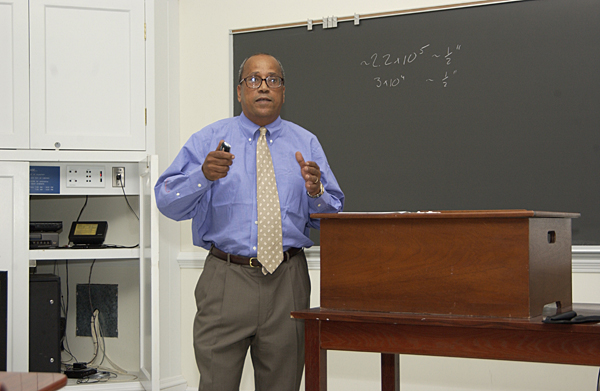
Addressing approximately 50 UD students and faculty members in the first lecture of the 2005-06 Black American Studies Program series, Ware discussed “The Geography of Discrimination: Race, Class and Hurricane Katrina.” He used newspaper articles, historic court cases and national statistics to show how federal mandates, mortgage lending practices and social attitudes all have played roles in preventing black Americans from enjoying the same economic advantages and housing opportunities enjoyed by whites in the United States. “The residents of New Orleans who were unable to evacuate the city during Hurricane Katrina were mostly African Americans,” Ware said, “and so were the majority of the people stranded on rooftops and throughout the city and living for days in the Astrodome. This is typical of what we see when there are disasters in Africa, but it was amazing to many of us to see it in America, one of the wealthiest nations in the world. “And yet, it wasn’t so amazing,” Ware said, “when you consider some facts about racial segregation in America. Since the 1890s, African Americans have been excluded from the federal government’s largest wealth-producing process of owning single-family homes, and housing discrimination practices still exist.” Touching on such practices as establishing racially restrictive covenants and redlining (the U.S. government’s policy of excluding certain neighborhoods from fair lending practices), Ware described how officially sanctioned discrimination practices against blacks have contributed to subpar neighborhoods, such as those in New Orleans that saw the most damage from Hurricane Katrina. Ware also displayed a map from The New York Times and recent statistics from the Dissimilarity Index, which social scientists use to measure discriminatory housing practices and to show racial and income-related clustering. “It’s no accident that certain neighborhoods in New Orleans suffered the most from the flooding,” Ware said. Emphasizing the social, as well as financial, toll such unjust treatment takes on a targeted population, Ware also discussed racial trends such as “white flight” to the suburbs and made the point that certain attitudes and behaviors are normal consequences of both covert and overt segregation. “Isolation encourages oppositional behavior,” Ware said, “and African Americans are more segregated than any other ethnic group in the nation. “I don’t mean to suggest that blacks need to live next door to whites to succeed,” Ware said, “but, these restrictions on liberty imposed by segregation adversely affect the economic and social well-being of black families, and opportunities and resources are not evenly distributed across the American landscape.” Ware concluded his lecture with an informal dialog with members of the audience. Ware was appointed in 2000 as the first holder of the Louis L. Redding Chair for the Study of Law and Public Policy at UD. He has authored more than 70 articles on various aspects of civil rights law and has lectured widely to audiences in the United Sates and Europe. He serves on the editorial board of the Fair Housing/Fair Lending Reporter, is a vice president of the National Board of Directors of the American Civil Liberties Union and is a member of the Board of Directors of WHYY Inc., Philadelphia and Delaware’s Public Broadcasting radio and television affiliate. He earned his bachelor’s degree in history from Fisk University in Nashville in 1970 and his law degree from Boston College Law School in 1973. Before coming to UD, he held professorships at St. Louis University School of Law, Boston College Law School and Rühr University in Germany. He also worked as a trial attorney in the Civil Division of the U.S. Department of Justice in Washington, D.C., from 1976-79. Article by Becca Hutchinson To learn how to subscribe to UDaily, click here. |
|
|