
|
|
|
|
|
|
|
|
||||
|
|
|
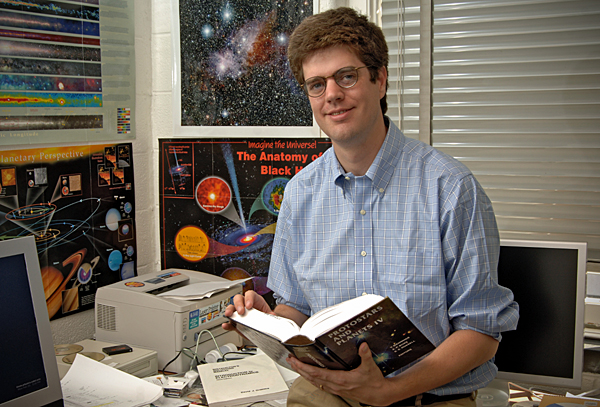
Prof wins NASA grant to study planetary system
John E. Gizis, UD assistant professor of physics and astronomy, was awarded the grant through NASA's Origins of Solar Systems program, which supports scientific investigations related to understanding the formation and early evolution of planetary systems, and to provide the fundamental research and analysis necessary to detect and characterize other planetary systems. The research also supports NASA's Vision for Space Exploration program, a long-term plan to return astronauts to the moon and extend exploration to Mars and beyond. Gizis said he is “very excited” about the funding, which will support the study of a particular planetary system that consists of a brown dwarf about three percent of the mass of the Sun and also a small planet. Brown dwarfs are gaseous masses that are essentially failed stars. “Clearly, this is a solar system very different from ours,” Gizis said. “The project is designed to help us understand how solar systems form and the study of this system might shed light on the formation of our own.” Gizis discovered the brown dwarf in question about five years ago, and European astronomers discovered the planet about two years ago. Researchers also know that there is a disk of gas and dust around the brown dwarf that likely is forming a more conventional planet. “The solar system we are studying is about 10 million years old,” Gizis said. “In astronomical terms, it is still very young and so planets are still forming.” It is unique among solar systems known to scientists today, he said. Gizis said the ultimate goal of the project “is to gain an understanding of how we get planets and life.” The study will rely on data from ground and space-based telescopes. Information from the Spitzer and Hubble space telescopes has been gathered, and Gizis said the funding would support travel to observatories in the southern hemisphere, the only part of the world from which the solar system is visible. “The next step will be to put the information together,” he said, adding, “I think this will prove to be an important solar system to study.” Gizis is leading the project in collaboration with researchers at the University of Toronto and Harvard-Smithsonian Center for Astrophysics. Article by Neil Thomas |
|
|