
|
|
|
|
|
|
|
|
||||
|
|
|
Prof named state climatologist Click here for Q&A with Legates on hurricanes
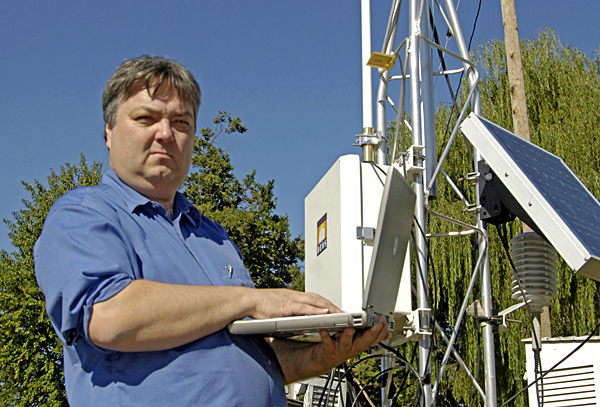
Legates is a Delaware native and earned his bachelor’s, master’s and doctoral degrees from UD, where he was inspired by the late geography professor John R. “Russ” Mather. Dr. Mather steered Legates from an early interest in meteorology to climatology, as UD emerged as a leader in that field. Meteorology is the science that deals with the atmosphere and its phenomena, particularly weather and forecasting, while climatology is the study of weather conditions over long periods of time. “Meteorologists generally are interested in real-time information,” Legates said. “They often are not interested in long-term patterns, trends or processes that drive them.” Legates said the state climatologist serves as the “keeper of the records,” maintaining an archive of information through which to conduct research and make long-term assessments about changes in climate. To do that, the state climatologist needs the “best records for the longest period possible.” Traditionally, weather records in Delaware have been spotty because the National Weather Service has maintained just three real-time weather stations, one in each county. Legates said he hopes that will change through the creation of the Delaware Environmental Observing System (DEOS), a real-time monitoring system for the entire state that provides a wealth of information on temperature, rainfall, stream levels and tides. DEOS is a project of the UD Department of Geography, which has developed a web site [www.deos.udel.edu] featuring colorful charts and reams of data presented in ways that are easy to use and understand. DEOS consists of three main components: a network of meteorological observations sites, which are coupled with existing weather and environmental observation sites in and around the state; an integrated visualization and analysis system that integrates surface weather observations with National Weather Service radar to provide estimates of meteorological and environmental variables over a high spatial resolution grid; and an analysis system designed to provide support to decision-makers in a variety of environmentally sensitive areas. Legates said the installation of DEOS began in the summer of 2003, and it is expected that compete installation and development of the system will be finished by 2008. The solar-powered DEOS observation stations include wind monitors, pyranometers to measure solar radiation, wetness sensors, thermometers, soil temperature and moisture probes and rain gauges. “This will serve as a complete repository for all environmental information,” Legates said. Given the swath of destruction left by Hurricane Katrina along the Gulf Coast, Legates said he hopes DEOS can be used as an early warning system for residents in Delaware, particularly those living along rivers and streams prone to flooding. “Using the database, we can set parameters for things such as rainfall,” he said. “Once a certain threshold has been exceeded, the system can be set up to trigger alarms and sent out e-mail and pages to emergency officials. They can then warn people that stream water levels are reaching critical levels before their beds float away.” A Delaware native who “was born in Sussex County, grew up in Kent County and lived most of my adult life in New Castle County,” Legates joked that he is on his “second tour of duty” at UD. Legates left Delaware in 1988 and spent nearly a decade at the University of Oklahoma before accepting a position at Louisiana State University. After two years at LSU, he returned to UD. Legates said he anticipates a smooth transition into his role as state climatologist, as he had been working as an associate to the former state climatologist, Daniel J. Leathers, UD professor of geography and chairperson of the department, who happens to have an office nearby in Pearson Hall. In addition to his work as state climatologist, Legates is director of UD’s Center for Climatic Research and of the Delaware Geographic Alliance. His primary research areas are hydroclimatology, precipitation and climate change, and computational methods. Article by Neil Thomas To learn how to subscribe to UDaily, click here. |
|
|