

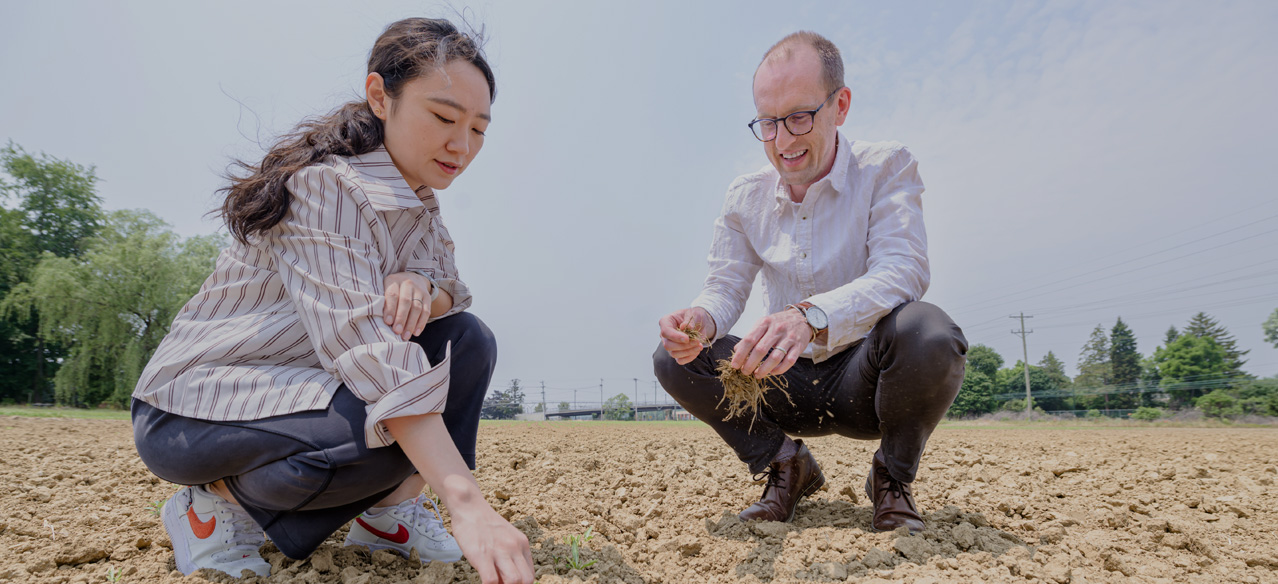
Geography, when reduced to a bumper sticker or T-shirt slogan, has been described as "why what is where." As with any such slogan, that is an oversimplification, but it contains some truth. A popular misconception of geography sees only the "what is where" aspects, as students come into the field remembering a middle-school course that catalogued the countries of the world in a litany of place names, capital cities, primary exports, leading religions, climate types, and so on. Such data are the raw material of geography, but they become useful and interesting when the "why" aspects get added in. Why were the steel mills built in Pittsburgh; why do trees get sparse west of the Mississippi River; why don’t tropical rain forests grow back easily after they have been cleared for cattle grazing once? These questions all involve interactions of systems that are not often studied together, except within geography. |
Geography courses at Delaware and in most other American universities fit into three categories:
Physical geography primarily covers natural processes that create the background environment in which human activities occur. Physical geography includes climatology (study of weather patterns and how they provide energy and moisture), land surface processes (literally the shape of the land, how hills and valleys and other topographic features form and change), biogeography (how naturally occurring plant and animal populations are influenced by these other parts of geography), and other combinations of subareas.
Human geography encompasses understanding of how all aspects of human activity fit into and respond to their environments. Human geography may include the social, cultural, economic, political, and historical aspects of human activity. Sometimes, human geography focuses on the essentials of human existence (how people acquire food and shelter) and other times it focuses on the uniquely human aspects of culture--how the arts and humanities help human societies define their place in the universe.
Although geographers use an eclectic mix of techniques borrowed from many disciplines, we also have a set of technical methods developed for our unique, place-oriented view of the earth. Geographic methods include all aspects of map making, map analysis, and data analysis techniques that are specialized for use with geographic data. Over the past two decades, a computerized mixture of mapping, spatial data analysis, and spatial database handling known as Geographic Information Systems (GIS) has grown from a research area to a multibillion dollar industry with a thriving job market.
Students in the B.A. program in Geography or Geography Education are required to take introductory courses in all three major areas--specialization into one of the three areas is allowed but not required at the advanced level. For a longer, more detailed essay on the nature of geography and its subfields, go here.
B.A. in Geography Education
Students wishing to teach social studies with a geography emphasis in high school and upper middle school should register for and follow the B.A. in Geography Education program. In addition to the requirements of the Geography major, Geography Education students take courses inhistory, economics, political science, and educational studies before student teaching in tier final semsester. To be eligible to apply for student teaching, students must have a 3.0 GPA in their major and a 2.75 overall GPA. Graduates of the Geography Education program receive a teaching credential from the State of Delaware in addition to their degree. Because course requirements are specific in this program, students are strongly advised to consult early and frequently with the Undergraduate Advisor.
A Program for the Last Two Years of College
Geography requires breadth of understanding. We like our students to understand a wide variety of topics that relate to how human and physical processes produce unique places, as well as learning useful techniques, such as mapping and geographic information systems for understanding those places. As a result of our emphasis on breadth, we do not have long chains of courses that must be taken in a sequence. It is therefore possible to do the Geography major in two years, with mostly introductory courses in the first year and advanced courses in the second year.
Advisement
Students considering a major in Geography should talk to an Undergraduate Adviser or to the Chair or Associate Chair. The Geography major offers a wide range of possibilities, so early and regular advising can help create a program of study that meets your interests, but also provides a well-rounded education in geography. You can arrange an initial advising meeting by visiting the Geography Department office (216 Pearson Hall) or sending a note to our general information email address, info@geog.udel.edu. Many students come into this major based on experiences and interest from one of our introductory courses. Any of our faculty will be happy to talk to students in their courses about the major, so feel free to make your initial inquiry to a professor you already know.
After College
Graduate Study. At the graduate level, nearly all disciplines require a student to become more specialized, and not all departments offer graduate study in all areas. This department offers M.A. and M.S. degree programs in selected areas of Geography (primarily climatology, land surface processes, cold regions research and human/cultural/environmental geography) as well as a Ph.D. program in Geography . Other programs and subareas can be found in The Guide to Geography Programs in the United States and Canada. The department always keeps a current copy of this annually updated guide for use by students. Students with an undergraduate major in Geography may also be prepared to undertake graduate study in fields other than geography, such as landscape architecture, history, American studies, urban or regional planning, resource management, or environmental policy. In any case, students should be investigating graduate schools no later than the start of their senior year.
Employment.
Most jobs for geographers do not bear "Geographer" as a job title, but geography, particularly for those with technical skills (GIS in particular) has been a good basis for a career. Visit our page for career information. The Association of American Geographers maintains an excellent web site about careers in geography. Geographers are employed in all levels of government, including with environmental, planning, natural resource agencies, water resource commissions, emergency planning agencies, and transportation agencies. Secondary schools have an increasing need for geography teachers; this career path usually requires the Geography Education major in order to obtain state certification. Private firms dealing with transportation and marketing, especially the location of plants and stores, also employ geographers. Increasingly, for any business that needs to develop a new location, any government agency that has any land management aspect, and any public or private utility that maintains a physical network (roads, sewers, wires) on the land, GIS has become an absolutely essential tool. |